
Tags
accountability, awareness, business analysis, constraints, Data Warehouse, modelling, opportunities, organisational awareness, Strategy
Written by Martyn Richard Jones
2026 Mix
 Strategic fit express the degree to which an organization is matching its resources and capabilities with the opportunities in the external environment.
Matching occurs through the practice of pre-strategy analysis.
That said, it is very easy to fall into the trap of oversimplifying high-level concepts and overstating the intricacies and interdependencies of strategic-fit factors.
Here is a stylised chart that I have used in the past to represent 9 critical factors in ensuring strategic fit. It is referred to as the Cambrian A9 Power Grid – Cambriano is the name of a small European strategy consulting outfit.
As you can appreciate, it’s simple and elegant, and relatively easy to use:
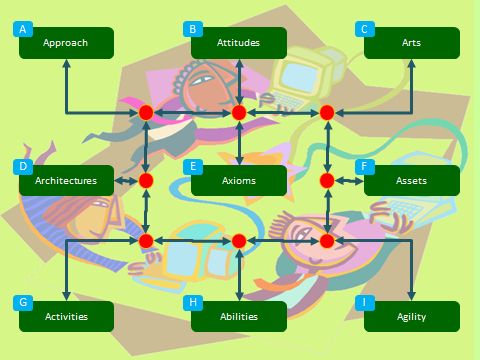
Figure – Strategic fit – Cambrian A9 Power Grid
Seasoned strategy wonks may also perceive similarities between the architecture and plumbing of the model drawn above and McKinsey’s 7S Framework.
Those coincidences are purely… coincidental.
What the Cambriano A9 Power Grid strategic-representational-model embodies are key strategic facets that must be clearly visible on the radar of strategic conceptualisation, development, agreement and execution.
They are facets that must be considered when thinking strategically about significant challenges facing the organisation and how to address them.
What the diagram identifies, and brings to the fore, are:
A – Approach – how the organisation intends to achieve its vision. The present strategy and the strategy are either in the conceptualisation stage, under development, or consideration.
B – Attitudes – the culture of the organisation and the way the leaders behave towards employees, customers, shareholders, and other participants, at all relevant levels of abstraction.
C – Arts – these are the specialist skills and talents that the organisation has access to through the combination of pioneering activities and innovative abilities.
D – Architectures – the hierarchy of responsibility and accountability within the organisation and how the business is organised functionally, geographically or by product-market
E – Axioms – or subordinate goals depending on which version you prefer – the core values and beliefs of the business.
F – Assets – capital, real estate, capital goods, intellectual capital, investments, formulas, patents, creative genius, goodwill, market and consumer perception, organisational wisdom, etc.
G – Activities – Systems, constructs, processes, decision points and courses – the way activities and processes get the work of the organisation done effectively and efficiently.
H – Abilities – the personnel within the organisation and their individual skills, abilities and attitudes. Core competences, extended competences.
I – Agility – the dexterity, nimbleness and agility of the organisation, how well it reacts, adjusts and moves, realigns and interacts. For example, the rate at which strategic changes can be effectively executed and measured.
This framework describes the key elements that shape an organisation’s overall capability and strategic readiness. It considers how the organisation intends to pursue its vision (Approach) and the cultural behaviours that guide interactions with stakeholders (Attitudes). It accounts for the unique skills and innovative strengths the organisation can draw upon (Arts) and the structural design that defines roles, responsibilities, and organisational configuration (Architectures). It includes the organisation’s underlying values and beliefs (Axioms) as well as the tangible and intangible resources it owns (Assets). It also examines how work is carried out through systems and processes (Activities), the skills and competencies of its people (Abilities), and finally, how quickly and effectively the organisation can adapt, change, and execute strategy (Agility).
When it comes to strategy, ignoring any of these facets might introduce additional risk into the process.
Therefore, attention must be paid to all of these aspects, and a facet should only be relegated or discarded after serious thought.
That is not to say that all facets must be analysed to death.
The idea is to develop a strategy that addresses a significant organisational challenge, not to spend a lifetime modelling the square root of zilch.
It is just to ensure that if a facet is well understood to the point of being “common sense”, then an explicit recognition of the facts related to the facet is all that is needed, even if it is just a high-level description, it should still be simply, clearly and comprehensively stated.
File under: Good Strat, Good Strategy, Martyn Richard Jones, Martyn Jones, Cambriano Energy, Iniciativa Consulting, Iniciativa para Data Warehouse, Tiki Taka Pro
Discover more from GOOD STRATEGY
Subscribe to get the latest posts sent to your email.
 GOOD STRATEGY