• Home
  • About
  • Strategy
    • Data Warehousing
    • Ask Martyn
  • Opinion
  • MARTYN
    • MARTYN’S MUSIC
    • Must-Read Books from Martyn
    • PODCASTS
    • MARTYN.ES

GOOD STRATEGY

~ THE STRATEGIES THAT WORK

GOOD STRATEGY

Tag Archives: Martyn Richard Jones

DATA WORLD: Friends! Romans! Countrymen! Big Data is not Data Warehousing – 2026/01/29

11 Wednesday Feb 2026

Posted by Martyn Rhisiart Jones in Big Data, Consider this, Data Warehousing, Good Strat, hadoop, hdfs, Martyn Jones

≈ Leave a comment

Tags

Analytics, Big Data, books, Data Mart, Data Warehouse, Data Warehousing, enterprise data warehousing, Good Strat, Good Strategy, google, Martyn Jones, Martyn Richard Jones, News, sports, technology

Martyn Rhisiart Jones

29th January 2026

Hold this thought: To paraphrase the great Bob Hoffman, just when you think that if the Big Data babblers were to generate one more ounce of bull**** the entire f****** solar system would explode, what do they do? Exceed expectations.

I am a mild mannered person. However, one thing that irks me is hearing variations on certain themes. These themes include phrases like “Data Warehousing is Big Data.” Another is “Big data is in many ways an evolution of data warehousing.” Lastly, some say “with Big Data you no longer need a Data Warehouse.”

Big Data is not Data Warehousing. It is not the evolution of Data Warehousing. It is also not a sensible and coherent alternative to Data Warehousing. No matter what certain vendors will put in their marketing brochures or stick up their noses.

Continue reading →

Postmodern Digital Stories: We’ve never seen anything like this before

23 Wednesday Aug 2017

Posted by Martyn Rhisiart Jones in business, Business Intelligence, business strategy, digital transformation, Good Strat, Good Strategy, Good Strategy Radio, Inform, educate and entertain., IT strategy, pomo, postmodern, Social Media, Strategy

≈ Leave a comment

Tags

data revolution, goodstrat, Martyn Richard Jones, postmodern

Picture2Martyn Richard Jones

Dunny on the Wold, 23rd August 2017

The prevailing conventional wisdom is that innovative technologies and their novel use are having an effect on many peoples’ lives. Indeed, the fascination with the possibilities offered by social media, the internet and the age of data is becoming all pervasive. Of course, not all is goodness and light. Some aspects, such as Denial of Service attacks, phishing without a permit and creatively-ambiguous chimping, mark the down side of this story. Continue reading →

Brand Aversion: Exhibit One

16 Sunday Apr 2017

Posted by Martyn Rhisiart Jones in advertising, All Data, Big Data, Big Data 7s, Big Data Analytics, dark data, data architecture, Data governance, Data Lake, data management, Data Mart, data science, Data Supply Framework, Data Warehouse, Data Warehousing, Inform, educate and entertain., Marketing, pig data, Sales, The Amazing Big Data Challenge, The Big Data Contrarians

≈ Leave a comment

Tags

Business, Marketing, Martyn Richard Jones, Rant, Sales

Martyn Richard Jones

San Luis Obispo 16th April 2017

La-mode-sur-tous-les-tableauxTaking a Pop at Traditional Data Warehousing

Pitch: I recently read a report from a data visualisation company on the “Top Ten Big Data Trends for 2017”. This is what they told me “Hadoop is no longer just a batch-processing platform for data-science use cases. It has become a multi-purpose engine for ad hoc analysis. It’s even being used for operational reporting on day-to-day workloads—the kind traditionally handled by data warehouses.” Continue reading →

Big Data: And it’s all gone quiet over there!

29 Tuesday Mar 2016

Posted by Martyn Rhisiart Jones in All Data, Big Data, Big Data 7s, Big Data Analytics, business strategy, Cambriano, Consider this, dark data, data architecture, Data governance, data science, Data Supply Framework, Data Warehouse, Data Warehousing, Good Strategy, Inform, educate and entertain., IT strategy, pig data, Strategy, The Amazing Big Data Challenge, The Big Data Contrarians

≈ 2 Comments

Tags

Behavioural Economics, Big Data, Good Strategy, goodstrat, Information Technology, IT Strategy, Martyn Jones, Martyn Richard Jones, Strategy

Big Data is all pervasive, all seeing and all knowing.

Everyone is doing Big Data, and if they aren’t then they will.  It’s inevitable.

Big Data will revolutionise the worlds of data, decision making and business.

Am I right, or am I right?

Continue reading →

CONSIDER THIS: Big Data Inertia

22 Tuesday Mar 2016

Posted by Martyn Rhisiart Jones in All Data, Big Data, Big Data 7s, Big Data Analytics, dark data, data architecture, Data governance, Data Lake, data management, data science, Data Supply Framework, Data Warehouse, Data Warehousing, Inform, educate and entertain., pig data, The Amazing Big Data Challenge, The Big Data Contrarians

≈ 1 Comment

Tags

Big Data, business strategy, Consider this, data, Data Warehouse, Information Technology, Martyn Jones, Martyn Richard Jones

“Half the time she did things not simply, not for themselves; but to make people think this or that; perfect idiocy she knew for no one was ever for a second taken in.”  Virginia Woolf, Mrs. Dalloway

It’s all very well for the blithering Big Data bullshitter savants to now claim, after a massive exercise in u-turning, that Big Data isn’t after all about data volumes, velocities and varieties, but about some minor variation on the theme of data architecture, management and processing.

But, look at the mess! Continue reading →

Too Much Information

16 Wednesday Mar 2016

Posted by Martyn Rhisiart Jones in All Data, Big Data, Big Data 7s, Big Data Analytics, business strategy, dark data, Data governance, Data Lake, data management, data science, Data Supply Framework, Data Warehouse, Data Warehousing, Good Strat, Good Strategy, goodstrat, Inform, educate and entertain., IT strategy, Marty does, Martyn does, Martyn Jones, Martyn Richard Jones, pig data, Strategy, The Amazing Big Data Challenge, The Big Data Contrarians

≈ Leave a comment

Tags

Ask Martyn, Big Data, Business Enablement, business intelligence, Business Management, Data Warehouse, Good Strat, Information Technology, Martyn Jones, Martyn Richard Jones, Organisational Autism, Strategy

Martyn Richard Jones

I have questions about data.

Most of us who have more than a cursory knowledge of the English language have heard of the phrase ‘too much information’. We know what it means, even if we don’t always know when to apply it.

For those who don’t know, or are unsure, the Urban Dictionary describes ‘too much information’ as “An expression of exasperation and disgust when a person is divulging personal details of his sex life, toilet habits, or anything the listener finds disgusting, uninteresting, and unwelcome.”[1]

Sum, sum. Just because we know it, doesn’t mean we should share it or even try and remember it, never mind go about analysing the hell out of it.

This is where Big Data comes in. Continue reading →

Can You Read? Be Honest, Now

15 Tuesday Mar 2016

Posted by Martyn Rhisiart Jones in business strategy, Good Strat, Good Strategy, goodstrat, Inform, educate and entertain., Marty does, Martyn does, Martyn Jones, Martyn Richard Jones, Strategy

≈ 2 Comments

Tags

Analytics, Ask Martyn, Behavioural Economics, Business Enablement, business strategy, Consider this, Martyn Jones, Martyn Richard Jones, Organisational Autism, Strategy

Martyn Richard Jones

When you have read this, if indeed you read it all, will I have failed to convey the essence of what I am trying to get at? Will a confusion of entropy win the battle? Will the wheel of fortune turn in my favour, or will I fail to connect and communicate effectively?

Let’s give it a spin and see what happens. Continue reading →

Testing the Data Warehouse

05 Saturday Mar 2016

Posted by Martyn Rhisiart Jones in All Data, Big Data, Big Data 7s, Big Data Analytics, business strategy, dark data, data architecture, Data governance, Data Lake, data management, data science, Data Supply Framework, Data Warehouse, Data Warehousing, Good Strat, Good Strategy, goodstrat, Inform, educate and entertain., IT strategy, Martyn does, Martyn Jones, Martyn Richard Jones, pig data, Strategy, The Amazing Big Data Challenge, The Big Data Contrarians

≈ Leave a comment

Tags

Ask Martyn, Big Data, Data Warehousing, Martyn Jones, Martyn Richard Jones

Image1Martyn Richard Jones

Dusseldorf, August 2006

Data Warehousing provides possibly one of the best opportunities for IT organizations to deliver a valuable business solution in order to address a set of business needs; requirements that go well beyond the area of day to day operational support, and traditional applications (web enabled or not), and when Data Warehousing is done the right way, and for the right reasons, its payback to all of its stakeholders can be positively significant. Continue reading →

12 Amazing Big Data Success Stories for 2016

22 Tuesday Dec 2015

Posted by Martyn Rhisiart Jones in Big Data, Big Data 7s, Big Data Analytics, Consider this, Data Warehouse, Data Warehousing, Good Strat, Good Strategy, Inform, educate and entertain., IT strategy, Martyn Jones, Martyn Richard Jones, The Big Data Contrarians, Uncategorized

≈ 1 Comment

Tags

Big Data, Data Warehousing, goodstrat, Martyn Jones, Martyn Richard Jones

If this piece tickles your fancy, then please consider joining The Big Data Contrarians on LinkedIn:

https://www.linkedin.com/groups/8338976

Every year I ask myself the same question. Will there be any tangible, coherent and verifiable Big Data success stories in the coming year? Every year I come up with nothing. Nothing at all. “Sorry, no rooms at the Big Data Success Inn, as we are closed for vacations.”

However, this year things are different. More positive, more alive and more fantastic. Continue reading →

Whither Big Data bullshit?

11 Wednesday Nov 2015

Posted by Martyn Rhisiart Jones in All Data, Big Data, Good Strategy, goodstrat, Martyn Jones

≈ Leave a comment

Tags

All Data, Big Data, Martyn Jones, Martyn Richard Jones

If you enjoy this piece or find it useful then please consider joining The Big Data Contrarians: https://www.linkedin.com/grp/home?gid=8338976

Many thanks, Martyn.

Pundits far and wide are hailing the end of the period of big data babble, hyperbole and bullshit and are looking forward to an epoch of practical, tangible and verifiable Big Data success stories.

Gartner themselves came out some time ago and declared that Big Data was no longer in the hype cycle. Some took this as a sign that the Big Data bullshit bonanza was over, others were more cynical and suspected a highly orchestrated ruse, a move to the next level in the game plan.

But does this new attitude towards Big Data really ring true?

Accompanying this apparent bold openness, frankness and humility in the ranks of the rehabilitated Big Data bullshit babblers there is an awful lot of what appears to be ‘more of the same’. Or as the people of Thailand might say, “same, same, but different”.

As some of you might know, I am the administrative owner of The Big Data Contrarians community group on LinkedIn, and even I was somewhat taken aback by a recent piece by Bernard Marr entitled 20 Stupid Claims About Big Data. So much so that I wrote a fairly complimentary comment on LinkedIn about it. The thing is, even as a posted it I was thinking to myself “you’ll be sorry”.

Today I read yet another Big Data ‘reformation’ piece on LinkedIn Pulse, this time from Matthew Reaney and with the compelling title of The 5 Myths of Big Data.

Call me naïve, call me illusory, and a believer in humankinds need for basic decency, but I frequently have the idea that praising moderately acceptable behaviour leads to even more good behaviour. But it was not to be, and as fast as one could say ‘what the hell is going on here?’ back came a surfeit of astroturfed Big Data bananas – from all directions – bigger, brasher and more bogus than ever before.

Make no mistake, Big Data hype hasn’t gone away, it has become more subtle, more cunning and even more misleading.

Leading the charge is the initiative to discredit Data Warehousing by all means possible, and the amount of bullshit, disinformation and blatant lies doing the rounds is beginning to look like Big Data hype reflecting Big Data itself, if only in terms of the vast volumes, varieties and velocities that this Big Data babbling bullshit comes in.

But seriously, we are simply getting more of the same, as the end of the Big Data hype war is declared, we are subject to a bombardment of Big Data boloney via Cloud, IoT, the Hadoop ecosphere (as if using Hadoop was someone linked to ecology and saving the planet), and especially this incredibly obnoxious and dopey vehicle for Big Data tripe known widely as the Data Lake – more on that stupidity at some other time. But onwards and upwards…

This all reminds me of a joke from many decades ago, retold in part from memory.

A teacher was looking for a subject about which her class pupils could write, to set as a homework exercise.

After much deliberation she decided to as ask the children to write about what they thought of the police?

Sure, not a good question, I know, and as I stated, this was many decades ago, when even grown-ups could be innocent and naïve and hopeful.

Anyway, when the children had handed in all their essays, the teacher read the essays and was disappointed to find that most of them were very wishy-washy and that the children were almost all unanimously indifferent or grudgingly respectful of the police, except for one. One of the children, let’s call him Dave, was very critical and had written “I don’t think much of the police.” When the teacher asked Dave why he had written that, he replied “All police is bastards, Miss”. The teacher was vexed by the reply, but being a good and caring teacher she considered how she could change this obviously hostile view of the bobby on the beat and the police detective taking evil doers out of circulation, so she decided to do something about it.

She had a bright idea and took her problem to the police and discussed what could be done to give the children a much more positive view of the police and the work they did, so they would see the police as a necessary part of society, to be respected but not feared.

As a result, the teacher and the police organised a police day at the school. It was a big party, with lots of free goodies, badges and posters, rides in patrol cars, sirens, interesting stories and a movie, and a big discussion with the police dog handler and his faithful and brave police-dog, Ajax. The police took special interest in Dave, he was the one they wanted to convince the most, and he was the one they made the most fuss of.

At the end of the day, the teacher again asked the children to write about what they got from the school police day that she had organised.

The following Monday, after all the essays had been handed in by the children, she sought out and read Dave’s essay, eager with anticipation.

This time it contained the surprising phrase of “I really, really don’t think much of the police.”

Again, the teacher asked Dave why he had written what he had wrote, especially considering all the effort the police had gone to in order to leave a good and lasting impression with the children in general, and Dave in particular.

He simply replied “the Police is cunning bastards, Miss.”

Personally, I have respect for the professionalism, courage and hard work of many officers in our police forces, but when it comes to my view of certain Big Data pundits – and naming no names, just watch my eyes – the feeling is not the same.

Make of that what you will.

Many thanks for reading.

If you enjoyed this piece or found it useful then please consider joining The Big Data Contrarians: https://www.linkedin.com/grp/home?gid=8338976

Many thanks,

Martyn.

Stuff a great data architect should know

16 Sunday Aug 2015

Posted by Martyn Rhisiart Jones in Consider this, data architecture, goodstart, goodstartegy

≈ 2 Comments

Tags

accountability, data archtecture, good start, goodstart, goodstrat, Martyn Jones, Martyn Richard Jones, Strategy

Stuff a really great Data Architect should know

If you enjoy this piece or find it useful then please consider joining The Big Data Contrarians:

Join The Big Data Contrarians here: https://www.linkedin.com/grp/home?gid=8338976

Many thanks. Continue reading →

Why so many ‘fake’ Big Data Gurus?

16 Sunday Aug 2015

Posted by Martyn Rhisiart Jones in Big Data, Consider this, good start, goodstart, Strategy

≈ Leave a comment

Tags

Big Data, cynicism, data management, fakes, good start, goodstart, gurus, Martyn Jones, Martyn Richard Jones, Strategy

Why so many ‘fake’ Big Data Gurus?

Where do you all come from?

Where do you all come from?

All your integrity’s gone

Now tell me, where do you all come from?

From ‘Where Do You All Come From‘ by Mott the Hoople Continue reading →

Consider this: The Big Data Workout

01 Friday May 2015

Posted by Martyn Rhisiart Jones in Big Data, Consider this, good start, goodstart

≈ Leave a comment

Tags

Big Data, Consider this, data architecture, data management, good start, goodstart, Martyn Richard Jones, Stories

To begin at the beginning

Miss Piggy said, “Never eat more than you can lift”. That statement is no less true today, especially when it comes to Big Data. Continue reading →

Consider this: Taming Big Data

01 Friday May 2015

Posted by Martyn Rhisiart Jones in Big Data, Big Data Analytics, Consider this, Good Strat, goodstart

≈ 2 Comments

Tags

accountability, Consider this, good start, goodstart, Martyn Richard Jones

Simply stated, the best application of Big Data is in systems and methods that will significantly reduce the data footprint.

Why would we want to reduce the data footprint?

  • Years of knowledge and experience in information management strongly suggests that more data does not necessarily lead to better data.
  • The more data there is to generate, move and manage, the greater the development and administrative overheads.
  • The more data we generate, store, replicate, move and transform, the bigger the data, energy and carbon footprints will become.

Continue reading →

Sexing up Big Data’s Dodgy Dossier

20 Friday Mar 2015

Posted by Martyn Rhisiart Jones in Big Data, Consider this, good start, Good Strat, goodstart, Martyn Jones

≈ Leave a comment

Tags

Big Data, good start, goodstart, Martyn Jones, Martyn Richard Jones

Most of us would probably like to work in a profession recognised for its legality, decency and honesty. At least I hope so. In my line of work, what we have right now is palpable evidence that the IT industry lacks a moral compass.

Imagine this. A major sensationalist tabloid pulls together a team of diverse journalists who are set to work on a national campaign to promote very high usage of sunbeds as a cure for cancer. Why? The newspaper owner’s son owns the sunbed franchise.

The health experts criticise the publisher for being irresponsible, unprofessional and lacking in scruples.

Continue reading →

The Biggest Contradiction of Big Data

20 Friday Mar 2015

Posted by Martyn Rhisiart Jones in Big Data, Consider this, good start, goodstart

≈ Leave a comment

Tags

Big Data, contradictions, data management, good start, Good Strategy, goodstart, Martyn Jones, Martyn Richard Jones

I have written at length about the fundamental contradictions of Big Data, but what I have omitted in the past is quite possibly the biggest contradiction of all. Probably because it has more to do with how Big Data is continually hyped, rather than having anything to do with Big Data as a bag of technologies – which has a whole assortment of problems in its own right.

Last time I spoke with you about the contradictions of the Big Data it was about the three Vs of volume, variety and velocity. In general, it was a view that was well received, even if not widely understood. Which of course is close enough for government work. But, get ready for “something completely different”.

If on the one hand some folk can claim that Big Data provides fact based insights and reliable forecasts of future habits, trends and preferences, then why is it so difficult to produce and socialise – yes, I like to use that term – Big Data success stories?

In short, I think we have arrived at the stage in Big Data’s cycle where it is reasonable to ask pundits to either put up or shut up.

So, why aren’t the current Big Data success fables accompanied by facts, such as names of those involved (at least businesses), the sponsors, the suppliers, the purpose of the exercise, the desired outcomes, the data used, how it is processed, what the results were, and what tangible benefits, if any, were accrued or are accruable. If that is not enough, then let people mention the technology used, the products purchased or licensed and the methodology followed.

In short, what I would like to know is why are the evangelists of Big Data telling us that bigger data is better, that more variety leads to greater insight, and that velocity is king. Why do we we told that Big Data almost assuredly results in better decisions, by people who are coy, shy or secretive about almost facts and data coming out of Big Data projects?

I have been reminded, time and time again, that there are Big Data success stories out there, and I have even been told that this information would be fully shared with me once it was agreed with the ‘clients’ that it was okay to do so. Okay, that’s fine, I know Big Data is a roaring success story (at least in people’s minds,) and I also know that it takes some time to make things up – some people are just not creative. Sure, I was told about these ‘successes’ some time ago, and you know, I’m not expecting anything that’s worth shaking a stick at, either now or later, but I’m still waiting, boys. Notwithstanding, you will still called you out as vacuous bullshitters when the time comes.

“But” I hear you cry “there is a wealth of success stories in the presses”.

Well, no, and you would wrong and gullible and foolish to think, but that is your problem, but unfortunately also mine, because this is my profession that you are playing fast and loose with.

The fact is that there is “wealth” of content that people try and pass off as legitimate Big Data success stories, but they aren’t in fact success stories, in any way, shape or form.

The thing is, people may read the blog title and even the stand-fast, but will be less inclined to actually read the article, so what remains is the impression that there are ‘loads of Big Data success stories’. But if people actually read the articles and were intelligent enough to understand them, then they would realise that inevitably there is a massive mismatch between the title of these pieces and the content. Indeed, if these pieces were actually pieces of advertising, rather than blog comments, they would be denounced in some jurisdictions for not fulfilling the advertising criteria of legal, decent and honest.

There is one more thing that Big Data evangelists (or any self-styled pundit, guru or expert for that matter) should understand, internalise and remember. If you say that you have a Big Data success story, with all the details, and that isn’t in fact the case, and it isn’t even remotely a success story or even true, then you are simply lying, and that’s deceit, it’s unprofessional and it’s unethical, and you are a scoundrel. So live with or fix it, the choice is yours.

Many thanks for reading.

Big Data’s Virtuous Circus

20 Friday Mar 2015

Posted by Martyn Rhisiart Jones in Big Data, Consider this, data management, good start, goodstart

≈ Leave a comment

Tags

Big Data, data architecture, data management, good start, Good Strat, Good Strategy, goodstart, Martyn Jones, Martyn Richard Jones

Many people come up to me in the street and ask me what Big Data is all about. It has happened to me so many times in the past that I am convinced that it might just happen to you as well. I know sort of thing, I read the Big Data tealeaves. Nothing gets past me.

The first time a complete stranger came up to me in public and said “Hello, will you tell me what this Big Data lark is all about then?” I was lost for words, you just ask my Aunt Dolly, he can vouch for that, no problem. Later that day I read a book – it was my dad’s book – and I then decided to adopt a strategy.

Therefore, in the spirit of springtime goodwill to all men and women, I have put together this blog piece in that hope that it will enlighten, help and entertain.

What is big data?

Big Data can be characterised by the 10 Vs – yes, 10, not 4. Which, in my book, is more than enough to bring up-to-speed the average Big Data John or Jane that one meets on the street, and who naturally wish to be informed of such matters.

In layperson’s terms this a series of landmarks and pointers in the analytics space used to frame and guide the didactic aspects of Big Data.

The fundamental Vs of the Big Data canon are these:

  • Vagueness
  • Volume
  • Variety
  • Virility
  • Velocity
  • Vendible
  • Vaticination
  • Voracity
  • Vanity

So, let me now explain what each of these characteristics mean to those who might know and for those who might want to know.

Vagueness: This is perhaps the trickiest of questions to address, given the vast panorama that is cast before this incredibly complex yet easily graspable concept. But let me state this, and let there be no mistake about it. At this point in time, what makes Big Data vague is also what makes Big Data specific, explicit and certain. That is to say, in order to ‘come to an understanding’ of Big Data, it is necessary to completely embrace the dialectic of knowing the unknowable. So belief is an absolute essential element – belief and data, that is.

Volume – If there ever was a time to “pump up the volume”, we have it here with Big Data.

Big, voluminous, gorgeously rotund and infinite. Big Data is called Big Data because there is a lovely, roly-poly, likeable never-ending load of it. Its volumes can be measured in zeta-bytes, which you can be assured, is a helluva lot of data.

Variety – As they might say down my way, “variety is the spice of life, innit”. This is what makes Big Data so special. So appealing.

Because before Big Data there was absolutely no variety in anything, at all. We lived in a bland world, bereft of detail, nuance and diversity. Nothing could be measured, analysed or explained, because we lacked Big Data. We were ignorant. So ignorant and stupid that we couldn’t see the sense of putting the diapers next to the beer, or of offering three for the price of two.

Fortunately, today this is no longer the case if we don’t want it to be, and thanks to Big Data we have a veritable sensorial explosion. No longer is IT just a couple of symbols scribbled in crayon on someone’s school notebook.

Virility – Move over Smart Data, the new kid on the block is Big Data.

If Big Data were described in the manner of a religious text, it would be accompanied by a never ending narrative of begets.

So, what does that mean?

Simply stated, Big Data creates itself, in and of itself. The more Big Data you have, the more Big Data gets created. It’s like a self-fulfilling prophecy in 360 degree, high-definition, poly-faceted and all-encompassing knowing. The sort of thing that governments would pay an arm and a leg to get their mitts on.

Velocity – Velocity is of the essence. Velocity kills the competition. More velocity, less haste.

We demand that service is ‘velocious’. ‘Everything’ must be ‘now’, or it’s too late.

This means we need to be able to handle Big Data at velocity – at the speed of need.

Charles Babbage once stated (or maybe it was more than once) that “whenever the work is itself light, it becomes necessary, in order to economize time, to increase the velocity.”

But remember, we are dealing with mega-velocity here, so don’t drink and drive the Big Data Steamship, Star-ship or Mustang.

Vendible – If you can sell it, and sell it as Big Data, then it ‘is’ Big Data. If you can’t, then it’s not. The saleability of Big Data proves its existence.

So, what are the vendible aspects of Big Data?

Let’s leave that easy question for another day. But for now I can confidently state that it is used to mobilise armies of commentators, industry analysts, publicists, punters, writers, bloggers, gurus, futurologists, conference organisers, conference speakers, educators, customer relationship managers, salespeople, marketers and admen.

Vaticination – Edmund Burke is down on record as stating that “you can never plan the future by the past”. Now Burke may have been a clever person when it came to many things, but he wasn’t exactly a whiz when it came to Big Data.

There are people in the world who are in no doubt that Big Data provides the sort of visionary and predictive powers only previously obtainable through ritual sacrifice, magic potions and the casting of spells. Others are highly critical of the understatement implicit in this belief.

For many, Big Data will make the Oracle of Delphi look like a mere call centre.

This is why the power of vaticination plays a characteristically important role in the world of Big Data.

Voracity – This is based on the quasi-rationalist argument that Big Data is big and it has an omnipresent and insatiable self-fulfilling desire.

Big Data comes with an attendant requirement for hardware, even if it is a whole load of consumer hardware tacked together in a magnificent and miraculous mesh of magic.

Big Data can be characterised by voracity, but this comes hand in hand with the ‘ventripotent’ IT industry.

Veracity – The eminence of the data being captured for Big Data handling can vary significantly. The quality or lack of quality of the data naturally has the potential to impact the accuracy of analysis using that data.

Before Big Data arrived on the scene we knew nothing about Data Quality or data verification. This is why ETL and Data Cleansing tools lacked the power to effectively quality check and verify data, to ensure that any erroneous or anomalous data was rejected or flagged.

But now, with the sophistication of tools such as ‘grep’ and ‘awk’ at our disposal, we have the power in our hands to ensure nothing ‘dodgy’ gets into the analytical mix.

Vanity – In my opinion, to fully grasp the underlying and profound meaning of Big Data, it is essential for us to understand the difference between vanity and conceit. Max Counsell claimed that “Vanity is the flatterer of the soul”. Goethe characterised vanity as being “a desire for personal glory”. After an incident with an Anarchist (presumably a Big Data Anarchist), Blackadder remarked to Baldrick that “The criminal’s vanity always makes them make one tiny but fatal mistake. Theirs was to have their entire conspiracy printed and published in plain manuscript”.

That’s all folks!

So that ends the brief rundown of the defining characteristics of Big Data.

So, to summarise. That, which has passed before, necessarily divulges both the upside and downside of Big Data. By reaching out, opening up the kimono and relating the 10 Vs we are disclosing that which cannot be disclosed, exhibiting the absence of essential essence, and thereby opening up the entire field, discipline, profession, science and art to examination, questioning and ridicule.

Many thanks for reading.

7 Signals that someone has quit

14 Saturday Mar 2015

Posted by Martyn Rhisiart Jones in Consider this, good start, Good Strat, goodstart, Martyn Richard Jones

≈ Leave a comment

Tags

careers, Consider this, good start, Good Strat, Good Strategy, goodstart, Martyn Jones, Martyn Richard Jones, quit

You are the boss. You are the leader, coach and manager, and there are some things that you just got to learn, like it or not. One of these skills is to be able to identify when someone has quit. “How dare they?” I here you ask.

The first time I quit a job and didn’t tell anybody was when I was in the RAF working as a fighter pilot in World War 2, and I accidentally bombed Newport in South Wales, and was given a stern talking to for my troubles. Well, I didn’t actually quit and I was never in the armed forces and I was born into the era of the Beat Generation, but that’s by the by, it’s just there for effect, to create some artificial empathy between me and those who have actually quit a job and not told anyone about it. Myself, I would never do such a thing. Although to be fair, Newport has looked like it has been freshly bombed with dark green, brown and grey shades of poster paints and self-raising flour, since forever. Continue reading →

Consider this: Big Data Forever!

14 Saturday Mar 2015

Posted by Martyn Rhisiart Jones in Big Data, Consider this, dark data, Martyn Jones

≈ Leave a comment

Tags

Big Data, Good Strat, Good Strategy, Martyn Jones, Martyn Richard Jones

Dans ce pays-ci, il est bon de tuer de temps en temps un amiral pour encourager les autres – Voltair

My gran used to tell me that honesty pays. Of course, she never really understood banking or IT, probably because she didn’t want to know anything about them, and she never lived to witness the amazing hype circuses, the spin doctors spiel or the focus-group dog-and-pony show of the 21st century. Indeed, if honesty were a guaranteed payer my gran would have amassed more wealth than even Warren Buffet himself.

If my gran lived today, she might reflect on what Big Data might be about – maybe she would even consider it benignly, as a sort of shelter for fallen men of once uncertain virtue. We will never know. So onwards and upwards.

The Harvard Business Review contemplated honesty in somewhat different terms:

“Honesty is, in fact, primarily a moral choice. Businesspeople do tell themselves that, in the long run, they will do well by doing good. But there is little factual or logical basis for this conviction. Without values, without a basic preference for right over wrong, trust based on such self-delusion would crumble in the face of temptation.”

In a marvellous book, A few good from Univac, David E. Lundstrom narrates the story of Sperry Univac in the 1960s, one of the true great innovators in the first forty years of IT, and includes an allegory taken from the engineering front-line. I will recount it here, edited to highlight the zeitgeist, for your entertainment and as Voltaire put it, “to encourage the others”:

In the beginning was the Big Data Plan.

And then came the Big Data Assumptions.

And the Assumptions were without form.

And the Plan was without substance.

And darkness was upon the face of the Workers.

And they spoke amongst themselves, saying: “It is a crock of shit, and it stinketh.”

And the workers went unto their Supervisors and said: “It is a pail of dung, and none may abide the odor thereof.”

And the Supervisors went unto their Managers, saying: “It is a container of excrement, and it is very strong, such that none may abide by it.”

And the Managers went unto their Directors, saying: “It is a vessel of fertilizer, and none may abide its strength.”

And the Directors spoke amongst themselves, saying to one another: “It contains that which aids plant growth, and it is very powerful.”

And the Vice Presidents went unto the President, saying unto him: “This new plan will actively promote the growth and vigor of the company, with powerful effects.”

And the President looked upon the Big Data Plan, and saw that it was good.

“But?” I hear you say, “why fight it, why not take advantage of the Big Data zeitgeist?”, “Why not cash in on the grand bonanza Big Data bandwagon?” or “Monetise the 3 three famous Vs of Big Data?”

Well, it had crossed my mind, briefly, and (outside of the USA) we’ve all done stuff we have not entirely believed in, so the temptation to cash in is present, capisci? This paraphrasing of a piece from My Blue Heaven might give you a better idea:

One of my best friends makes his living as a completely phony Big Data Scientist. For two hundred bucks he can make you a Data Scientist or a Big Data guru. Some guys give you an education but this guy gives you immediate access to high paying jobs, sex that would make the 256 trillion Shades of Blah blush and a life in the City, the Big Apple or a small town in Germany.

Moreover, for an extra 250 bucks (limited time offer) you can also become a certified Big Data Neuro Trainer, which will allow you to do unto others what has been done unto you.

I also considered Big Data Brokerage, Big Data Certification and Big Data Independent Trading (New York – Paris – Peckham). The opportunities are immense.

However, what happens when the Big Data well runs dry, and I (and many others get tarnished with the mark of Big Data) become pariah by complicity, collusion or simple association?

That question I will leave for another day. But just consider the following.

All right, I admit, I am a big long-time fan of comic genius Mel Brooks, who has a knack of capturing deep insight from the human condition, especially when the human condition is off guard and shallow. In that vein, this is how I like to think the dialogue from the Dole Office scene from The History of the World Part Two would have gone, if he were to write that today:

Dole Office Clerk: Occupation?

Data Magnus Comicus: Stand-up Big Data scientist.

Dole Office Clerk: What?

Data Magnus Comicus: Stand-up Big Data scientist. I coalesce the vaporous datas of the human interaction with the social-media networking, Internet of Everything, and always-connected experience into a… viable, analytical and meaningful predictive-comprehension.

Dole Office Clerk: Oh, a Big Data bullshit artist!

Data Magnus Comicus: *Grumble*…

Dole Office Clerk: Did you bullshit Big Data last week?

Data Magnus Comicus: No.

Dole Office Clerk: Did you try to bullshit Big Data last week?

Data Magnus Comicus: Yes!

Finally, I leave you with some wise words from Israeli American professor of psychology and behavioural economics, Dan Ariely:

“Big data is like teenage sex: everyone talks about it, nobody really knows how to do it, everyone thinks everyone else is doing it, so everyone claims they are doing it…”

Many thanks for reading.

What’s all the fuss about Dark Data? Big Data’s New Best Friend

10 Tuesday Mar 2015

Posted by Martyn Rhisiart Jones in All Data, Big Data, Consider this, dark data, Good Strat

≈ Leave a comment

Tags

All Data, Big Data, dark data, data architecture, data management, Good Strat, Martyn Jones, Martyn Richard Jones

What is Dark Data?

Dark data, what is it and why all the fuss?

First, I’ll give you the short answer. The right dark data, just like its brother right Big Data, can be monetised – honest, guv! There’s loadsa money to be made from dark data by ‘them that want to’, and as value propositions go, seriously, what could be more attractive?

Let’s take a look at the market.

Gartner defines dark data as “the information assets organizations collect, process and store during regular business activities, but generally fail to use for other purposes” (IT Glossary – Gartner)

Techopedia describes dark data as being data that is “found in log files and data archives stored within large enterprise class data storage locations. It includes all data objects and types that have yet to be analyzed for any business or competitive intelligence or aid in business decision making.” (Techopedia – Cory Jannsen)

Cory also wrote that “IDC, a research firm, stated that up to 90 percent of big data is dark data.”

In an interesting whitepaper from C2C Systems it was noted that “PST files and ZIP files account for nearly 90% of dark data by IDC Estimates.” and that dark data is “Very simply, all those bits and pieces of data floating around in your environment that aren’t fully accounted for:” (Dark Data, Dark Email – C2C Systems)

Elsewhere, Charles Fiori defined dark data as “data whose existence is either unknown to a firm, known but inaccessible, too costly to access or inaccessible because of compliance concerns.” (Shedding Light on Dark Data – Michael Shashoua)

Not quite the last insight, but in a piece published by Datameer, John Nicholson wrote that “Research firm IDC estimates that 90 percent of digital data is dark.” And went on to state that “This dark data may come in the form of machine or sensor logs” (Shine Light on Dark Data – Joe Nicholson via Datameer)

Finally, Lug Bergman of NGDATA wrote this in a sponsored piece in Wired: “It” – dark data – “is different for each organization, but it is essentially data that is not being used to get a 360 degree view of a customer.

Say what?

Okay, let’s see if we can be a bit more specific about the content of dark data?

Items on the dark data ticket include: Email; Instant messages; documents; Sharepoint content; content of collaboration databases; ZIP files; log files; archived sensor and signal data; archived web content; aged audit trails; operational database backups – full and incremental; roll-back, redo and spooled data files; sunsetted applications (code and documentation); partially developed and then abandoned applications; and, code snippets.

Most importantly, dark data is data that is not actively in use, is underutilised, or is something else. Seriously.

What can you do with it?

So, the conclusion that some have come to is this: there is a vast collection of data in various formats waiting to be monetised.

Personally, the idea that really grabs my attention is the potential ability to do novel forensic research on email. If only to find out what happened in the past.

For example, maybe it would be fascinating to see how significant challenges were identified, flagged and discussed; how strategic responses to those challenges were formulated, chosen and executed; and, how the outcomes of all of that process were reflected in email communications.

I think that this line of work can be very interesting for some people, and that interesting insights may be uncovered, but I would hate to have to put a tangible value on it, if only to avoid adding to the already galactic magnitudes of nonsense and hype surrounding certain data topics.

There are other more mundane uses of dark data.

Imagine that you are just about to embark on a Data Warehouse project (you really are a late adopter aren’t you), and you want establish a base collection of historical data. Where do you get that historical data from?

Right! Operational databases are not characteristically used to store significant amounts of historical reference data and historical transactions beyond a certain time window; there are performance and other reasons for keeping OLTP systems as lean as possible, so, initial loads of historical data is typically recreated in the Data Warehouse from backups, audit trails or logs.

Dark data and data governance

You don’t need a Chief Data Officer in order to be able to catalogue all your data assets. However, it is still good idea to have a reliable inventory of all your business data, including the euphemistically termed Big Data and dark data.

If you have such an inventory, you will know:

What you have, where it is, where it came from, what it is used in, what qualitative or quantitative value it may have, and how it relates to other data (including metadata) and the business.

What needs to be kept, and for how long, and what can be safely discarded, and when.

The risks associated with the retention or loss of that data.

If you don’t have such a catalogue and have never done a data inventory then a full data inventory and audit seems to be your new best friend.

What does it mean?

Simply stated, you may have dark data that has value, or it may be a simple collection of worthless digital nostalgia. But if you don’t know what you have, it may pay to find out what’s there, and if necessary, to let it go.

There is no point in hoarding unneeded and unwanted rubbish data. That is simply not good data management.

Finally a word on all the fuss surrounding dark data.

Failure to monetize when there is value to be obtained from dark data is one thing, claiming that value can be invariably obtained whilst actually not knowing what the data is, or how it could be monetised, is just adding to the mountain of data related ‘nonsense and hype’ doing the rounds these days. Please consider not adding to that mountain.

That’s all folks

British Rail, the national UK rail Company, used to be notorious for the number of delays and cancellations to services, and their reasons for failing to meet their obligations became stranger and stranger.

In winter, it would snow and there would be problems. And people would ask ‘how come you couldn’t deal with the snow this year, we’ve had snow for centuries?’ And back came the answers ‘Yes, Sir, but this year it was the wrong type of snow’. In autumn (the fall), it was ‘the wrong types of leaves, and ‘the wrong type of rain’, and in Summer, the ‘wrong type of sunshine’ and so on and so forth.

I hope this will not be the excuse from the Big Data and dark data pundits and punters when the much-vaunted and ‘almost’ guaranteed monetisation isn’t frequently realised.

‘Of course Big Data gives you big dollar benefits, it was just littered with the wrong type of data’ or ‘you just weren’t trying hard enough’.

Many thanks for reading.

Consider this: Big Data is not Data Warehousing

06 Friday Mar 2015

Posted by Martyn Rhisiart Jones in Big Data, Consider this, Data Warehousing, Good Strat, hadoop, hdfs, Martyn Jones

≈ 4 Comments

Tags

Big Data, enterprise data warehousing, Good Strat, Good Strategy, Martyn Jones, Martyn Richard Jones

Hold this thought: To paraphrase the great Bob Hoffman, just when you think that if the Big Data babblers were to generate one more ounce of bull**** the entire f****** solar system would explode, what do they do? Exceed expectations.

I am a mild mannered person, but if there is one thing that irks me, it is when I hear variations on the theme of “Data Warehousing is Big Data”, “Big data is in many ways an evolution of data warehousing” and “with Big Data you no longer need a Data Warehouse”.

Big Data is not Data Warehousing, it is not the evolution of Data Warehousing and it is not a sensible and coherent alternative to Data Warehousing. No matter what certain vendors will put in their marketing brochures or stick up their noses.

In spite of all of the high-visibility screw-ups that have carried the name of Data Warehousing, even when they were not Data Warehouse projects at all, the definition, strategy, benefits and success stories of data warehousing are known, they are in the public domain and they are tangible.

Data Warehousing is a practical, rational and coherent way of providing information needed for strategic and tactical option-formulation and decision-making.

Data Warehousing is a strategy driven, business oriented and technology based business process.

We stock Data Warehouses with data that, in one way or another, comes from internal and optional external sources, and from structured and optional unstructured data. The process of getting data from a data source to the target Data Warehouse, involves extraction, scrubbing, transformation and loading, ETL for short.

Data Warehousing’s defining characteristics are:

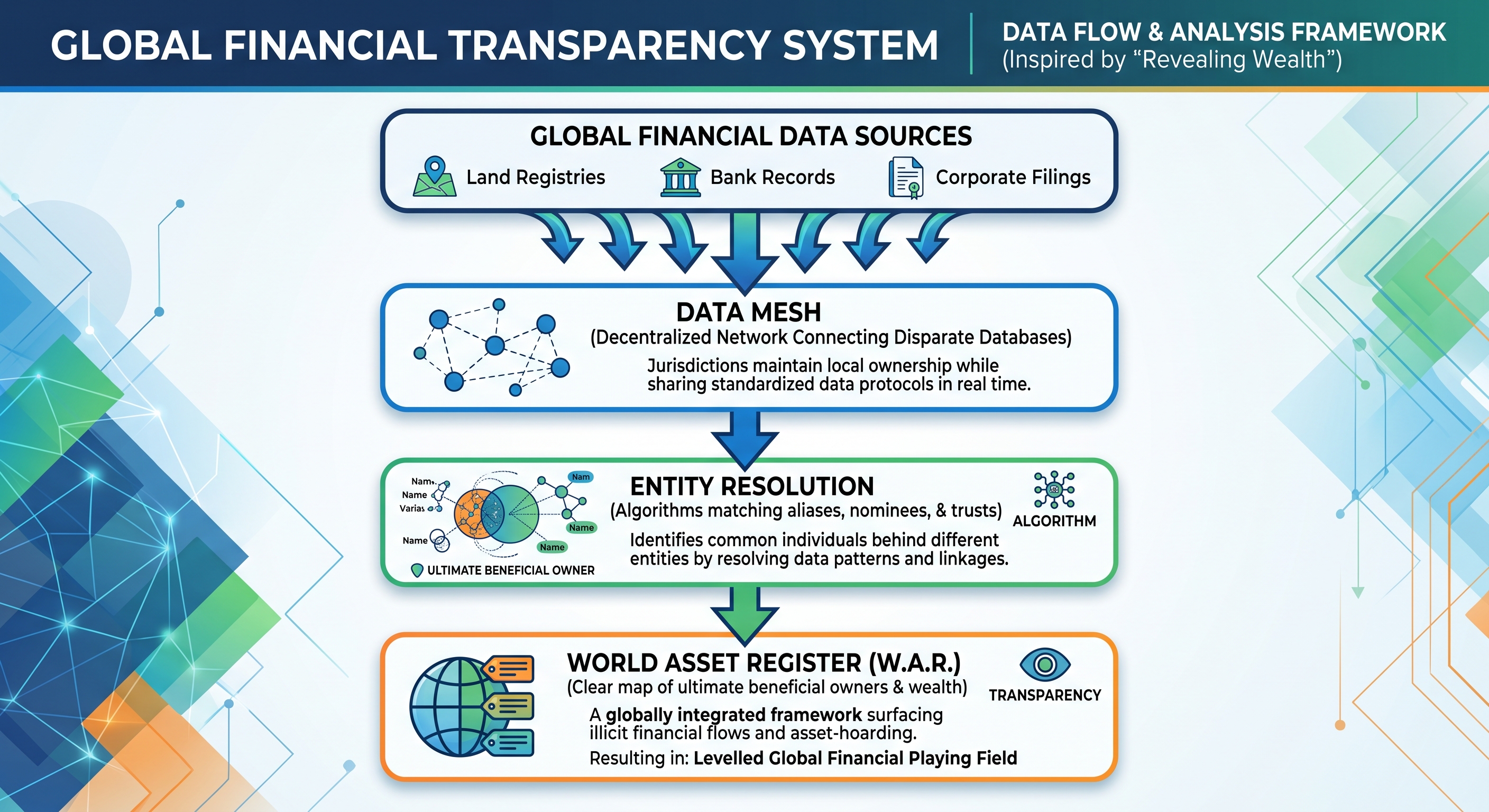
Infographic illustrating the Global Financial Transparency System, encompassing global data sources, a data mesh for connecting databases, entity resolution algorithms, and the World Asset Register framework.

Subject Oriented: Operational databases, such as order processing and payroll databases and ERP databases, are organized around business processes or functional areas. These databases grew out of the applications they served. Thus, the data was relative to the order processing application or the payroll application. Data on a particular subject, such as products or employees, was maintained separately (and usually inconsistently) in a number of different databases. In contrast, a data warehouse is organized around subjects. This subject orientation presents the data in a much easier-to-understand format for end users and non-IT business analysts.

Abstract geometric landscape with winding path, city, compass, and growth chart
A winding path leads through an abstract landscape toward a stylized geometric city.

Integrated: Integration of data within a warehouse is accomplished by making the data consistent in format, naming and other aspects. Operational databases, for historic reasons, often have major inconsistencies in data representation. For example, a set of operational databases may represent “male” and “female” by using codes such as “m” and “f”, by “1” and “2”, or by “b” and “g”. Often, the inconsistencies are more complex and subtle. In a Data Warehouse, on the other hand, data is always maintained in a consistent fashion.

Historic mining town with factories, railways, and smoke-filled mountain valley
A historic mining settlement winds through a mountain valley beneath smoke-filled skies.

Time Variant: Data warehouses are time variant in the sense that they maintain both historical and (nearly) current data. Operational databases, in contrast, contain only the most current, up-to-date data values. Furthermore, they generally maintain this information for no more than a year (and often much less). In contrast, data warehouses contain data that is generally loaded from the operational databases daily, weekly, or monthly, which is then typically maintained for a period of 3 to 10 years. This is a major difference between the two types of environments.

Historical information is of high importance to decision makers, who often want to understand trends and relationships between data. For example, the product manager for a Liquefied Natural Gas soda drink may want to see the relationship between coupon promotions and sales. This is information that is almost impossible – and certainly in most cases not cost effective – to determine with an operational database.

Antique compass on a weathered world map with red and gold cords
An antique compass rests on a weathered world map crossed by colorful travel cords.

Non-Volatile: Non-volatility means that after the data warehouse is loaded there are no changes, inserts, or deletes performed against the informational database. The Data Warehouse is, of course, first loaded with cleaned, integrated and transformed data that originated in the operational databases.

We build Data Warehouses iteratively, a piece or two at a time, and each iteration is primarily a result of business requirements, and not technological considerations.

Each iteration of a Data Warehouse is well bound and understood – small enough to be deliverable in a short iteration, and large enough to be significant.

Conversely, Big Data is characterised as being about:

Massive volumes: so great are they that mainstream relational products and technologies such as Oracle, DB2 and Teradata just can’t hack it, and

High variety: not only structured data, but also the whole range of digital data, and

High velocity: the speed at which data is generated, transmitted and received.

These are known as the three Vs of Big Data, and they are subject to significant and debilitating contradictions, even amongst the gurus of Big Data (as I have commented elsewhere: Contradictions of Big Data).

From time to time, Big Data pundits slam Data Warehousing for not being able to cope with the Big Data type hacking that they are apparently used to carrying out, but this is a mistake of those who fail to recognise a false Data Warehouse when they see one.

So let’s call these false flag Data Warehouse projects something else, such as Data Doghouses.

Glowing central network connecting six distributed data platforms
A glowing central network connects distributed data platforms through colorful digital pathways.

“Data Doghouse, meet Pig Data.”

Failed or failing Data Doghouses fail for the same reasons that Big Data projects will frequently fail. Both will almost invariably fail to deliver artefacts on time and to expectations; there will be failures to deliver value or even simply to return a break even in costs versus benefits; and of course, there will be failures to deliver any recognisable insight.

Failure happens in Data Doghousing (and quite possibly in Big Data as well) because there is a lack of coherent and cohesive arguments for embarking on such endeavours in the first place; a lack of real business drivers; and, a lack of sense and sensibility.

There is also a willing tendency to ignore the advice of people who warn against joining in the Big Data hubris. Why do some many ignore the ulterior motives of interested parties who are solely engaged in riding on the faddish Big Data bandwagon to maximise the revenue they can milk off punters? Why do we entertain pundits and charlatans who ‘big up’ Big Data whilst simultaneously cultivating an ignorance of data architecture, data management and business realities?

Some people say that the main difference between Big Data and Data Warehousing is that Big Data is technology, and Data Warehousing is architecture.

Now, whilst I totally respect the views of the father of Data Warehousing himself, I also think that he was being far too kind to the Big Data technology camp. However, of course, that is Bill’s choice.

Let me put it this way, if Oracle gave me the code for Oracle 3, I could add 256 bit support, parallel processing and give it an interface makeover, and it would be 1000 times better than any Big Data technology currently in the market (and that version of Oracle is from about 1983).

Therefore, Data Warehousing has no serious competing paragon. Data Warehousing is a real architecture, it has real process methodologies, it is tried and proven, it has success stories that are no secrets, and these stories include details of data, applications and the names of the companies and people involved, and we can point at tangible benefits realised. It’s clear, it’s simple and it’s transparent.

Just like Big Data, right?

Well, no.

See what I mean?

Therefore, the next time someone says to you that Big Data will replace Data Warehousing or that Data Warehousing is Big Data, or any variations on that sort of ‘stupidity’ theme, you can now tell them to take a hike, in the confidence that you are on the side of reason.

Many thanks for reading.

More perspectives on Big Data

Aligning Big Data: http://www.linkedin.com/pulse/aligning-big-data-martyn-jones

Big Data and the Analytics Data Store: http://www.linkedin.com/pulse/big-data-analytics-store-martyn-jones

A Modern Manager’s Guide to Big Data:http://www.linkedin.com/pulse/managers-guide-big-data-context-martyn-jones

Core Statistics coexisting with Data Warehousing

Accomodating Big Data

A bronze statue of a girl in a dress standing on a pedestal, holding her hand up, with a wolf and a sheep beside her, surrounded by leafy trees.
Girl and wolf in Munich

And a big thank you to Bill Inmon (the father of Data Warehousing and of DW 2.0)

Contradictions of Big Data

01 Sunday Mar 2015

Posted by Martyn Rhisiart Jones in Big Data, Consider this

≈ 1 Comment

Tags

Ask Martyn, Big Data, data management, Good Strat, Good Strategy, Martyn Jones, Martyn Richard Jones

What we’ve been told

We’ve been told that Big Data is the greatest thing since sliced bread, and that its major characteristics are massive volumes (so great are they that mainstream relational products and technologies such as Oracle, DB2 and Teradata just can’t hack it), high variety (not only structured data, but also the whole range of digital data), and high velocity (the speed at which data is generated and transmitted). Also, from time to time, much to the chagrin of some Big Data disciples, a whole slew of new identifying Vs are produced, touted and then dismissed (check out my LinkedIn Pulse article on Big Data and the Vs).

So, beware. Things in Big Data may not be as they may seem.

It’s not about big

I have been waging an uphill battle against the nonsensical and unsubstantiated idea that more data is better data, but now this view is getting some additional support, and from some surprising corners.

In a recent blog piece on IBM’s Big Data and Analytics Hub (Big data: Think Smarter, not bigger), Bernard Marr wrote that “the truth is, it isn’t how big your data is, it’s what you do with it that matters!”

Elsewhere, SAS echoed similar sentiments on their web site: “The real issue is not that you are acquiring large amounts of data. It’s what you do with the data that counts.”

Can we call that ‘strike one’ for Big Data Vs?

It’s not about variety

It is claimed that 20% of digital data is structured, it is based on the problematic suggestion that structured data is uniquely relational. It is also claimed that unstructured data includes CSV files and XML data, and this makes up far more than the 20% of the data generated. But this definition is simply wrong.

If anything, CSV data is structured, and XML data is highly structured, and it’s typically regular ASCII data. So it does not add variety, even though it is not structured in the ways that some people might expect, especially if that someone lacks the required knowledge and experience. Simply stated, CSV data is structured, it’s just that it lacks rich metadata, but that doesn’t make it unstructured.

“But”, I hear you say “what about all the non-textual data such as multi-media, and what about the masses of unstructured textual data?”

Take it from me, most businesses will not be basing their business strategies on the analysis of a glut of selfies, home videos of cute kittens, or the complete works of William Shakespeare or Dan Brown. Almost all business analysis will continue to be carried out on structured data obtained primarily from internal operational systems and external structured data providers.

Strike two! Third time lucky?

It’s not even about velocity

So, if we accept that Big Data isn’t really about the data volumes or data variety that leaves us with velocity, right? Well no, because if it isn’t about record breaking VLDBor significant data variety, then for most commercial businesses the management of data velocity becomes either less of an issue or just is no issue. The fact that some software vendors and IT service suppliers set up this ‘straw man’ argument and then knock it down with the ‘amazing powers’ of their products and services, is quite another matter.

Strike three, and counting.

It’s not about the manageability of Big Data

We have been told and time again that the major difference between a data scientist and professional statistician is that the ‘scientists’ know how to cope very well with massive volumes, varieties and velocities of data. Now it turns out that this is also questionable.

According to Bob Violino writing in Information Management (Messy Big Data Overwhelms Data Scientists – 20 February 2015) “Data scientists see messy, disorganized data as a major hurdle preventing them from doing what they find most interesting in their jobs”. So, when it comes to data quality and structure the ‘scientists’ don’t really have an advantage over professional statisticians.

Last year Thomas C. Redman writing in the Harvard Business Review (Data’s Credibility Problem) noted that when Big Data is unreliable “managers quickly lose faith” and “and fall back on their intuition to make decisions, steer their companies, and implement strategy” and when this happens there is a propensity to reject potentially “important, counterintuitive implications that emerge from big data analyses.”

Strike four?

The new analytics aren’t new

Data science and Big Data analytics are the new kids on the block, aren’t they?

Well, here are some real life scenarios.

A major banking equipment supplier: A lot of banking equipment is hybrid analogic-digital, a simple example of this would be a photo copier or a physical document processing device. One major supplier decided to incorporate the capture of sensor data produced by their devices to predict failure and problems. Predictive preventive maintenance rules are created and corroborated using the data generated by sensors on each customer device, and these rules then get incorporated into the devices logic.

A major IT vendor: What happens when you create an intersection and convergence between technologies, techniques and method from areas of mainstream IT, data architecture and management, statistics (quantitative and qualitative analytics) and data visualisation, artificial intelligence/machine learning and knowledge management? This is precisely what one of the main European IT vendors did, and the idea proved to be quite attractive to customers, prospects and investors.

A major integrated circuit supplier: The testing of ICs at the ‘fabs’ (manufacturing plants) generates serious amount of data. This data is used to detect errors in the IC manufacturing process, it is captured and analysed in as near real-time as possible, which is necessary due to the costly nature of over-running the production of faulty ICs. To get around this problem the company uses a combination of fast data capture, transformation and loading of data into a data analytics area to ensure early and precise problem detection.

All Big Data Analytics success stories?

The first happened in 1989, the second in 1993 and the third in 2001. Yes, Big Data and Big Data analytics are sort of newish.

Strike five.

The science is frequently not very scientific

What is science?

According to Vasant Dhar of the Stern School of Business (Data Science and Prediction), Jeff Leek (The key word in “Data Science” is not Data, it is Science), and repeated on Wikipedia, “In general terms, data science is the extraction of knowledge from data”. Well, excuse me if I beg to differ. I have seen data scientists at work, and the word science doesn’t actually jump out and grab you. It’s difficult to make the connection, just as it is to accurately connect some popular science magazines with fundamental scientific research.

If a professional and qualified statistician wants to label themselves a data scientist then I have no issue with that, it’s their problem, but I am not willing to lend credibility to the term ‘data scientist’ when it is merely an interesting job title, with at most a tenuous connection to the actual role, and one that is liberally applied, with the almost customary largesse of IT, to creative code hackers and business-averse dabblers in data.

As Hazelcast VP Miko Matsumura suggested in Data Science is Dead “… put “Data Scientist” on your resume. It may get you additional calls from recruiters, and maybe even a spiffy new job, where you’ll be the King or Queen of a rotting whale-carcass of data” and ” Don’t be the data scientist tasked with the crime-scene cleanup of most companies’ “Big Data”—be the developer, programmer, or entrepreneur who can think, code, and create the future.”

Strike six.

And the value is questionable

DATA: “Data is a super-class of a modern representation of an arcane symbology.” – Anon

If I had a dollar for every time I heard someone claim that data has intrinsic positive value then I would be as wealthy as Warren Buffet.

If I have said it once, I have said it a hundred time. In order for data to be more than an operational necessity it requires context.

Providing valid data with valid context turns that data into information.

Data can be relevant and data can be irrelevant. That relevance or irrelevance of data may be permanent or temporary, continuous or episodic, qualitative or quantitative.

Some data is meaningless, and there are cases whereby nobody can remember why it was collected or what purpose it serves.

Taking all this into account we can ask the deadly pragmatic question: what value does this data have? Which is sometimes answered with a pertinent ‘no value whatsoever’.

Strike seven.

So what is it really about?

It is said that Big Data is changing the world, but for all intents and purposes, and shamed by previous Big Data excesses, some people are rapidly changing the definitions and parameters of Big Data, and to position it as being more tangible and down-to-earth, whilst moving it away from its position as an overhyped and dead-ended liability.

Big Data is a dopey term, applied necessarily ambiguously to a surfeit of tenuously connected vagaries, and its time has come and gone. So, let’s drop the Big Data moniker, and embrace the fact that data is data, and long live ‘All Data’, yes, all digital data. Let’s consider all data and for what it’s worth to the business, and not for what some chatterers reckon its value is – having as they do, little or no insight into the businesses to which they refer, or of the data in that these businesses possess.

So, when push comes to shove, is Big Data really about high volumes, high velocity and high variety, or is it in fact about much noise, too much pomposity and abundant similarity leading to unnecessary high anxiety?

Thanks very much for reading.

Big Data in Question – Again

01 Sunday Mar 2015

Posted by Martyn Rhisiart Jones in All Data, Big Data, Consider this

≈ Leave a comment

Tags

All Data, Big Data, data management, Good Strat, good strat blog, Good Strategy, Martyn Jones, Martyn Richard Jones

Big Data is now an inhospitable and unhealthy land inhabited by those who, through accident or design, deceive naïve and sentimental bystanders and those who are willingly mislead.

When all of this Big Data malarkey started it was sort of funny, humorous and occasional witty, especially in the affected, bizarre and the frequently uninhibited ways that freshly-minted self-appointed gurus and experts would “big it up”

Doctor Freud would have had a field day with all of that, being as it was, and for that matter still is, a postmodern mishmash of Riefenstahl, Freddy Mercury and Monty Python on steroids. However, after that extended, operatic and high-camp hiatus it all went downhill.

The Big Data scene is fast becoming an outrageous and brash festival of deception, disinformation and obliviousness. Which is a pity, because it does the industry no good whatsoever.

It is telling that Big Data evangelists, gurus and assorted sycophants cannot even define Big Data adequately, never mind discuss (or for that matter, point at) tangible success stories, without falling into contradictions on all of the key defining characteristics of volume, variety and velocity, and resorting to crude debating devices to avoid or finesse the concerns and the questions.

Almost every morning I check out the industry news, and almost invariably, it comes with new mind-boggling examples of Big Data nonsense.

However, it isn’t always nonsense for nonsense’s sake, there are agendas, there are rational explanations why Big Data has become at the same time, one of the most hyped up fads in the history of IT, and one that its supporters find so difficult to actually explain and justify, in any reasonable sort of way.

Therefore, when it comes to Big Data, beyond the surfeit of platitudes, clichés, bluff and bluster, the only thing in play are the interests of industry, the patrons, the courtesans and their entourage of the innocent and the beguiled.

One of the biggest deceptions in Big Data is in the misleadingly named ‘success stories’. The thing is that most of these success stories that I have ever read have been:

  • So vague that it’s difficult to know how success is being defined never mind reached.
  • So secretive and obtuse is the avoidance of naming names, locations and other relevant Big Data references that it’s impossible to corroborate if these claims are actually true or not. Disclaimer: I have worked for some of the biggest IT vendors, and in senior roles, and I know what is behind comments such as “the Big Data project is a success, although the client name and project are confidential” and “it’s delivering such major competitive advantages that we are obliged to keep it under wraps”.
  • Stories stolen from elsewhere, such as from Data Warehousing, Business Intelligence, VLDB or Business Application projects.
  • Borderline fantasies and badly contrived technology fan fiction.

However, it doesn’t stop there.

One of the clearest examples of the questionable nature of Big Data evangelism is when it is used to piggyback Big Data hype on simple, tangible and immediately recognisable artefacts or applications that have little in common with Big Data.

This is an extreme illustration, but it works like this: “iPhones are commercially successful, iPhones are part of Big Data, and therefore Big Data is commercially successful.”

As if the mere conjuring up of association, affinity and proximity will convince people of the great and growing value of Big Data.

What I am also referring to are publicity pieces that may as well have been titled:

  • Smith, Galbraith, Mies, Keynes, Homer SImpson and the economic justification of Big Data
  • Lovelace, Babbage, von Neumann, Eckert, Davies, Codd, Knuth, Naur and the technological underpinnings of Big Data
  • Einstein, Freud, Edison, Faraday, Recorde and the intellectual structure of Big Data
  • Socrates, Kant, Hegel, Marx , Adorno and the philosophical correctness of Big Data
  • Great quotes about Big Data, from the Cambrian era to the postmodern époque
  • Great jokes about Big Data, from Mel Brooks to Steve Martin
  • Sportspeople and Big Data, from Lottie Dodd and Babe Ruth to Rafa Nadal and CR7
  • Industry support of Big Data, from Henry Ford to Neutron Jack

Do you recognise similarities?

It’s no big deal, just the use of unreliable, misleading and inappropriate fallacies, dressed up as cute, plausible and accessible collateral. People may think that such things are clever and witty, but they aren’t, it’s just misleading.

Let’s continue with something simple.

Evasion is, in ethics, an act that deceives by stating a true statement that is immaterial or leads to a false deduction. For example, citing events, persons or anecdotes from the history of IT to justify the supposed or imaginary value of Big Data. This is close to the notion of a non sequitur, which of course is an argument, the conclusions from which do not follow from its premise. It falls short of being full-on sophistry, purely because the simplistic, puerile and superficial arguments put forward in favour of Big Data do not match those of the true sophist who seeks to reason with clever but fallacious and deceptive arguments. Too many of the Big Data arguments are fallacious and deceptive, but no one, equipped with a reasonable capacity for critical thinking, should take such ‘arguments’ as valid.

Hold this thought: Big Data hype is a viper’s nest of logical fallacies, white lies and disinformation.

Just when I think things could not get any weirder, they do, and Big Data ceiling of hyperbole rises even higher, up to the rarer atmosphere of extreme tendentiousness.

There is a growing mass of Big Data hoop-la, hyperbole and flim flam that exceeds all previously bounds of overstatement, solecism and confabulation. This is where the real volumes, varieties and velocities are in Big Data; in hokie.

We live, as Oscar Wilde said in his day, in and age of surfaces. Yes, superficiality, puerility and short-termism are the competing orders of the day. However, I am still amazed – and maybe wrongly so – by what ostensibly professional, experienced and knowledgeable people are willing, able and prepared to accept, especially when it comes to Big Data flim flam sauce.

Here are some examples of the nonsense about Big Data that is taken as gospel by ‘adults’:

Data Warehousing is part of Big Data: No comment.

Big Data will replace Enterprise Data Warehousing: People can’t even explain the features and benefits of Big Data. I try it make it as easy as possible, ‘if you can’t say it, point to it’. But, seriously, people can’t even relate tangible and credible Big Data success stories, never mind show how it will replace Enterprise Data Warehousing, whether that’s the Inmon or Kimball flavour, take your pick.

Everyone and every organisation can benefit from Big Data: If people can’t explain this, and they don’t in terms of tangible benefits, then the claim should remain questionable.

Data Scientists will replace Statisticians: Why is that so? It is claimed that Data Scientists are uniquely equipped to handle massive volumes, varieties and velocities of data – well, as it turns out, this isn’t certain either.

Big Data is in its infancy: I think we may be confusing infancy with lack of real traction, and of time and place utility.

You cannot be serious: Just what are people talking about here? I have read vague, naïve and ill-informed pieces about data management, data architecture, data warehousing, reporting, business intelligence and a plethora of etcetera that have been passed off as observations and commentary on Big Data. So, what makes people recycle hackneyed, misleading and badly conceptualised ‘content’?

In the commentary on one of Bernard Marr’s pieces on LinkedIn (a professional networking site) I observed that no one can adequately explain what Big Data is without falling into contradictions and fancies, and no one seems to be capable or willing to provide tangible success stories.

Bernard responded to this comment by pointing out “the reason for that is that Big Data means different things to different people.”

Fair enough. It’s an explanation.

That said, I have always had more than a tenuous dislike of postmodern thinking, in fact most things ‘postmodern’. Call me old fashioned, jaded or cynical, but to me, the idea that everything can mean anything is an aberration that I prefer to leave to others.

I am at a loss to explain why so many reasonable people are willing to embrace the hype surrounding Big Data and Big Data Analytics, including the attendant surfeit of nonsense, incongruences and contradictions, and from my perspective, it defies reason and good sense.

Therefore, I will just end again with a fabulous quote from Ben Goldacre:

“You cannot reason people out of a position that they did not reason themselves into”.

Many thanks for reading.

Contradictions of Big Data – Short

01 Sunday Mar 2015

Posted by Martyn Rhisiart Jones in Big Data, Consider this, Good Strat, Good Strategy, Martyn Jones, Martyn Richard Jones

≈ Leave a comment

Tags

Big Data, data management, Good Strat, Good Strategy, Martyn Jones, Martyn Richard Jones

Please note: This is an edited version of a previous piece with a similar name, but focusing solely on the three main Vs of Big Data.

What we’ve been told

We’ve been told that business Big Data is the greatest thing since sliced bread, and that its major characteristics are:

  • massive volumes – so great are they that mainstream relational products and technologies such as Oracle, DB2 and Teradata just can’t hack it, and
  • high variety – not only structured data, but also the whole range of digital data, and
  • high velocity – the speed at which data is generated, transmitted and received

Which is a simple and straightforward means of classification. Big Data is about massive volumes, high variety and high velocity. Right?

It’s not about big

I have never bought into the idea that more data is necessarily better data, or that it provides better focus or leads to increased insight, in fact I have been quite vocal with my contrarian opinion, but now this view is getting some additional support, and from some surprising corners.

In a recent blog piece on IBM’s Big Data and Analytics Hub (Big data: Think Smarter, not bigger), Bernard Marr wrote that “the truth is, it isn’t how big your data is, it’s what you do with it that matters!”

Over at Fierce Big Data it was Pam Baker who stated that “the term big data is unfortunate because it’s really not about the size of the data”. (Big data is not about petabytes, but complex computing).

Elsewhere, SAS echoed similar sentiments on their web site: “The real issue is not that you are acquiring large amounts of data. It’s what you do with the data that counts.”

Well, apparently Big Data isn’t about “massive volumes” of data.

Strike 1!

It’s not about variety

It is claimed that 20% of digital data is structured, it is based on the problematic suggestion that structured data is uniquely relational.

It is also said that unstructured data includes CSV files and XML data, and this makes up far more than the 20% of the data generated. But this definition is wrong.

If anything, CSV data is structured, and XML data is highly structured, and it’s typically regular ASCII data. So there it does not add variety, even though it is not structured in the ways that some someone might expect, especially if that someone lacks the required knowledge and experience. Simply stated, CSV data is structured, it’s just that it lacks rich metadata, but that doesn’t make it unstructured.

“But”, I hear you say “what about all the non-textual data such as multi-media, and what about the masses of unstructured textual data?”

Take it from me, most businesses will not be basing their business strategies on the analysis of a glut of selfies, juvenile twittering, home videos of cute kittens, or the complete works of William Shakespeare. Almost all business analysis (whether done by a professional statistician or a data scientist) will continue to be carried out using structured data obtained primarily from internal operational systems and external structured data providers.

Variety, Sir? No problem.

Strike two!

It’s not even about velocity

So, if we accept that Big Data isn’t really about the massive data volumes or high data variety then that leaves us with velocity. Because if it isn’t about record breaking VLDB or significant data variety, then for most commercial businesses the management of data velocity becomes either less of an issue or just is no issue.

Even in some extreme circumstances, one can explore the suggestion that data sampling can remove issues with data volume as well as velocity.

However, the fact that some software vendors and IT service suppliers set up this‘straw man’ velocity argument and then knock it down with the ‘amazing powers’ of their products and services, is quite another matter.

So, is it really about velocity?

Strike three!

So what is it really about?

Big Data is a dopey term, applied necessarily ambiguously to a surfeit of tenuously connected vagaries, and its time has come and gone. Let’s dump the Big Data moniker, and the 3 Vs along with it, and embrace the fact that data is data, there will always be more of it.

So, let’s consider ‘all data’ and principally for its time and place utility.

If there is something that you are not sure about or have questions with then please leave a comment below or email me.

Thanks very much for reading.

← Older posts

Follow Good Strategy

Enter your email address to follow this strategy platform and receive free notifications of new content by email.

Top posts

  • Censoring Mister Jones
  • DATA WORLD: DATA! STRATEGY, INNOVATION AND VALUE BULLSHIT
  • Adaptive Reasoning
  • Big Data, analytics and 4th generation data warehousing by Martyn Jones at Big Data Spain 2015
  • The Top 7 Vapourware Hallucinations For Next Year
  • The secrets of big data success!

Recent Comments

Unlocking Business V… on Building the Data Logistics Hu…
Unlocking Business V… on DATA WORLD: Understanding the…
Unlocking Business V… on Podcast Episode: DATA WORLD: T…
Unlocking Business V… on Building the Data Logistics Hu…
Unlocking Business V… on DATA WORLD: The Risks of Using…

Meta

  • Register
  • Log in
  • Entries feed
  • Comments feed
  • WordPress.org

Recent articles

  • Censoring Mister Jones
  • The Top 7 Vapourware Hallucinations For Next Year
  • Tokenmaxxing for Jesus
  • La revuelta por la vivienda en España: el audaz enfrentamiento de Sánchez con la derecha
  • Spain’s Housing Revolt: Sánchez’s Daring Showdown With the Right
  • How Green Was My Data?
  • Why Smart Leaders Trust Both Data Analytics and Gut Instinct
Privacy & Cookies: This site uses cookies. By continuing to use this website, you agree to their use.

To find out more, including how to control cookies, see here: Cookie Policy

Hours & Info

Spain
+34 692 376 698
martyn.jones@martyn.es
Lunch: 13:30pm - 14:30pm
Dinner: M-Th 20:00pm - 21:00pm, Fri-Sat:21:00pm - 22:00pm

The Stats

  • 130,609 hits

Meta

  • Register
  • Log in
  • Entries feed
  • Comments feed
  • WordPress.org
Log in
  • Censoring Mister Jones

Create a website or blog at WordPress.com

Loading Comments...