An Open Letter to Brendan O’Neill of The Spectator
Sir Afilonius Rex and the Editorial Team
Brussels, The European Union, 3rd December 2025
Brendan O’Neill claims that Dublin City Council’s proposal to rename Herzog Park amounts to “erasing Jewish history.” He argues that removing Chaim Herzog’s name is like scrubbing a Jew’s name from a public space. Herzog was a Belfast-born Jew who later became Israel’s sixth president. He suggests this action is antisemitic. He presents the renaming as a disturbing and targeted act rather than a routine administrative decision.
Here is a response from some leading associates of goodstrat.com
The trauma and post-traumatic stress from the Holocaust and historical pogroms profoundly influence many non-religious (secular) pro-Zionists today. This manifests itself as mechanisms like inter-generational trauma, collective memory, and a deep-seated sense of vulnerability tied to Jewish identity. This isn’t limited to religious observance; Judaism often functions as an ethnic and cultural heritage. Situations in which historical persecutions shape worldviews even among atheists or agnostics. Here’s a breakdown of why this persists and affects them so significantly.
Inter-generational Trauma Transmission
The trauma from the Nazi Holocaust was passed down in multiple ways. Centuries of pogroms across Europe and the Middle East also left their mark. It was passed down biologically, psychologically, and socially. Studies show epigenetic changes. These are alterations in gene expression that do not change the DNA sequence. They can occur in the offspring of survivors. This leads to heightened stress responses, anxiety, or depression.
Note: Epigenetic. Relating to changes, especially heritable changes, in the characteristics of a cell or organism. These changes result from altered gene expression or other effects. These do not involve changes to the DNA sequence itself.
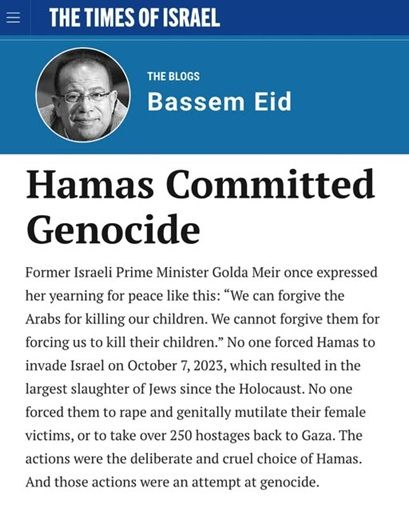
The article by Bassem Eid in The Times of Israel (Nov 2025) asserts that Hamas’s actions on October 7, 2023, and its use of human shields constitute genocide against Jews. It cites Golda Meir’s 1957 remark (“We can forgive the Arabs for killing our children… but we cannot forgive them for forcing us to kill their children”) to frame Hamas’s strategy as deliberately engineering Palestinian civilian deaths to provoke Israeli retaliation—thus meeting the legal threshold for genocide.
This is a bold, provocative claim that weaponises a revered Israeli leader’s words but fails under scrutiny on legal, factual, and rhetorical grounds.
Detailed List of Entities Calling for the Unconditional Release of Israeli Hostages Held by Hamas
The following is a comprehensive, categorised list of world leaders, governments, political parties, universities, social leaders, and NGOs that have publicly called for the immediate and unconditional release of the Israeli hostages (and, where applicable, their remains) taken during the October 7, 2023, Hamas-led attack.
This demand has been a consistent theme in international responses to the Gaza war hostage crisis, often framed as a war crime under international law and tied to calls for ceasefires and humanitarian access. The list is compiled from official statements, joint declarations, and reports up to November 6, 2025, including the recent U.S.-brokered ceasefire phases during which many hostages were released. I’ve focused on explicit calls for “unconditional” release, excluding conditional proposals (e.g., tied solely to prisoner swaps without emphasising immediacy).
Entries include brief context, dates where available, and sources for verification.
Note: Although universities were less prominent in direct calls (more often involved in protests or faculty statements), I’ve included relevant examples.
1. World Leaders. These individuals issued personal or official statements urging Hamas to release hostages without preconditions, often in UN addresses, summits, or media.
Why are so many social media supporters of Israel and Hamas so evil, amoral, depraved and degenerate?
I said:
The perception that supporters of both Israel and Hamas on social media are widespread. They are viewed as disproportionately “evil, amoral, depraved, and degenerate.” However, it is not evidence of inherent moral rot in either group. This view results from the dynamics of social media. It also stems from human behaviour in polarised, high-stakes conflicts. It’s a predictable outcome of how social media works and how humans behave in polarised, high-stakes conflicts. Here’s a clear, non-partisan breakdown.
Thank you for sharing your perspective on this deeply complex and painful situation in Gaza. As a fellow advocate for human rights and peace, I appreciate the passion you bring to discussions on justice. These are qualities you highlight in your impressive profile. Your background is as a U.S. Army veteran, filmmaker, and activist. This undoubtedly provides you with unique insights into the costs of conflict. I respect your commitment to standing against terrorism in all its forms. However, I must firmly push back. It appears to be a one-sided portrayal that risks oversimplifying a humanitarian crisis. This portrayal can perpetuate division. It does not foster the empathy needed for a lasting resolution. First, we’ll focus on the core of your post. You claim that the international community is pressuring Israel to “let [Hamas fighters] walk away” without consequences. This narrative, while emotionally charged, doesn’t fully align with the reported facts. Recent developments show that mediators from Egypt, Qatar, and the US are holding discussions. These talks concern the fate of approximately 200 Hamas fighters. They are trapped in tunnels in IDF-controlled areas of southern Gaza, such as Rafah and Khan Younis.
A recent poll has been used to claim that most Palestinians “support Hamas’s atrocities.” In truth, it reveals not moral depravity but the depth of hopelessness created by occupation, blockade, and the collapse of politics.
Sir Afilonius Rex
New York, New York
1st November 2025
A commentary circulated this week declares that “most Palestinians support Hamas’s atrocities.” It cites a new opinion poll as evidence that a future Palestinian state would be a moral and political disaster. The claim makes for an alarming headline, but it is also deeply misleading. What it really reveals is how data, stripped of context and empathy, can become a form of propaganda.