Is Data Warehousing Truly Iterative and Agile?

Tags

, , , ,


Data warehousing eschews iterative development?

Martyn Jones, Santander, 10th October 2024

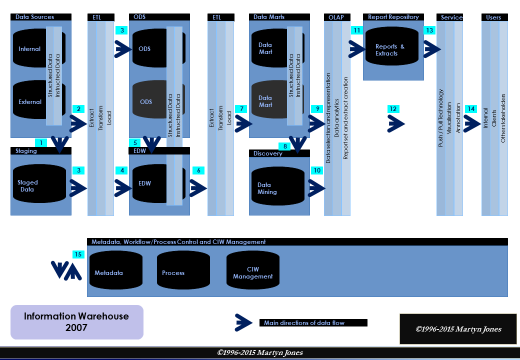
Narrator: The development method for data warehousing, whether following Inmon or Kimball, has always been iterative with apparent aspects of self-service, agility, rapid development and end-user development.  

Dud: We always built data warehouses iteratively, didn’t we, Pete?

Pete: Yes, that’s right, Dud. Iterations are delivered in increments. Small enough to be quickly deliverable. Large enough to be significant to the business.

Continue reading

Rethinking Data Warehousing and Team Collaboration

Tags

, , , ,


Data Warehousing means monolithic and siloed teams?

“Great things in business are never done by one person;

they’re done by a team of people.”

Steve Jobs

Martyn Richard Jones, Tours, 4th October 2024

Narrator: There is a widespread belief amongst the know-it-all crowd that data warehousing and business intelligence necessarily mean monolithic and siloed teams. And that the only way of moving away from such team organisations is to kill off data warehousing. But is this really a rational, coherent, and cohesive approach, as some people say it is? Or is it destructive stupidity born out of conceit, ignorance, and arrogance?

Continue reading

Can Agile Methods Win a War?

Tags

, , , ,


“Logistics is all of war-making, except shooting the guns, releasing the bombs, and firing the torpedoes.”

ADM Lynde D. McCormick, USN

Martyn Richard Jones, Córdoba, 3rd October 2024

Narrator: Here is a billion-dollar question: Can Agile-to-Scale be effectively used to fight a war, a regional conflict, or a global existential threat?

Continue reading

Origins of Relational Databases: Transaction Processing Misconceptions

Tags

, , , ,


Were relational database management systems first used for transaction processing?

Martyn Richard Jones, Madrid, 3rd October 2023

Narrator: Relational database theory is over fifty years old. Relational database technologies go back more than four decades. Some claim that relational databases were first used for online transaction processing applications. Say what?

Continue reading

Understanding Exhaust Data in Data Warehousing

Tags

, , , ,


The data warehouse is the place to copy exhaust data to

Martyn Jones, Bilbao, 2nd October 2024

Narrator: Not all data we have is related to strictly business domains such as products, organisation structure and corporate real estate. A lot of data we collect is simply about monitoring all aspects of IT, applications, networking, security and governance. To name just a few.

Dud: What’s all this data in my exhaust? Is my data back-end going well, or do I have a mechanical data governance issue? All this OLTP exhaust data is so tedious and tiring.

Continue reading

Is Data Warehousing Really Outdated?

Tags

, , , ,


Data warehousing is out of date?

Martyn Jones, Manhattan, 29th September 2024

Narrator: According to some data-mesh folk, data warehousing is “a data management construct that dates back to the eighties,” I have a problem with that. It’s as if that was somehow a bad thing. Is it? For me, that’s quite a weak argument that, in a way, treats people as if they were idiots.

It is like someone asking Newton, “So, Sir Isaac, you don’t still believe in that old gravity nonsense, do you?”

Continue reading

Data Warehousing means monolithic databases?

Tags

, , , , , , , , , , , , ,


Data Warehousing means monolithic databases?

Martyn Jones, Brooklyn, 27th September 2024

Narrator: Another false meme doing the rounds is that Data Warehousing necessarily means monolithic databases. This is not what data warehouses have been for many businesses.

Continue reading

Orientation! Domain or Subject?

Tags

, , , ,


Domain orientation or subject orientation?

Martyn Jones, New Jersey

Narrator: Here, in this piece, we wander down Differential Avenue to look at what people consider domain and subject orientation. This story is about the good, the embarrassingly lousy hyperbole and then the ugliest provocative nonsense.

Continue reading