
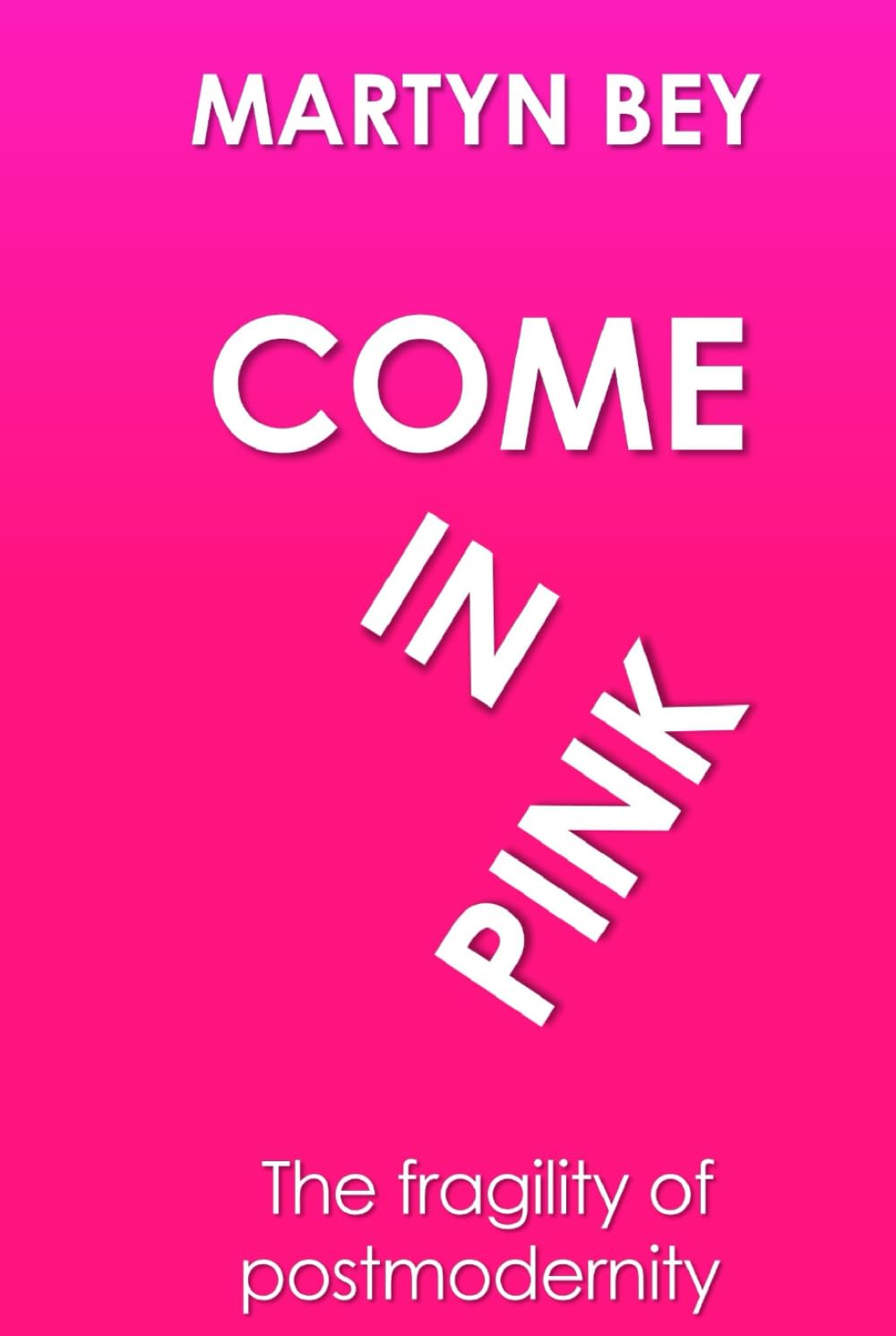
Come In Pink by Martyn Bey – Available from Amazon and Barnes & Noble
The New Yorker: Shouts & Murmurs / A Critic at Large
The Rhinestoned Raconteur: Martyn Bey’s High-Camp Hegemony By Steff Griffiths
There is a particular kind of London air, one part diesel exhaust, two parts rain-dampened pavement, and three parts unearned audacity, that seems to breathe through the lungs of Lloyd Jones, the “velvet-voiced narrator” of Martyn Bey’s Come In Pink. Jones is less a protagonist and more a sentient pashmina, a “chiffon-wrapped time traveller” who claims to have provided the lavender soap for Pontius Pilate.
Bey’s novel is a dizzying, episodic “metaphysical cabaret” that refuses to sit still. We move from the “kebab-slicked streets of Istanbul” to the “velvet parlours of Notting Hill,” guided by a man who describes his own past as a series of postcards from futures that never happened. The prose is relentlessly, almost exhaustingly, fabulous. In Bey’s world, birds don’t just sing; they toss “glitter into a foggy glass of champagne”. Even a simple writing desk is described as “an opulent slab of walnut and rosewood” that “lounges… like a diva reclining after a long aria”.
Yet, beneath the sequins and the “zipper sex,” there is a genuine, sharp-edged anxiety about the “postmodern jungle”. Bey uses his flamboyant cast, including the “sorceress of sequins,” Karen Williams of Brielle, New Jersey, to poke at the bruises of a world where “logic is the drag act reactionaries can’t handle”. It is a book that suggests we might escape the decline of empires not through policy, but through a well-timed wink and a very strong martini.
The Times Literary Supplement (TLS)
The Sordid and the Sacred: Bey’s Postmodern Pastiche By Gail Jones
In his latest work, Come In Pink, Martyn Bey offers a spirited, if structurally fragmented, critique of what he terms “the fragility of postmodernity”. The narrative, delivered through the “inimitable” and decidedly camp persona of Lloyd Jones, functions as a series of intellectual and erotic skirmishes. Bey’s project appears to be a fictionalized dialogue with the “grand narratives” of the twentieth century, particularly those of Marx and Feuerbach, while simultaneously reveling in the “pastiche, parody, and… mischievous cynicism” that defines the postmodern era.
The novel’s strength lies in its refusal to decouple the intellectual from the sensory. A debate on “Marx, Knowledge and Truth” sits uncomfortably, yet intentionally, alongside graphic “wet dream sequences” and “zipper sex”. Bey’s characters, Clare, Kate, and the enigmatic Martyn Bey himself (appearing here as a “literary renegade”), navigate a world where shared truths have dissolved into “glowing skin” and “the slow, heady heat of longing”.
Ultimately, Bey suggests that postmodernism “undermines itself” by discarding universal truth in favor of irony. Yet, by concluding with a dreamlike conversation on the meaning of love, the author avoids “abject nihilism”. Come In Pink is a dense, often ribald “love letter to the outrageous,” demanding that we view the “half animal, half angel” of humanity through a prism of shimmering, pink-hued ambiguity.
The Guardian
Sequins and Subversion: A Love Letter to the Misfits By Barbara Belle
“Truth is fine, but truth dipped in glitter is divine,” declares the narrator of Martyn Bey’s Come In Pink. It is a manifesto that the book follows with religious zeal. Part memoir, part magical realism, and part political broadside, Bey’s novel is a “glitter cannon fired at the moon”.
The story centres on a group of “artists, musicians, writers, philosophers and charlatans” who gather for a “dominical dinner party” and a weekend of “party pieces”. At its heart is the bond between the narrator, Lloyd, and his “Jersey girl,” Karen Williams, a woman who “hexes” trends and wears “animal print and combat heels” while reading your chakras and your credit history.
Bey isn’t afraid to get his hands dirty. Between the “prime time erotic diversions” and the “chiffon-wrapped” anecdotes, he launches a scathing attack on the “elephant… bedazzled, bloated, and utterly baffling” that is modern democracy. He laments a world where “politicians lie, the press amplifies, and the crowd chants in emoji spells”.
Come In Pink is a “whispered dare in a moonlit alley”. It is often over-the-top, occasionally “provocatively obnoxious,” and unashamedly “sordid”. But in its “breathless tenderness” and its defense of “honest work” and “friends of Humanity,” it finds a strange, shimmering sort of hope. As Lloyd Jones might say: “Stay if you sparkle”.
Discover more from GOOD STRATEGY
Subscribe to get the latest posts sent to your email.
 GOOD STRATEGY