
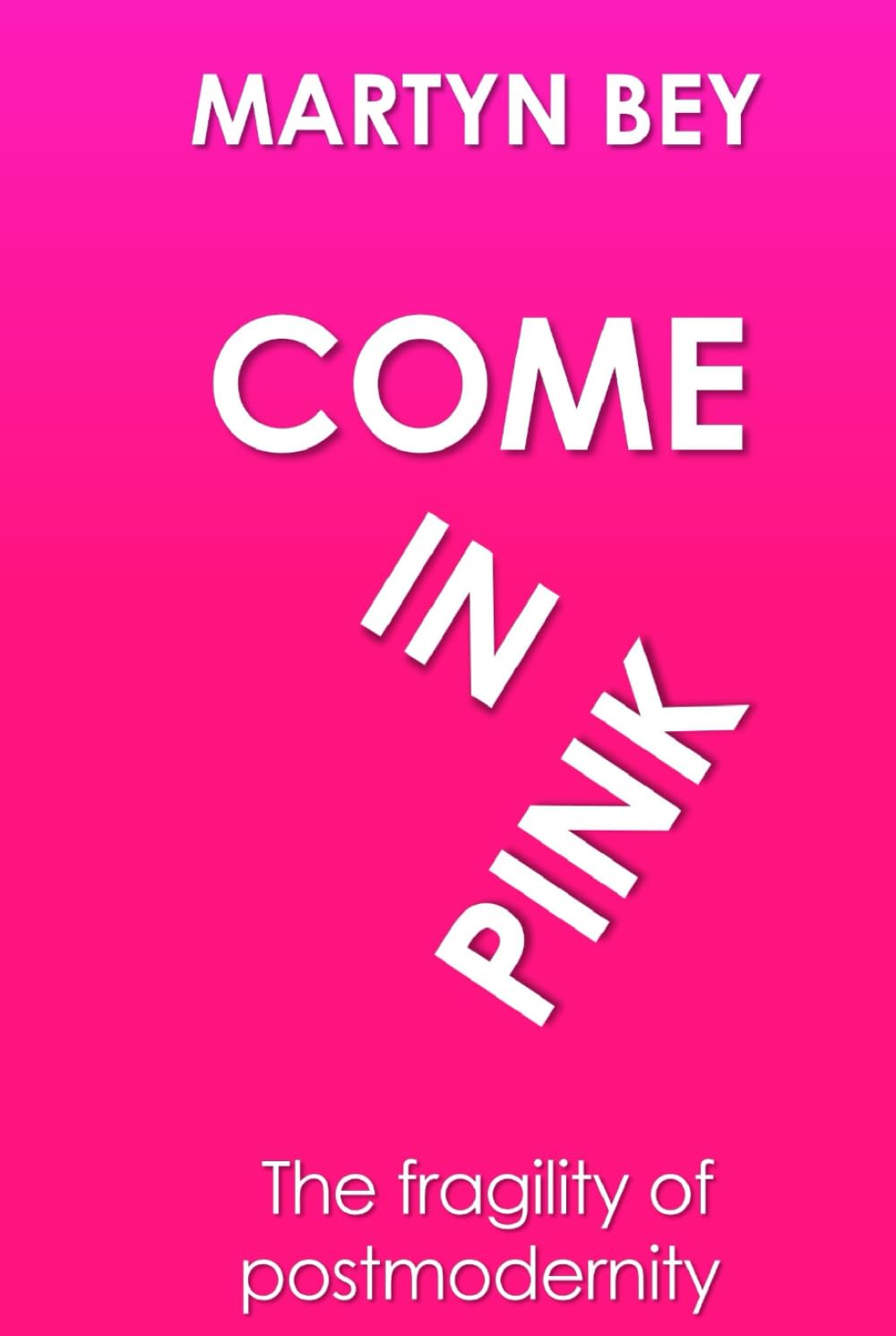
Come In Pink by Martyn Bey
By Florence la Galesa
In Come In Pink: The Fragility of Postmodernity, Martyn Bey has written a novel that behaves like a drag revue in a philosophy department: sequinned, self-aware, intermittently profound, and constitutionally incapable of lowering the lights. It is at once a campus satire, a political fantasia, a queer picaresque, and a baroque meditation on what the author calls “the fragility of postmodernity.” If that sounds like a mouthful, it is because Bey has never knowingly left a mouth unfilled.
The book’s presiding spirit is Lloyd Jones—“part oracle, part showgirl”—a narrator who claims to have whispered to Caesar and supplied Pontius Pilate with lavender soap. This diabolical emcee, equal parts cabaret MC and fallen angel, frames the novel’s central drama: the intellectual and erotic peregrinations of Martyn Bey (a character who shares his author’s name and several of his vanities) between Istanbul, Notting Hill, and a Wales forever shadowed by dragons. The metafictional wink is not subtle. Subtlety, here, is for reactionaries.
Bey’s prose arrives dressed for the opera. A sunrise does not simply rise; it “prances across the cityscape with the confidence of a debutante at her first ball.” A football match becomes “the last religion with weekly sermons and skybox altars.” Even a sandwich is described with Eucharistic gravity. The tonal register oscillates between camp and catechism, between the boulevard and the barricade. One hears, at various moments, the theatrical mischief of Oscar Wilde, the cosmopolitan melancholy of Orhan Pamuk, and the eschatological fabulism of Gabriel Garcia Marquez—though Bey’s true loyalty is to excess.
At its best, Come In Pink reads like a postmodernist answer to the Victorian triple-decker: capacious, digressive, crowded with talk. The “Karen Talks” sequences—in which the titular Jersey oracle livestreams her jeremiads on wokeness, terrorism, and the hypocrisies of liberal democracies—are among the book’s most compelling inventions. They capture with unsettling precision the vertiginous moral theatre of the internet age, where AI assistants equivocate, hashtags metastasize, and righteousness is both weapon and brand. Bey has an ear for the absurdities of contemporary discourse, particularly the way outrage flattens nuance into meme.
Yet the novel’s animating tension lies elsewhere: in its insistence that reason itself has become a kind of drag act. Lloyd’s lament that “extremes despise subtlety” recurs like a bass line beneath the glitter. The book is obsessed with the shrinking space for the sentence that begins, “On the other hand.” In scene after scene—whether in a café scented with bara-brith and eccles cakes, or in a studio debating antisemitism—Bey stages the same confrontation: the rationalist aesthete versus the zealot, the connector clause versus the slogan.
There is courage in this, and risk. Bey’s satire of political tribalism cuts in multiple directions; he is as suspicious of liberal sanctimony as of right-wing bombast. But the novel occasionally succumbs to the very grandiosity it mocks. Polemic crowds out plot. Characters become mouthpieces; metaphors metastasize. One begins to long, perversely, for a little less chiffon and a little more cotton.
And yet—one keeps reading. Because beneath the rococo surfaces lies a genuine anxiety about how to live, and love, in an age of perpetual mediation. The river that Lloyd contemplates from his bridge is not merely a symbol of time; it is a question. Is there, the novel asks, a script? A plan? Or only the endless scroll of reflection and refraction?
The book’s title is both invitation and injunction. “Come in pink” is a summons to flamboyance, to chosen family, to solidarity among misfits. But it is also an admission of vulnerability. Pink, after all, bruises. Postmodernity, in Bey’s telling, is not triumphant irony but something brittle, flickering in the wind of resurgent absolutisms.
In the end, Come In Pink is less a novel than a performance—part séance, part salon, part street protest in feather boas. It will exasperate readers who crave narrative discipline; it will delight those who prefer their philosophy with a martini and a monologue. Bey has written a book that fiercely believes in the moral seriousness of camp. Whether that camp can withstand the storms it so flamboyantly summons is the question that lingers, like perfume, after the curtain falls.
Discover more from GOOD STRATEGY
Subscribe to get the latest posts sent to your email.
 GOOD STRATEGY