
Martyn Rhisiart Jones, Madrid 28th January 2026
I would like to introduce you to a pragmatic approach to Big Data and Big Data Analytics. It is real-world focused and business-centric. This is the best approach to Big Data you are ever likely to find. Yet, I am still significantly understating the magnificent utility. It is also timely and has all the pertinent facets of the approach.

Now with the introduction done and dusted, the virtues of the BIG SMILES approach have been exalted. It should come as no surprise. This method is eminently sensible, highly rational, and thoroughly reasonable. It is a methodical and no-nonsense technique. It has been applied successfully in more than 500 business-oriented situations.
Best of all, this amazing Big Data approach is free of charge. There are no strings attached. You don’t even have to buy my book. Now, isn’t that amazing?
Let’s start with the basics. The BIG in BIG SMILES refers to Business Insight Gains. This refers to the focus of SMILES. Simple, right? Now, what does SMILES refer to:
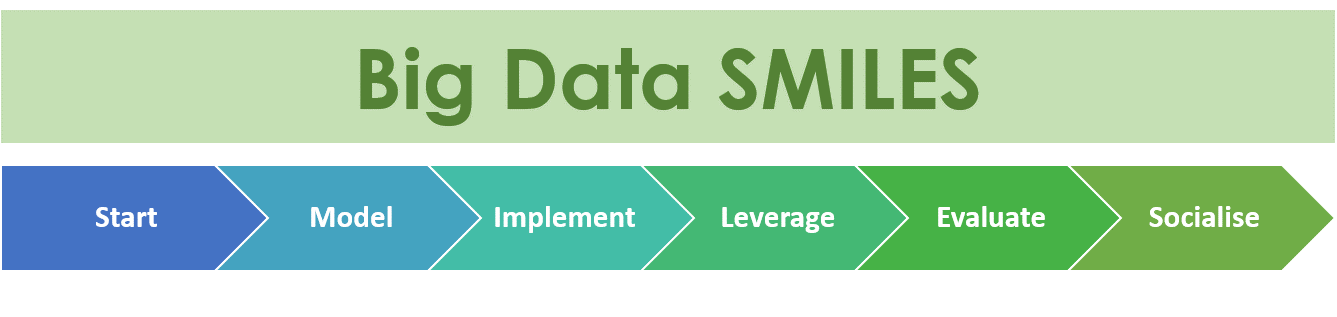
Fig. The process chain of Big Data SMILES
SMILES is also an acronym. It refers to the six major components of the SMILES Big Data approach (as illustrated above). Or, more precisely the various phases of the approach. Namely:
- Start with a significant data-centric business challenge
- Model high-level options and approaches
- Implement your chosen option
- Leverage the products
- Evaluate performance and value
- Socialise the outcomes
Let’s take a look at each of those aspects of Big Data SMILES in a little more detail.
1. Start with a significant data-centric business challenge
It makes sound business sense to start any business initiative with a compelling business reason. If you don’t have one then don’t start, it’s as easy as that.
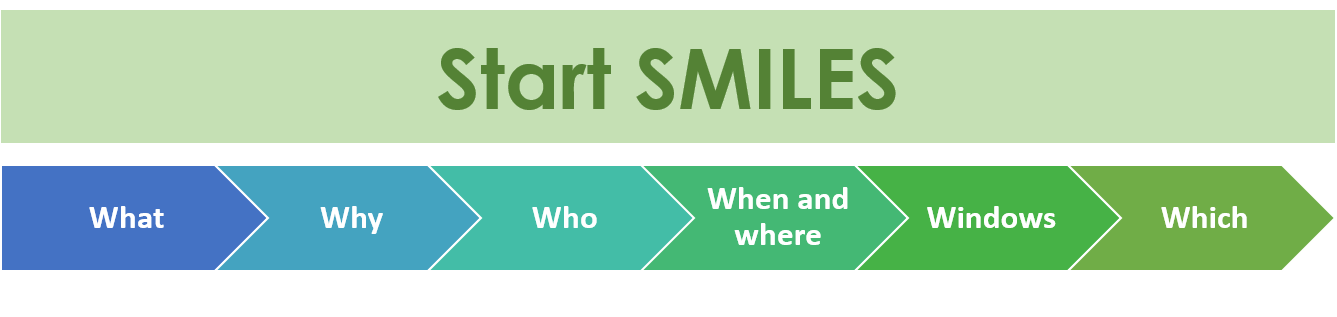
Fig. Start SMILES
Now, having identified your significant business challenge you should ask the following questions:
- What: What do you want to accomplish with respect to the significant business challenge?
- Why: Why do we want to address the challenge?
- Who: Who should be involved in helping address this challenge?
- When and where: Can you identify the time and place the challenge first comes into effect?
- Windows of opportunity: During what periods can we most effectively address the challenge?
- Which: Can you enumerate the requirements and constraints associated with the challenge and the possible responses?
When compiling your view of the significant business challenge, you could look for example at questions along the lines of:
- How do I find the Big Data I need?
- What is the original source of the Big Data?
- How was this summarization, enrichment or derivation created in the Big Data?
- What queries and mechanisms are available to access the Big Data?
- How have Big Data related business definitions and terms changed?
- How do interpretations of the Big Data/Data vary across organizations?
- What business assumptions have been made that are related to this Big Data?
Don’t forget, asking great questions about significant business challenges will lead to even more questions. This is when you will want to highlight the new questions. These questions could quite possibly be answered, wholly or partially, using Big Data. Also, don’t confuse great questions with complex ones. The idea is not to impress the audience. The goal is to identify and address the challenge.
In relation to the SMILES approach, remember that you should never try and boil the ocean. Avoid attempting to execute or implement everything all at once. That is, do not try and implement and leverage Big Data analytics in your organisation in big leaps and bounds. Start out with baby steps, and treat it like a game of tennis. Win points, games, and sets and beat challenges and bad decisions one-step at a time.
Finally, make sure each iteration of SMILES starts with an objective that is big enough to be significant. However, it should also be small enough to be doable in a reasonably short-time scale. Ideally, this objective is made up of sprints of no more than 5 to 10 days.
2. Model high-level options and approaches
Here we are looking at a process of discovery and insight. It also involves conceptualisation and creativity. Design and innovation are key aspects. Finally, prototyping expertise and domain capabilities play a crucial role.
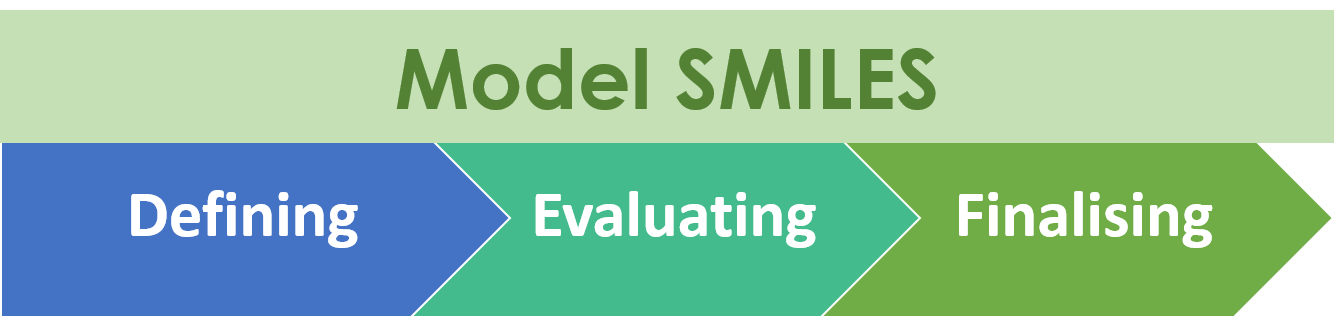
Fig. Model SMILES
This phase has three parts:
- Defining the problem and developing options
- Evaluating and selecting the best model
- Finalising and developing the implementable prototype
Defining the problem and developing options
Co-operative Prototype Ideation, Concretisation, and Realisation is a unique rapid development feature of SMILES. Using this feature, you may now choose to develop options. You can also develop models to various stages of maturity and extensiveness.
Evaluating and selecting the best model
Through a cycle of hypothesise and test you may arrive at the model most suited to your needs. If no such model is forthcoming, do not proceed to the next step. Similarly, if the best model is not good enough or promising enough, do not continue. Make sure you have a good reason to progress. Inertia is definitely not a good reason. Neither is ‘because we have to do something’.
Developing the implementable prototype
In this phase, you develop the chosen model. You take it to the stage where it is ready to be ‘productised’. This occurs in the following prototype implementation phase.
In addition, as part of this phase, you will assess various technology options. You will evaluate which options might best fit your requirements. Common technological options are typically linked to the Hadoop ecosphere. Technology such as Hive, Pig, Bash, Spark, or Python may adequately address your problem. Products like MapR, Neo4j, or EXASol may also offer solutions. Datatricks? Avoid like the plague?
3. Implement your chosen option
In this phase, you take your well thought out proof of concept prototype. You then turn it into a business ready product. Finally, you make it production hardened.
What is involved in turning a Big Data solution prototype into a product?
We are focusing on tools. We aim to build competence and teamwork. We also provide product piloting and development support. Moreover, we address the realities of production and support.
Remember as a final note for this phase description. The implementation phase requires the active participation of the development sponsors. Their involvement is crucial. It also involves the target user group. Every phase to date, and all follow-on phases, should also include such participation.
4. Leverage the product
It’s been designed, prototyped, built and productised. Now what?
Well, here comes the moment of truth.
In this phase, SMILES can help Big Data teams rapidly respond to changing business and market needs. It does so by capturing and managing new and evolving requirements. Additionally, it constantly monitors feedback. The framework can be fully integrated into agile development processes. This is especially helpful where requirements are extremely dynamic and free-flowing. However, they must still be managed at a complete Big Data product level.
5. Evaluate performance and value
An assessment of the value of the Big Data initiative should be made periodically. However, there should be at least four event-pegged must-do valuations carried out during the life-time of the project products.
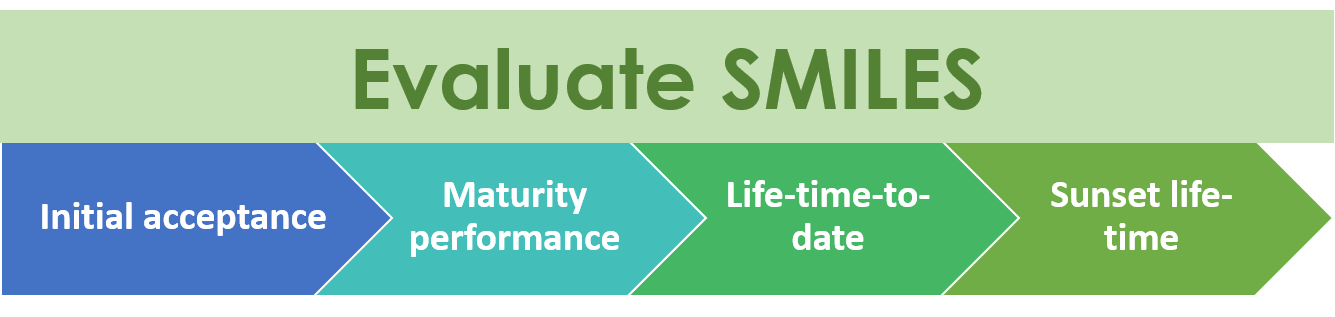
Fig. Evaluate SMILES
- Initial acceptance criteria alignment and qualitative valuation.
- Maturity performance and tangible ROI contribution. Include both the mitigation and avoidance of loss and the enablement of all direct and indirect gains.
- Life-time-value-to-date to be carried out before all major enhancements.
- Sunset life-time assessment and valuation. On replacement or withdrawal from service.
6. Socialise the outcomes
These are the activities that generally put the smiles in SMILES.
Whatever happens with your initiative, you must never fail to socialise the outcomes. The exercise may appear kitsch, cute, or painful to you or anyone else.
Put it this way. You’ve gone to all the effort and trouble of making a Big Data initiative work. It’s working well. People like it, and it’s delivering value. So, what else is there to do? It’s a success. You shout it from the rooftops. You tell all your colleagues and peers. Put the news on the intranet and in the company house magazine. Organise a party.
If your project is killed off early or late or simply fails to deliver value, sometimes this just happens. Then hold a wake, in the Celtic manner. Learn all the lessons that are worth shaking a stick at. Make them part of your corporate data management story and knowledge base.
The golden rules of SMILES for beginners
When entering the new dynamic world of Big Data and Big Data Analytics, you must ensure success. Follow the 9 golden rules of SMILES. This will help SMILES deliver the kind of success that others enjoy. These are the golden rules for beginners.

Fig. The 9 golden rules of SMILES
- Infrastructure – Ensure that the infrastructure is adequate for the needs of the project. Make sure executive management separates your prototyping, development, and deployment cycles. Disconnect them from the rigorous requirements imposed on core business operational systems. These requirements are necessarily rigorous, time-consuming, and constricting. Remember this is operational, but it is not life-threatening, customers will not be lost nor will serious money be burned. Ensure that senior management unchains Big Data from Big IT bureaucracy. Aim to do this permanently if possible.
- Pilot – When you first take on Big Data and Big Data analytics, always start with pilot prototypes and projects. Make sure the pilot is small enough to be doable. Avoid overreach at all costs. It should also be large enough to be significant. Remember, small and useful doesn’t have to be trivial.
- Timescale – Aim to deliver initial pilot Big Data prototypes in around the 3 to 6 week mark. Aim to get the first projects into the leverage phase in around 3 to 5 months, tops.
- Long-term – Aim to deliver fast, simple, and elegantly. Also, keep a keen eye on the long-term prospects and issues for Big Data and Big Data Analytics.
- Cash-flow – Control the cash but make sure you have enough to do what you need to do. Focus on value, keep sprints and iterations short, and be intelligent in the management of funding. (see comments on funding later in this piece)
- Continuous involvement and justification – Justify every decision in terms of business (mandatory) and technological (optional) drivers. Involve business partners, continuously. Make this an absolute mandatory condition for starting the project and continuing. If involvement from business stops, then stop the project. Resume when the implication and involvement of the business stakeholders picks up again. Make all of this clear from the outset. Continually seek and reaffirm business justifications for the projects existence – this is a showcase, and people are watching.
- Sponsors – Ensure that your project has high-level business sponsorship. This cannot come from IT. The source cannot be the CIO or the CDO. However, an exception occurs if your Big Data project measures the performance of aspects of IT. It should also report on Data Governance.
- Clean – Make sure that the data that you use is to the quality levels required. The data that you analyse must be at least as good at that stage as when it was sourced. In many cases, you will need to scrub and clean data. This is especially true when it comes from badly designed, tragically engineered, and shoddily built web applications. The designers and developers of these applications may have only had a passing acquaintance with sound database engineering principles. They might not have been familiar with them at all.
- Tenacity – finally, never give up until it’s time to do so. If you believe that success is achievable then go for it. If you see that the project is on a suicide mission then kill it quickly, don’t wait until you’ve burned all your hours and cash.
When using SMILES keep these 9 golden nuggets of rules in mind, and you won’t go far wrong.
A note on funding
Try to make sure that your funding aligns with the phases of SMILES.
However, split your funding requests into three parts.
- Start with a significant data-centric business challenge. 2. Start with a significant data-centric business challenge. 3. Model high-level options and approaches.
- Implement your chosen option.
- Leverage the products. 6. Evaluate performance and value. 7. Socialise the outcomes.
This ensures an optimum allocation of resources. It provides additional executive and project management safeguards and options. It also helps to align contractual assurances and obligations with committed and planned budgets.
A note on testing
Testing is an integral element of every phase of the SMILES approach. For brevity, the approach has not been detailed in this document. However, the philosophy is essentially to test early and test often. Under normal circumstances, the SMILES approach does not require a User Acceptance Testing phase. If we are in shops that do require this testing, then the UAT becomes a mere bureaucratic formality.
Some people may be surprised that the Big Data SMILES approach does not start with a strategy. In my view, thinking that strategy can start without identifying a significant challenge is incorrect. This approach is wrong for two reasons: i. It’s not the way to go about strategy, and ii. It’s not the way to go about Big Data.
The BIG SMILES approach is not in itself a strategy. It is a guide, reference, and framework. It is for those who wish to develop a specific Big Data oriented strategy to address a significant business challenge. This is where it is powerful, useful and relevant. It’s a roadmap, a cookbook, and a method to understand issues. It helps formulate questions and provide adequate, appropriate, and timely responses. It separates the wheat from the chaff, the core from the periphery, and the important from the inconsequential.
Things to remember
If you haven’t done so yet, look at the Cambriano Information Supply Framework. This applies to you or your Big Data analysis and design development team. I suggest this action. It provides a solid basis to architect and design Big Data oriented solutions.
That’s all from me for now. Have fun and enjoy the Big Data journey.
Thank you for reading.
If you would like to know more about SMILES, the Information Supply Framework, Core Statistics, Core Data Sourcing, Data Governors, the Analytics Data Store or 4th generation Enterprise Data Warehousing then please drop me an email or visit:
On a lighter note, readers may also be interested in joining The Big Data Contrarians. It is the friendliest Big Data community. It is also the most relevant and massively irreverent on the entire world wide web. So, if you think you are up for it then we can be found on LinkedIn at this address:
https://www.linkedin.com/groups/8338976
A Retrospective on BIG SMILES
With the benefit of distance, BIG SMILES feels less like a Big Data manifesto. It seems more like a corrective to an era that mistook scale for sense. During the optimistic commissioning of Hadoop clusters, much like the Victorian railways, SMILES insisted on something fundamental. Unfashionably, it all started with a single vote: is there a real business problem here at all?
What distinguishes the approach is not its tooling, which has inevitably dated, but its temperament. SMILES shows patience where Big Data culture was breathless. It is sceptical where others were credulous. It remains insistently business-centred in a domain prone to abstraction. The insistence on small, winnable iterations, tennis points, not ocean boiling, now reads as prescient rather than cautious.
The six phases are not a linear pipeline. They form a discipline of attention. This includes attention to purpose, to evidence, to value, and finally to narrative. The requirement to socialise outcomes. Successes are celebrated. Failures are mourned and mined for learning. This anticipates today’s interest in organisational memory and learning cultures. Few frameworks are brave enough to mandate a wake.
The golden rules are equally telling. They betray a veteran’s scars. Unchain Big Data from Big IT. Demand continuous business involvement. Kill doomed projects early. This is not theory; it is post-incident wisdom.
In retrospect, BIG SMILES was never about Big Data. It was about restraint, judgement and method at a moment when the industry had precious little of any three. That it asked for no fee, no book purchase, and no leap of faith only reinforces its quiet confidence. As methods go, it wears its age well, and its relevance is even better.
Discover more from GOOD STRATEGY
Subscribe to get the latest posts sent to your email.
 GOOD STRATEGY