Tags
AI, Artificial Intelligence, boom, burn, Business, bust, chatgpt, crash, tech, technology, wreck
Martyn Rhisiart Jones
Galicia, Spain. 7th December 2025.
A Late-2025 Update from the Edge of the Abyss
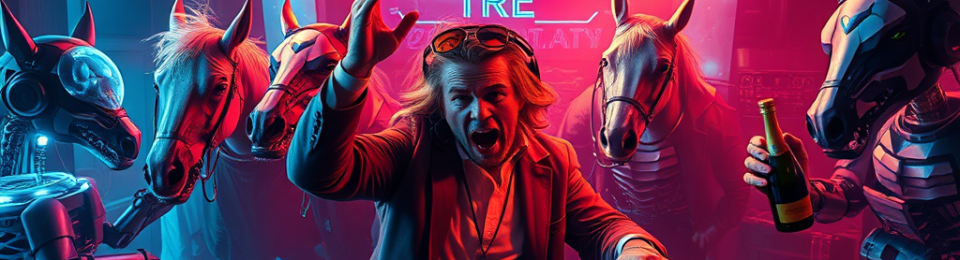
Darlings, it’s December 2025 and the party is now officially sweaty. The champagne has gone warm. Someone’s been sick in the ficus. The DJ is playing the same four AI remixes on loop. He is frantically checking the fire exits. Here is your updated field guide to the seven trends. These were going to “reshape humanity.” Now they are mostly reshaping venture capitalists’ therapy bills.
1. Generative AI – The Guest Who Won’t Stop Talking About Their Novel
We are now six months into the “trough of disillusionment”. The trough is starting to look suspiciously like a mass grave.
McKinsey has quietly deleted the slide that said GenAI would add $4.4 trillion to the economy and replaced it with a shrug emoji. Companies that rebranded themselves “AI-first” in 2023 are now frantically Ctrl-Z-ing back. They are returning to whatever boring thing they used to do (cloud plumbing, ad tech, selling insurance to dogs).
Latest Bloomberg headline: “Goldman Sachs report finds zero evidence of material productivity gains from AI.” Translation: even the vampire squid can’t find the blood.
Bubble status: Already half-deflated and wheezing like a sex doll that’s discovered existentialism. A complete rupture is expected in Q1 2026. This will happen when the first Big Tech firm admits it spent $60 billion. They trained a model whose primary skill is writing better layoff emails.
2. Agentic AI – The Intern Who Declared Themselves CEO on Day One
Remember when every startup deck promised “agents that replace entire departments”?
Current reality: the most reliable agent in existence is still the one that books a restaurant table. However, even that agent double-books you with your ex.
The hottest agent demo of November 2025 was Devin by Cognition. It lasted exactly 11 days. Users discovered it was 40% hallucinated benchmarks. The remaining 60% consisted of graduate students in Sri Lanka working for $8 an hour.
Sam Altman now refuses to say the word “agent” in public without doing air-quotes you can see from orbit.
Scheduled meltdown: Chinese New Year 2026. A major bank’s “fully autonomous trading agent” accidentally buys $11 billion in volatile cat-themed memecoins. It mistook “MOON” for a buy signal.
3. Quantum Computing – The Fancy Toaster That Costs £300 m and Can’t Toast Bread
2025 has delivered not one, not two, but three separate quantum “breakthroughs” that each turned out to be accounting errors.
PsiQuantum’s $620 million Series E valued the company at $6 billion for hardware that currently exists only in PowerPoint. Investors were reassured by the fact the slides have really nice animations.
China’s Jiuzhang 3.0 “achieved quantum supremacy” for the third time this decade. It is starting to feel less like supremacy and more like a participation trophy.
The tell? IBM has started calling its quantum division a “science project” again. When even IBM’s marketing department gives up, you know the rapture is nigh.
Pop date: Spring 2026. This is the day a major quantum company admits its main revenue line. Their main revenue line is leasing fridge space for the dilution refrigerators.
4. Humanoid Robots – Uncanny Valley’s Got Talent
There are now more humanoid-robot companies in Shenzhen than bubble-tea shops, which is saying something.
Unitree’s G1 robot can do backflips but still walks like it’s permanently constipated. Tesla’s Optimus can fold a T-shirt… eventually… if you unfold it first, stand very still, and don’t breathe on it.
Elon promised Optimus would cost less than a car. Current estimated BOM: $130,000–$180,000. My 2009 Honda Civic just took that personally.
The Chinese government has formally asked everyone to “please stop throwing money at robots for five minutes.” The market responded by raising another $4.2 billion.
Collapse forecast: Autumn 2026. Boston Dynamics will finally release a video of Atlas doing something genuinely useful (opening a door without falling over). The entire Chinese sector will file for bankruptcy simultaneously out of sheer embarrassment.
5. Spatial Computing – Return to Zuck’s Legless Hellscape
Apple Vision Pro sales have been so disappointing. Apple Stores now use them as very expensive paperweights for the iPhone displays.
Meta’s Horizon Worlds has achieved the impossible: it is now less populated than Second Life in 2009.
The hottest “spatial” use case of 2025? Virtual PowerPoint presentations where everyone’s avatar looks like they’re attending their own intervention.
Tim Cook was spotted in public without the headset for the first time since launch. Analysts are calling this “the strongest sell signal in tech history”.
6. Nuclear Reactors for AI – Because Nothing Says “Green Future” Like 1950s Technology
AI needs so much electricity that tech companies are now speed-dating uranium. Microsoft has restarted Three Mile Island. Yes, really. Google is writing love letters to small modular reactors. Sam Altman is personally investing in fusion. Apparently, ChatGPT can’t run on hope and wind turbines.
If the AI boom slows even slightly, we’re left with the world’s most expensive collection of concrete doorstops. We also face a trillion dollars of debt labelled “synergy”.
Meltdown (financial, not radioactive): 2026. The first SMR comes online six years late. It immediately asks for a software update.
7. Neuromorphic Computing – Chips That Think Like Brains (i.e. Slowly and With Questionable Judgement)
The pitch: copy the human brain, use 100× less power, achieve nirvana.
The reality: copy the human brain. Inherit its tendency to daydream about David Bowie. Forget where it left the car keys.
Intel, IBM and a dozen startups are racing to ship silicon that behaves like a hungover neuroscience graduate. Early results are promising if your definition of “promising” includes hallucinating benchmarks.
In 2026–2027, a neuromorphic chip will finally be built. It will pass the Turing test by refusing to work on Mondays.
Epilogue: Enjoy the Party, Mind the Exit
By late 2026 the combined market cap of these seven darlings could shrink by a round trillion dollars. This amount is roughly the GDP of the Netherlands plus whatever loose change Belgium has in the sofa.
But take heart. After every bubble, there comes a golden age. People buy the wreckage for pennies and actually build useful things. The internet survived 2000. Smartphones survived 3D TVs. Humanity will survive the Seven Horsemen of the Techpocalypse. They will endure another round of grown adults trying to live inside computers while robots fold laundry badly.
See you in the trough, darling. Bring gin.
Thanks for reading.

Discover more from GOOD STRATEGY
Subscribe to get the latest posts sent to your email.
 GOOD STRATEGY