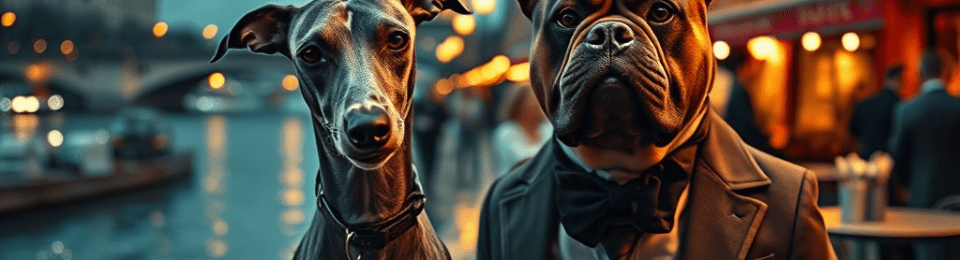
(or, A Trifle in Three Acts, with Greyhounds and Killer Dogs)
Martyn Rhisiart Jones, Madrid, 21st March 2026.
In the drizzle of a Paris evening, where the lamps along the Seine flicker like guilty secrets, a man may still feel the old thrill of espionage. Not the sort that involves microfilm or beautiful women in railway carriages, though God knows there are enough of both, but the quieter intrigue of the dog. I had come to the capital to write a harmless travel piece; instead, I found myself tailing a creature that looked as if it had escaped from a medieval bestiary and was now plotting to annex the Left Bank. Its owner, a woman in Hermès and despair, called it “Mon Petit Assassin.” I called it Tuesday.
Graham Greene might have recognised the atmosphere at once: the moral fog, the sense that every leash hides a treaty about to be broken. Oscar Wilde would have seen the comedy of it. Mel Brooks would have yelled, “Cut! Print it in Yiddish and give the dog a Cuban cigar!” And all three would have been right. For in the great European capitals, Madrid with its magnificent, occasionally discreet and dusty plazas, Paris with its existential pavements, Rome, Berlin, even smug little Brussels, there trots an entire parliament of dogs that are ugly, anachronistic, and, on paper at least, lethal. Why? Ah, dear reader, pour yourself an absinthe (of the best sort) and allow me to explain.
First, the greyhounds. They are the aristocrats of the absurdity. In Madrid, you see them everywhere, long as a sonnet, thin as a creditor’s smile, eyes like disappointed poets. They were bred for the hunting fields of Castile when Philip II still dreamed of ruling the waves and subduing the English; now they are walked by graphic designers who live in 40-square-metre flats and call them “Galguito.” The poor beasts look permanently astonished, as though they have just realised the Plaza Mayor is not, in fact, a racetrack. Their legs were made for the open sierra; instead, they negotiate Metro steps and the existential hazard of a dropped bocadillo or churros. Anachronistic? Darling, they are practically medieval cosplay. Wilde would have said: “To be natural is such a very difficult pose to keep up, especially when you are a dog with the soul of a Renaissance fresco and the postcode of Chueca.”
Yet the greyhounds are the charmers. The real theatre belongs to what the tabloids, in their delicate way, term “killer dogs.” The Staffordshire, the American Bully, the Rottweiler with the face of a disappointed prizefighter. In Paris, they are walked by young men in tight trousers who wish you to believe they are dangerous only in the most aesthetic sense. One sees them outside cafés, muscles rippling like bad prose, while their owners sip flat whites and pretend the beast is merely “misunderstood.” Misunderstood! The creature has a jaw that could file its own tax return and a stare that suggests it once auditioned for the role of Cerberus but was told it was “too method.” Mel Brooks would cast it instantly opposite Gene Wilder: “Igor, the brain! The brain! Wait, that’s not a brain, that’s a pit bull who’s had ten espressos and still bears a grudge!”
So why, in these cities of light and reason, do sensible people, people who queue for the Louvre and recycle their pain au chocolat wrappers, keep such creatures? The answer, like all great truths, is deliciously trivial.
It begins with nostalgia, that most European of vices. Our capitals are museums that forgot to close. Paris still believes it is 1927; Madrid clings to the ghost of the Habsburgs; London (though not strictly continental in the geographic sense) mutters about empire while wearing elasticated trousers. What better way to signal one’s attachment to a nobler, bloodier past than by parading a dog that looks as though it just stepped out of a Goya etching or a Roman amphitheatre? The greyhound is the last courtier; the killer dog is the last gladiator. Together they form a living diorama: “See how we have tamed history and put it on a lead!”
Then there is fashion, that giddy courtesan. Ten years ago, it was French bulldogs, snorting, wheezing, adorable in the way a tax audit is adorable. Now the pendulum has swung to the opposite extreme. The uglier and more anachronistic the better. One must be seen to be ironic. “Yes, darling, he does resemble a sofa that has learned to bite, but the vet says his existential dread is improving.” Wilde would have adored the paradox: the more dangerous the dog appears, the more it proves its owner’s gentleness. “I walk a killer so you don’t have to fear me,” runs the unspoken motto. It is the canine equivalent of wearing a hair shirt to the opera.
And danger? Pure theatre. In cities where the actual crime rate is lower than a vegan’s cholesterol, the killer dog has become the ultimate accessory for the timid. A 60-kilo staffie with a head like a concrete block and a heart like a marshmallow is the perfect bodyguard for the millennial who is frightened of loud noises and his own mother. The dog barks at nothing; the owner feels heroic. Mel Brooks would film the scene in one take: “He’s not a killer dog, he’s a lover dog! He just expresses affection through 300 psi of jaw pressure. Oy vey!”
There is, too, a subtler conspiracy. The dogs are revenge. Revenge on the sleek, the minimalist, the Instagram-filtered. In an age of glass towers and oat-milk lattes, the anachronistic beast is a glorious “no.” The greyhound reminds us that speed once mattered more than Wi-Fi. The killer dog reminds us that teeth once settled arguments before lawyers did. They are walking protests against the tyranny of good taste. And we adore them for it, the way we adore a bad opera: because it is magnificent, ridiculous, and entirely ours.
I watched one such spectacle last week in the Jardin des Tuileries. A woman of impeccable breeding, cashmere, cheekbones, and the faint aroma of expensive regret was being towed by a greyhound and a bully cross that looked like it had lost a fight with a sofa and won. The greyhound floated like a sigh; the bully marched like a small coup d’état. Passers-by smiled the special smile reserved for other people’s folly. The woman caught my eye, lifted one perfectly arched brow, and said, in the accent of someone who has read too much Colette and not enough warning labels:
“They are impossible, of course. But then, so is civilisation. One must have something to walk that is more dramatic than oneself.”
At that moment, the bully sneezed, a sound like a small howitzer, and the greyhound gave me a look of pure aristocratic pity. I tipped my hat. The dogs, in their infinite wisdom, had won.
And so, dear reader, the boulevards remain gloriously cluttered with these relics of romance and ruin. Greyhounds that dream of hares they will never chase, killer dogs that dream only of belly rubs and the next lamppost. They are ugly, they are anachronistic, they are, on the strictest reading, dangerous. But they are also the last romantics in a world that has grown nervously polite. They remind us that life is not a flat white; it is a slobbering, loping, occasionally terrifying thing that must be taken for a walk every day.
As the sun sets over the Seine, painting the river the colour of old claret, one can almost hear Mel Brooks cackling in the wings: “Beautiful! Fantastic! Next time give the greyhound a beret!” And Oscar, leaning on his cane, adds with a sigh: “Each man kills the thing he loves, unless, of course, it is a dog. Then he simply buys it a better collar.”
And Graham Greene, somewhere in the shadows, lights another cigarette and murmurs: “The dogs know. They always knew. We are the ones still learning the code.”
Fade out on a perfectly absurd, perfectly European bark. Curtain. Bravo.
Discover more from GOOD STRATEGY
Subscribe to get the latest posts sent to your email.
 GOOD STRATEGY