Tags
China, economy, global-conflict, News, Politics, the-end-of-honour, ww3, xi-jinping
Martyn Rhisiart Jones, Madrid 12th March 2026
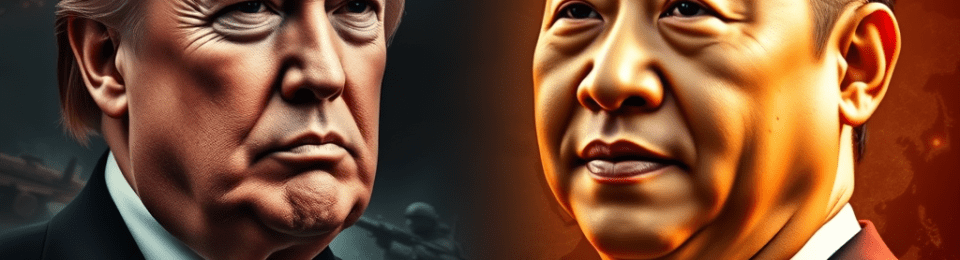
We asked some of our clients, bespoke AI and our Strategy Team: Who is the political leader most likely to cause World War III, and who is the political leader most capable of stopping World War III?
And this was the response:
Viewed through the prism of strategic history and contemporary financial diplomacy, the question of which leader might inadvertently ignite, or instead forestall, a wider conflagration is less a matter of personality than of structural power, institutional constraints, and geopolitical incentives. Yet, as historians from Thucydides to modern analysts have repeatedly noted, individual leaders can still accelerate or dampen systemic pressures. With that caveat, recent expert commentary, polling data and geopolitical assessments as of March 2026 suggest two figures loom particularly large in opposite directions: Donald Trump, the incumbent president of the United States, and Xi Jinping, China’s paramount leader.
The Leader Most Likely to Catalyse a Global Conflict: Donald Trump
A growing body of commentary from Western policy institutes and strategic analysts places Donald Trump at the centre of contemporary escalation risks. The argument is not that Washington seeks a world war, no major power does, but that the current American posture has introduced unusually volatile dynamics into the international system.
Escalatory military actions
The most frequently cited flashpoint is the February 2026 U.S.–Israeli strike on Iranian nuclear facilities, which reportedly killed Ali Khamenei. The operation triggered retaliatory activity across the Middle East and disrupted global energy markets. Critics within the Western security establishment have warned that such actions risk widening the theatre of confrontation, particularly if outside powers such as Vladimir Putin or Kim Jong-un interpret the crisis as an opportunity to press their own strategic agendas.
A separate episode, a January 2026 raid in Venezuela that reportedly seized Nicolás Maduro, has also been cited by Russian officials, including Dmitry Medvedev, as evidence of what they characterise as Washington’s willingness to pursue regime change through force.
Strains within alliances
Equally consequential, analysts argue, is the stress placed upon the Western alliance system. Trump’s suggestion that the United States might acquire Greenland, currently an autonomous territory of Denmark, by coercive means has unsettled European capitals. Should transatlantic trust erode further, strategists warn that NATO could weaken, potentially emboldening Moscow in sensitive regions such as the Baltic states.
Public opinion data underline this anxiety. Surveys in countries including France, Germany and Spain show majorities viewing the United States under Trump as a serious threat to international stability, a remarkable reversal of traditional Atlanticist sentiment.
Structural risks
Think-tank commentary often frames the issue in systemic terms. Trump’s scepticism towards multilateral institutions and alliances, coupled with a readiness to employ unilateral force, has introduced what strategic planners call “miscalculation risk”: a scenario in which several regional crises, from the war in Ukraine to tensions in the South China Sea, begin to intersect.
For this reason, many analysts rank Trump above other risk-bearing leaders. Benjamin Netanyahu and Vladimir Putin are frequently cited as drivers of regional conflicts, while Xi Jinping is scrutinised over Taiwan. Yet the global reach of American power means that Washington’s decisions inevitably reverberate more widely.
The Leader Most Capable of Preventing Escalation: Xi Jinping
If one leader appears structurally positioned to dampen great-power confrontation, analysts increasingly point to Xi Jinping.
Diplomatic leverage and economic gravity
China’s economic centrality grants it unusual diplomatic leverage. China remains a crucial trading partner for Iran, Russia and the European Union alike. That economic interdependence creates incentives for Beijing to prevent conflicts that might fracture global supply chains.
The precedent often cited is China’s brokering of the 2023 rapprochement between Saudi Arabia and Iran, which demonstrated Beijing’s willingness to step into diplomatic spaces traditionally occupied by Washington.
Strategic influence over other powers
China also retains considerable influence over states whose actions carry escalation risks. Its economic ties with Russia and its role as North Korea’s principal patron provide potential channels for quiet pressure. While Beijing rarely intervenes overtly, its capacity to nudge partners toward restraint is widely recognised in strategic circles.
Stability as a national strategy
Above all, China’s leadership has strong incentives to preserve global stability. The country’s economic model depends heavily on open trade routes and predictable financial flows. From this perspective, Xi’s emphasis on order, even if coupled with assertive regional policies, reflects a calculation that China’s long-term ascent would be jeopardised by systemic war.
Other Potential Mediators
Other leaders occasionally mentioned in strategic assessments include Narendra Modi, whose India has cultivated relations across rival blocs, and Emmanuel Macron, who has advocated stronger European defence and diplomacy. Yet neither commands the combination of economic scale and geopolitical reach that China possesses.
A Structural Reality
The broader conclusion drawn by most analysts is that a third world war remains improbable in the literal sense. Nuclear deterrence, dense economic interdependence and institutionalised diplomacy still impose powerful constraints on escalation.
The more realistic danger lies in what strategists call “cascading crises”: regional conflicts, whether in Eastern Europe, the Middle East, or the Indo-Pacific, that overlap in ways that entangle great powers through misjudgment rather than design.
In that environment, the behaviour of individual leaders can matter profoundly, not because they control history, but because their choices can either amplify the system’s fault lines or help keep them contained.
Discover more from GOOD STRATEGY
Subscribe to get the latest posts sent to your email.
 GOOD STRATEGY