Martyn Rhisiart Jones
Madrid, Sunday 7th March 2026
History has a peculiar habit of clearing its throat at inconvenient moments. Unfortunately, the present tends to respond by turning up the volume on cable news.
In an age where political discourse is conducted through rallies, retweets, and the occasional midnight proclamation on social media, one cannot help but wonder what the great minds of earlier centuries might make of it all. The phenomenon surrounding Donald Trump and the rallying cry of Make America Great Again (MAGA) has spilt far beyond the borders of the United States, casting a long and argumentative shadow across Europe and the broader international order. Nationalism, isolationism, suspicion of alliances, and the rhetorical targeting of those deemed “other” are hardly new ideas, but like vintage fashions and bad moustaches, they have returned with startling enthusiasm.
So imagine, if you will, an impossible symposium. Not a séance, history rarely bothers with the supernatural when satire will do, but a gathering of long-departed thinkers, leaders, and troublemakers. Each of them, armed with the ideas and wit they wielded in life, has just been handed a smartphone and told to scroll for five minutes.
The result is not subtle.
The Philosophers: Ideology Meets the Red Baseball Cap
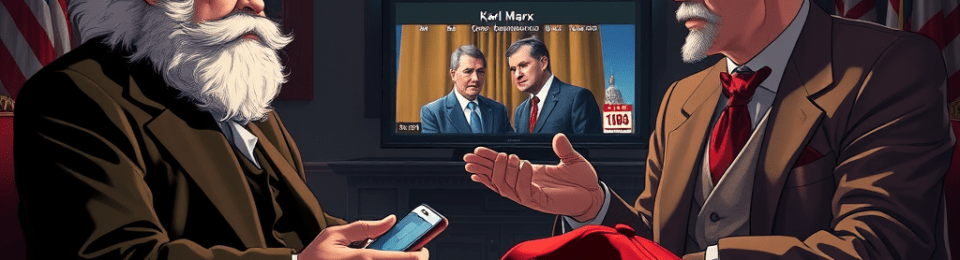
First to speak is the ever-displeased ghost of Karl Marx, who studies the spectacle with the expression of a man who has just discovered that capitalism has learned stand-up comedy.
“Fascinating,” he mutters. “The opiate of the masses has upgraded from religion to reality television. The workers cheer a billionaire who promises to defend them from…other workers. MAGA, you say? False consciousness in a baseball cap. The proletariat rallies behind a landlord who would happily charge them rent for the air.”
Marx pauses, scrolling further.
“And what is this? ‘America First.’ How charmingly nineteenth century. Imperial ambition dressed up as national therapy. Divide the workers internationally, convince them their enemies are migrants rather than billionaires, excellent strategy. I must admit, had I written this plot myself, critics would have called it unrealistic.”
Across the room sits historian Paul Kennedy, whose career chronicling the rise and fall of empires has left him permanently unimpressed by grand political promises.
“Empires,” he says dryly, “tend to collapse in two ways: they overspend, or they overestimate themselves. Preferably both.”
He gestures toward a glowing television screen.
“Tariffs on allies, scepticism toward NATO, fiscal theatrics, and political theatrics disguised as strategy. Classic symptoms of imperial fatigue. The trouble with shouting ‘greatness’ is that history often hears it as the opening line of a eulogy.”
The British Left: Sarcasm Served with Tea
From Britain comes a chorus of unimpressed Labour grandees.
Denis Healey leans back with the expression of a man who has watched politics long enough to develop a lethal sense of humour.
“Trump reminds me of certain Eton boys,” he remarks, “except most of them at least pretend to have read a book. MAGA’s vision of the world, superior nations, inferior ones, strong men everywhere, feels like colonial nostalgia with better marketing.”
He sighs.
“As for Europe, he’s treating alliances like crockery in a bullfight. Extraordinary really, decades building transatlantic partnerships, and now we’re watching them being dismantled by a man whose primary diplomatic instrument appears to be the capital letter.”
Nearby, the indomitable Tony Benn is considerably less amused.
“This is corporate feudalism dressed as populism,” Benn declares. “Power concentrated at the top while the language of democracy is used as decoration. A billionaire preaching rebellion against elites is rather like a fox organising a poultry union.”
He pauses.
“And the rhetoric about outsiders, migrants, and so-called inferiors? That is the oldest political trick in the book: distract the public with enemies while the powerful rearrange the furniture.”
American Presidents: Watching the House
Across the Atlantic, two former presidents look particularly perplexed.
John F. Kennedy examines the slogans thoughtfully.
“Ask not what your country can do for you,” he says slowly, “but apparently ask what your country can shout on social media.”
He shakes his head.
“Leadership once meant persuading the world to cooperate. Now it seems to involve persuading your own allies that you might abandon them if they don’t applaud loudly enough.”
Next to him, the blunt Texan presence of Lyndon B. Johnson offers a more colourful summary.
“Hell,” he says, “that man’s got the charm of a rattlesnake at a picnic.”
Johnson watches a rally clip.
“You don’t strengthen a country by telling half of it that the other half is the enemy. That’s not leadership, that’s political arson with a microphone.”
Women with Sharper Pens
The literary gaze of Virginia Woolf drifts over the spectacle.
“In this political universe,” she muses, “there seems to be a room of one’s own, entirely filled with mirrors. The narrative is loud but curiously empty, like a novel written entirely in capital letters.”
Then, with devastating elegance:
“One might forgive vulgarity in private life. In public life, it becomes a kind of aesthetic tragedy.”
Israeli stateswoman Golda Meir is less poetic.
“Strong leadership requires discipline,” she says. “Chaos is not strategy. If you constantly inflame fear and resentment, you eventually discover that they obey no one.”
Meanwhile, computing pioneer Grace Hopper peers at the situation like a programmer diagnosing a malfunction.
“This system has bugs,” she concludes.
“Input: fear, anger, and conspiracy theories. Output: division and institutional breakdown. If this were software, I’d recommend a complete reboot, and perhaps fewer people shouting at the keyboard.”
Rebels and Welfare Builders
Welsh nationalist hero Owain Glyndŵr laughs thunderously.
“A self-declared liberator who centralises power? I’ve seen that play before. Usually ends with someone building castles and calling them freedom.”
Meanwhile, the architect of Britain’s National Health Service, Aneurin Bevan, looks deeply unimpressed.
“In my day, we tried to build systems that cared for citizens from cradle to grave,” he says.
“Here we have grievance from cradle to grave. It’s cheaper politically, though not morally.”
Europe’s Pragmatists
Former German Chancellor Helmut Schmidt lights an imaginary cigarette and squints at the screen.
“Diplomacy,” he says, “should ideally involve thought.”
He gestures toward another headline.
“This appears to involve tweets.”
French president François Mitterrand adds with trademark Gallic irony:
“Nationalism always promises dignity. In practice, it usually delivers loneliness.”
The Global Moralists
South African icon Nelson Mandela speaks softly but firmly.
“Walls are easy to build,” he says. “Trust is much harder.”
“When leaders gain power by dividing people, they must continue dividing them to remain powerful. That is the trap.”
And finally, Irish wit Oscar Wilde cannot resist delivering the closing line.
“Mr Trump,” Wilde declares, “is a fascinating study in excess. Excess confidence, excess volume, and a remarkable shortage of irony.”
He smiles.
“Politics, like art, requires taste. Without it, one ends up with a very large golden frame and absolutely nothing inside.”
The Punchline History Keeps Repeating
In this imaginary gathering, the verdict is remarkably consistent. From revolutionaries to presidents, philosophers to poets, the reaction ranges from alarm to laughter, often both at once.
Yet the real irony lies elsewhere.
History is full of warnings delivered with impeccable clarity. The difficulty is that those who most need to hear them are usually too busy chanting slogans to listen.
And so the voices of the past continue to echo, dry, sceptical, occasionally hilarious, while the present hurtles forward, determined to rediscover lessons it once promised never to forget.
Discover more from GOOD STRATEGY
Subscribe to get the latest posts sent to your email.
 GOOD STRATEGY