
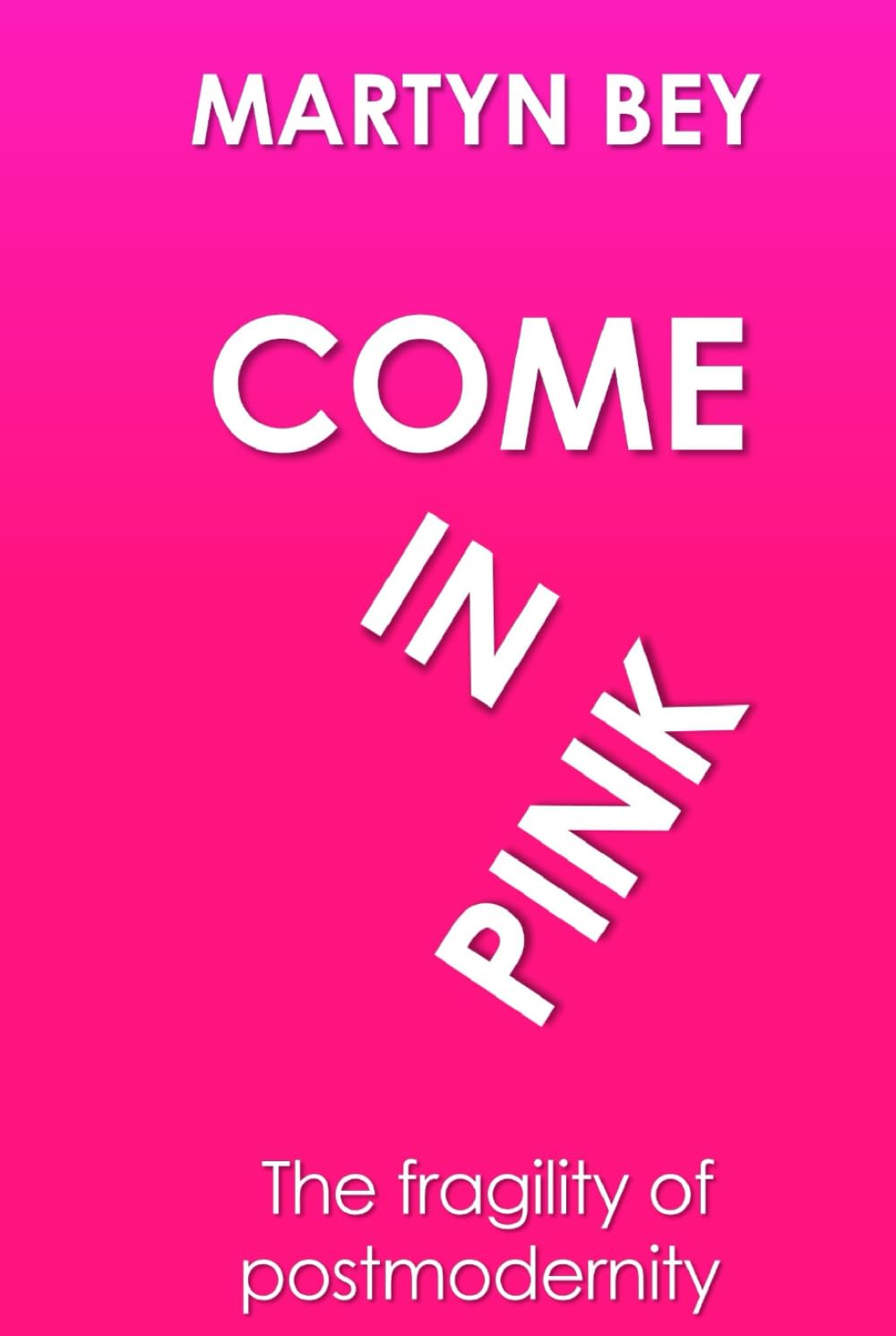
Come In Pink by Martyn Bey
By Vanessa Bell
To Begin At The Beginning – What To Say
To Begin At Tn the kaleidoscopic whirl of Martyn Bey’s Come In Pink: The Fragility of Postmodernity, we encounter a narrative that sashays defiantly between the sequined excesses of camp and the shadowed precipices of existential doubt. Published in 2025, this debut novel, framed as a “memoir” narrated by the irrepressible Lloyd Jones, arrives like a feather boa flung across the staid tables of contemporary fiction. Bey, a literary renegade with roots in Istanbul’s labyrinthine streets and Notting Hill’s velvet parlours, channels a voice that echoes the mischievous ghosts of Oscar Wilde and Kenneth Williams, while nodding to Orhan Pamuk’s intricate tapestries of memory and myth. Yet beneath the sparkle lies a poignant interrogation of postmodernity’s brittle facade, where truth fractures like a disco ball underfoot.
The book unfolds through Lloyd’s rhinestone-encrusted lens, a spectral guide who introduces himself with a flourish: “Man? Perhaps. But with a taste for souls, silk, and scandal.” What follows is a fragmented chronicle of mischief, memory, and mayhem, weaving Lloyd’s encounters with a cast of vivid eccentrics, chief among them the indomitable Jersey girl Karen Williams, a “glitter bomb of Brielle” whose sarcasm could “slice through reinforced emotional armour.” From kebab-slicked Istanbul alleys to the opulent drawing rooms of English country estates, the narrative pirouettes through erotic diversions, political diatribes, and surreal dream sequences. Chapters like “Jersey Girl” and “The Fragility of Postmodernism” blend Bruce Springsteen lyrics with philosophical musings on the demise of honour in Western politics, while “Wet Dream Sequence” and “Zipper Sex” indulge in unapologetic sensuality. It’s a portal, as the blurb promises, to the “outrageous and the outcast,” culminating in a thriller-esque climax involving shadowy intruders and a blood moon eclipse.
Here I Am – What Is Being Said
Bey’s prose is a tour de force of stylistic exuberance, marrying magical realism with biting wit. Descriptions shimmer with synaesthetic flair: mornings arrive “like a diva with too much perfume,” leaves dance as “gold-copper-green confetti,” and gems on Lloyd’s desk “pulse gently like they’re having an opinion.” This camp aesthetic, replete with sequins, show tunes, and spectral whispers, serves as both armour and lens, critiquing the “fragility of postmodernism” through irony and excess. Lloyd’s voice, part oracle and part showgirl, dismantles binaries: man/woman, reality/fiction, sin/salvation. In one bravura passage, he reflects on free will as “sin, but with sequins,” evoking a world where choice is “seasoned” rather than absolute. Here, Bey deftly engages with postmodern theorists like Baudrillard, whose simulacra haunt the novel’s media-saturated rants on social engineering and “digital witchcraft.” Yet the fragility extends beyond philosophy; it’s personal, embodied in relationships strained by jealousy, loss, and the “vacant, fruitless and futile adventure in the postmodern jungle.”
The novel’s strengths lie in its fearless embrace of ambiguity and its queer sensibility, which infuses even the darkest moments, unexplainable terrorism, and death threats, with a defiant sparkle. Karen emerges as a feminist iconoclast, her Jersey grit a counterpoint to Lloyd’s ethereal flamboyance, while supporting characters like Clare and Samantha add layers of complicity and sensuality. Bey’s erotic interludes, from “Prime Time Erotic Diversion” to “Chinois a Trois,” are rendered with breathless tenderness, refusing to shy from dark themes without moralising. This aligns with a broader critique of authoritarianism, in which “extremes despise subtlety” and rational discourse is dismissed as “drag act reactionaries can’t handle.” In an era of polarised politics, Bey’s invocation of Jimmy Carter as a “nice, decent man” scorned by hysterics feels prescient, a lament for nuance in a world of “emoji spells.”
Not All That Glitters is Gold
While Come In Pink dazzles with its vibrant energy and bold ambition, its postmodern fragmentation becomes one of its greatest strengths, weaving whimsical soliloquies and thrilling set-pieces into a dynamic, ever-shifting tapestry that keeps the reader delightfully off-balance, like a captivating cabaret performance full of surprises. Lloyd’s ruminations on gems, guitars, and ghosts brim with affectionate charm and poetic richness, inviting readers into a deeply personal and evocative world. The novel’s political threads are sharply insightful, landing with memorable, resonant aphorisms (such as the poignant nod that educating the mind without educating the heart is no education at all) that echo Feuerbach while adding fresh, heartfelt layers to the conversation. And though the magical realism enchants throughout, the resolution, culminating in a powerful, dramatic showdown, delivers an emotionally charged payoff that amplifies rather than diminishes the story’s tender fragility, leaving a lasting impression of both intensity and grace.
What Has Been Said
Comparisons to Gabriel García Márquez’s enchanted chronicles or Jeanette Winterson’s gender-fluid fabulism are apt, but Bey’s work feels uniquely attuned to our post-truth moment, where “freedom of expression is a costume party, until it’s not.” In blending outrage with tenderness, it resurrects the spirit of camp as resistance, much like Susan Sontag envisioned. For readers weary of earnest realism, this is a glittering dare: enter if you sparkle.
Martyn Bey has crafted a debut that pulses with life, lust, and lament, a love letter to misfits in a crumbling empire. Come In Pink may not resolve postmodernity’s riddles, but it invites us to dance amid the ruins. In these fractured times, that’s no small feat.
Discover more from GOOD STRATEGY
Subscribe to get the latest posts sent to your email.
 GOOD STRATEGY