
• Home
  • About
  • Strategy
    • Data Warehousing
    • Ask Martyn
  • Opinion
  • MARTYN
    • MARTYN’S MUSIC
    • Must-Read Books from Martyn
    • PODCASTS
    • MARTYN.ES

GOOD STRATEGY

~ THE STRATEGIES THAT WORK

GOOD STRATEGY

Category Archives: Big Data

Posts that contain a reference to Big Data

On Not Knowing Sentiment Analysis

12 Tuesday May 2015

Posted by Martyn Rhisiart Jones in Big Data, Big Data Analytics, Consider this, good start, goodstart, sentiment analysis

≈ Leave a comment

Tags

All Data, Analytics, aspiring tendencies in IM, awareness, good start, Good Strat, goodstart, Martyn Jones, Strategy

If you know all about Sentiment Analysis, you’ve come to the right place. Because I don’t have a clue if what I know about it is accurate or not.

I started to do a bit research into this Sentiment Analysis lark, in particular with the theoretical idea of using it to analyse and draw conclusions from comments on Pulse – assuming that this is what it can be used for.

To begin at the beginning, which is good place to start, I read the piece on Wikipedia, and this was how it began:

“Sentiment analysis (also known as opinion mining) refers to the use of natural language processing, text analysis and computational linguistics to identify and extract subjective information in source materials.

Generally speaking, sentiment analysis aims to determine the attitude of a speaker or a writer with respect to some topic or the overall contextual polarity of a document. The attitude may be his or her judgment or evaluation (see appraisal theory), affective state (that is to say, the emotional state of the author when writing), or the intended emotional communication (that is to say, the emotional effect the author wishes to have on the reader).” Source: Wikipedia Link:http://en.wikipedia.org/wiki/Sentiment_analysis

Well, that’s a fairly intuitive description. I could have almost have guessed as much.

But, back to the aim of analysing sentiment in Pulse comments, where to start and what to do.

What would sentiment analysis make of these:

On the death of an IT-business celebrity. What would sentiment analysis make of the very emotive comments of desolation, sadness and poignancy of people who didn’t personally know the departed, even remotely, or maybe didn’t even know of them until after they had ‘shuffled off life’s mortal coil’? How would that work? What would sentiment analysis make of the maudlin aphorisms, surrogate grief and bizarre sorrow of people separated by more degrees than Kofi Anan and Mork from Ork.  What additional insight does sentiment analysis tell us when these comments are analysed along with the body of the text and other comments that triggers these comments?

In a similar vein, how does sentiment analysis catch instances of sycophancy? Especially considering the fact that some of it is so ‘in your face’ and blatant that it often times seems to be a bad parody of a bad parody. “Oh, Ricky, why are you such a sexy brainbox?” How does it work in those situations?

Worse than that is the preening, gushing and obtuse texts of massive, errm… fabulators[i]. If it wasn’t about Big Data or Strategy or IT, it would be about something else, usually about the writer themselves. “I give Rafa and Rodge tips on tennis! I went to the University of the Universe and got a first! I challenged Superman to a race, and won! I have read the entire works of Dan Brown, 25 times…Neeeh!” What would sentiment analysis do with that sort of gold?

Also, what does sentiment analysis do with texts so ambiguously daft that they could mean anything? Okay, it might be able to pick up a few trigger words here or there, “rubbish”, “of”, “load”, “a”, “what”, etc. However, how does it know when “excellent” is being used in a way that means anything but excellent? For example, “Excellent Big Data job there”, with the silent “if you want a job doing properly then do it yourself”.

Finally, for the purpose of this little piece, what would sentiment analysis do with term abuse, if it could actually identify it? Going back to the use of the terms such as Big Data or Strategy, how can sentiment analysis discern between the dopey and wrong-headed use of the term, and when it is actually being used in a coherent, cohesive and consistent way, in line more or less with its formal definition? I suppose we can always write a mountain of rules to help us out:

If topic in focus of piece is strategy

And context of topic is business

And author of piece is Richard Rumelt

Then the credibility of text is good (with a certainty of 100%)

But you and try and maintain a rule base with isntances like that. It soon becomes a management nightmare.

Alternatively, maybe it could be used to analyse this text. It’ll have its work cut out, that’s for sure. Does sentiment analysis do sarcasm and cynicsm?

Anyway! I bet you might know how this sentiment analysis works, don’t you? On the other hand, if not, then it will be someone else who ‘knows’. But of course, all will not be revealed, because it’s a secret so powerful, that in the wrong hands it could be used to dominate the entire galaxy.

Only joking; and many thanks for reading.

[i]To engage in the composition of fables or stories, especially those featuring a strong element of fantasy: “a land which … had given itself up to dreaming, to fabulating, to tale-telling” (Lawrence Durrell).

lang: en_US

Big Data Tales: Bernice and the Martians

12 Tuesday May 2015

Posted by Martyn Rhisiart Jones in Big Data, Consider this, good start, goodstart, goostart, Martyn Jones

≈ Leave a comment

Tags

Big Data, big data analytics, good start, goodstart, Stories

Bernice and the Martians, BATM for short, were an incredibly popular progressive-rock band.

Their first big commercial success came with the release of their first album and their planned promotional tour, which took in all continents.

The manager of the band was none other than effable polymath, Renaissance man and good all-round rogue, Ricky Jonesy – an obsessive control freak, lover of fine wines and darling of predictive analytics. He really loved his numbers, his social media and his sentiment analysis.

In fact, much of the early success BATM came about due to Ricky’s unparalleled passion for the ‘Big Data’.

Ricky was the band’s architect. He had major input into their material: what they composed; how they composed; their stage sets and lighting; where they performed; the way they played; how they dressed; were photographed; spoke; walked; and, ate and drank. In short, he controlled the whole BATM enchilada. It was like being in data-driven heaven.

As I said, their first album, a progressive-rock masterpiece called ‘Your Hole’, achieved major critical acclaim even before it was bolting out of the stalls and across the interwebs. Overnight the band became big property, and their notional market value ran higher than Twitter on steroids.

The band members were really please. The presses interviewed Bernice right, left and centre and he made no bones about the fact that a major part of their success was due to Ricky and his Big Data mojo.

Articles about the phenomenon appeared in all the major social media sites. Facebook, LinkedIn and BubbaToons. Ricky was named Supreme Data Scientist of the year by the Gardener Group, hailed as a messiah by the Big Data Front and lauded by all and sundry.

Then the band went on tour. Blazing a trail of ones and zeros across the face of the planet.

They were 5 gigs into their tour and Ricky decided to call a band meeting.

“Hi, guys” said Ricky “I’ve been analysing the stats, and I see that those yokes Big Blokes in Tights are trending strongly on the social media, coinciding with the release of their new single Never Stick A Banger In Your Ear”.

“Oh, whoa” chimes in Bernice, “tell us what we gotta do then, Ricky”.

Back comes Ricky. “Well, this is what I thought we might do”

“We take the old Fester and Ailin song Tropical Diseases, we practice it as much as can, and then we play it at the next gig in Birmingham, this weekend”

“But, Ricky!” pipes up Marty Smarty, “it’s an Irish country and western song. It doesn’t fit in with what we do, does it? And, anyway, we only have three days to get it prepared.”

Ricky responds. “Ah, you don’t want to be worrying your little head over that. Trust me. Learn the song. It’ll be great. The public will love it.”

So, BATM learn the song. It’s perfect. At the Saturday gig, they play it as the encore. The fans love it to bits and there’s not a cold cigarette lighter in the place.

Then they fly off to Palma de Mallorca for a bit of a rest before their next gig in Madrid.

The guys and gals are lounging at the poolside at the legendary Don Pimpón Espinete Plaza complex. The weather is glorious, the food is glorious, the scenery is glorious, and even the orchestra is glorious.

Then along comes Ricky, calling yet another band meeting.

“Hi, guys” said Ricky “I’ve been analysing the stats again, and I see that those yokes Spanky’s Magic Piano are trending strongly on the social media with their cover version of Engel Humpadink’s The Monkey Song”

“Oh yeah, what’s that mean for us, Ricky” chimes in Halo Popette, the bands keyboardist.

Back comes Ricky. “Well, this is what I thought we might do”

“We take the old Fester and Ailin song There’s A Dead Man Up The Chimney, and we rewrite it in the style of Tom Jones when he made that album of his, Little Fockers, was it? Then we practice it as much as can, until it’s perfect, and then we play it at the next gig in Madrid, this weekend”

“But, Ricky!” pipes up Brian McGarsical, “It’s a bit of an odd one isn’t it? I mean to say, it doesn’t fit in with what we do, does it? And, anyway, we only have four days to get it prepared.”

Ricky responds as fast as a chalked-up cat going down a drainpipe. “Ah, you don’t want to be worrying your little head over that. Trust me. Learn the song. It’ll be great. The public will love it. And anyways, it will fit nicely on the playlist, up there with Tropical Diseases.”

The band rewrite the song, and practice the Bedejaysus out of it. Ricky likes it so much that he gets the stats to confirm that this has to be number one on the next gig playlist.

Come the day of the gig, and BATM kick off, not with a progressive-rock anthem, but with There’s A Dead Man Up The Chimney. A group of young people at the front clearly are loving this new sound, but quite a few people are starting at the stage in fright, and it’s not from skunk induced paranoia either.

Two guys are having a conversation at the back of the hall.

“Yo, lunchbox, hurry this gig up, I thought this band was all progressive-rock and stuff, not this wiener schnitzel stuff.”

“No comment.”

Having divided the crowd with their first song, they play songs from their album. Again, they encore with Tropical Diseases. The crowd at the front go wild. The progressive rockers look on, bemused.

“Well, that was a mixed bag” says Bernice.

“Take it from your man Ricky. It all went fine lads. Just needs some fine-tuning of the songs and the analytics need to be a bit more real time. Take me word for it.”

Back comes a unison of “Okay, Ricky. We believe yas!”

So, off they go to Bonn, to prepare for the following weeks gig at the Live Music Hall in Cologne.

The band goes out visiting the museums, they have lunch at Brauhaus Bonnsch, and after a leisurely walk along the banks of Rhine they are taking a beer or three in a lovely little beer garden close to the United Nations campus.

Then out of the blue, a familiar voice can be heard.

“Hi, guys! We’re all goin’ on a summer ‘oliday”. It’s the voice of Ricky. “Anyway, Good news guys. I’ve been analysing the amazin’ Big Data stats again, and I see that those mensch Die Zahnarzt are trending strongly on the social media, especially on Swotter and Titter, with their amazon’ cover version of Podge and Rodge’s chillout mix of Currywurst and Microchips.”

Silence. No one says a word for the best part of infinity.

Ricky continues… “As you’re not going to ask, lads, I’ll tell you. We take the old song A Great Day for the Washing, and we rewrite it in the style of techno-Buddah-bar-chill. Then we practice it as much as can, until it’s perfect, and then we bang it out at the next gig in Cologne, this Friday. Innit. Come on lads, it’s 20 minutes of stage magic, and it’s a breeze.”

Come the day of the gig, and the band arrive early at the hall. Ricky is already there. He’s changed the stage set completely and has a new wardrobe for the lads – Bavarian romantic. They’ll soon be all Princed and Smiley Virused up to the eyeballs, wrecking ball included.

and BATM kick off, not with a progressive-rock anthem or chill, but again with There’s A Dead Man Up The Chimney. Again, a group of young people at the front clearly are loving this new sound, but quite a few people are starting at the stage in drug induced awe. Then they follow that up with A Great Day for Washing. By the time they get to the encore of There’s A Dead Man Up The Chimney, boisterous arguments are breaking out everywhere and empty crisp packets and used sticks of chalk are being thrown at the stage. It’s a disaster.

Four guys are having a conversation at the back of the hall.

“I liked the first song”

“No! The first was terrible. Minging! I want my prog rock back.”

“It’s like the choice of leprosy or the plague.”

“Down with this sort of thing.”

Next day Bernice calls an urgent meeting of the band.

Ricky kicks off.

“Well, lads bit of mid-week game yesterday wasn’t it?”

Bernice comes back with a “You can say that again, Rick”

“Don’t worry, I have analysed the social-media Big Data from all of the concerts, and we’re doing good guys. It’s in the analytics”

“We have to go back to our roots and drop all the changes we made”

A stranger in the lounge where they are having the meeting walks up to them and in simple language explains to them what has happened.

“You created a great product, a great brand, with some interesting progressive music”

“Your music was acclaimed and your world tour was eagerly anticipated by all your fans”

“But then you went wrong”

“You became data driven, dopey and data driven”

“You chased fads, tendencies and styles, and it became a mish-mash”

“People don’t want mish-mashes. Not your base. They wanted good progressive music”

“You’ve lost all credibility. No, you’re just an eccentric band of brothers and sisters that no one will really want to see more than once, if at all”

“Your former fan base is acutely embarrassed by you. That’s your bread, butter, vodka and caviar… in your terms”

“Data drive, Big Data, Big Data analytics in real time?”

“You people have no idea the damage you can do, and so easily”

To be continued…

Many thanks for reading.

Consider this: The Big Data Workout

01 Friday May 2015

Posted by Martyn Rhisiart Jones in Big Data, Consider this, good start, goodstart

≈ Leave a comment

Tags

Big Data, Consider this, data architecture, data management, good start, goodstart, Martyn Richard Jones, Stories

To begin at the beginning

Miss Piggy said, “Never eat more than you can lift”. That statement is no less true today, especially when it comes to Big Data. Continue reading →

Consider this: Taming Big Data

01 Friday May 2015

Posted by Martyn Rhisiart Jones in Big Data, Big Data Analytics, Consider this, Good Strat, goodstart

≈ 2 Comments

Tags

accountability, Consider this, good start, goodstart, Martyn Richard Jones

Simply stated, the best application of Big Data is in systems and methods that will significantly reduce the data footprint.

Why would we want to reduce the data footprint?

  • Years of knowledge and experience in information management strongly suggests that more data does not necessarily lead to better data.
  • The more data there is to generate, move and manage, the greater the development and administrative overheads.
  • The more data we generate, store, replicate, move and transform, the bigger the data, energy and carbon footprints will become.

Continue reading →

Sexing up Big Data’s Dodgy Dossier

20 Friday Mar 2015

Posted by Martyn Rhisiart Jones in Big Data, Consider this, good start, Good Strat, goodstart, Martyn Jones

≈ Leave a comment

Tags

Big Data, good start, goodstart, Martyn Jones, Martyn Richard Jones

Most of us would probably like to work in a profession recognised for its legality, decency and honesty. At least I hope so. In my line of work, what we have right now is palpable evidence that the IT industry lacks a moral compass.

Imagine this. A major sensationalist tabloid pulls together a team of diverse journalists who are set to work on a national campaign to promote very high usage of sunbeds as a cure for cancer. Why? The newspaper owner’s son owns the sunbed franchise.

The health experts criticise the publisher for being irresponsible, unprofessional and lacking in scruples.

Continue reading →

The Biggest Contradiction of Big Data

20 Friday Mar 2015

Posted by Martyn Rhisiart Jones in Big Data, Consider this, good start, goodstart

≈ Leave a comment

Tags

Big Data, contradictions, data management, good start, Good Strategy, goodstart, Martyn Jones, Martyn Richard Jones

I have written at length about the fundamental contradictions of Big Data, but what I have omitted in the past is quite possibly the biggest contradiction of all. Probably because it has more to do with how Big Data is continually hyped, rather than having anything to do with Big Data as a bag of technologies – which has a whole assortment of problems in its own right.

Last time I spoke with you about the contradictions of the Big Data it was about the three Vs of volume, variety and velocity. In general, it was a view that was well received, even if not widely understood. Which of course is close enough for government work. But, get ready for “something completely different”.

If on the one hand some folk can claim that Big Data provides fact based insights and reliable forecasts of future habits, trends and preferences, then why is it so difficult to produce and socialise – yes, I like to use that term – Big Data success stories?

In short, I think we have arrived at the stage in Big Data’s cycle where it is reasonable to ask pundits to either put up or shut up.

So, why aren’t the current Big Data success fables accompanied by facts, such as names of those involved (at least businesses), the sponsors, the suppliers, the purpose of the exercise, the desired outcomes, the data used, how it is processed, what the results were, and what tangible benefits, if any, were accrued or are accruable. If that is not enough, then let people mention the technology used, the products purchased or licensed and the methodology followed.

In short, what I would like to know is why are the evangelists of Big Data telling us that bigger data is better, that more variety leads to greater insight, and that velocity is king. Why do we we told that Big Data almost assuredly results in better decisions, by people who are coy, shy or secretive about almost facts and data coming out of Big Data projects?

I have been reminded, time and time again, that there are Big Data success stories out there, and I have even been told that this information would be fully shared with me once it was agreed with the ‘clients’ that it was okay to do so. Okay, that’s fine, I know Big Data is a roaring success story (at least in people’s minds,) and I also know that it takes some time to make things up – some people are just not creative. Sure, I was told about these ‘successes’ some time ago, and you know, I’m not expecting anything that’s worth shaking a stick at, either now or later, but I’m still waiting, boys. Notwithstanding, you will still called you out as vacuous bullshitters when the time comes.

“But” I hear you cry “there is a wealth of success stories in the presses”.

Well, no, and you would wrong and gullible and foolish to think, but that is your problem, but unfortunately also mine, because this is my profession that you are playing fast and loose with.

The fact is that there is “wealth” of content that people try and pass off as legitimate Big Data success stories, but they aren’t in fact success stories, in any way, shape or form.

The thing is, people may read the blog title and even the stand-fast, but will be less inclined to actually read the article, so what remains is the impression that there are ‘loads of Big Data success stories’. But if people actually read the articles and were intelligent enough to understand them, then they would realise that inevitably there is a massive mismatch between the title of these pieces and the content. Indeed, if these pieces were actually pieces of advertising, rather than blog comments, they would be denounced in some jurisdictions for not fulfilling the advertising criteria of legal, decent and honest.

There is one more thing that Big Data evangelists (or any self-styled pundit, guru or expert for that matter) should understand, internalise and remember. If you say that you have a Big Data success story, with all the details, and that isn’t in fact the case, and it isn’t even remotely a success story or even true, then you are simply lying, and that’s deceit, it’s unprofessional and it’s unethical, and you are a scoundrel. So live with or fix it, the choice is yours.

Many thanks for reading.

Big Data’s Virtuous Circus

20 Friday Mar 2015

Posted by Martyn Rhisiart Jones in Big Data, Consider this, data management, good start, goodstart

≈ Leave a comment

Tags

Big Data, data architecture, data management, good start, Good Strat, Good Strategy, goodstart, Martyn Jones, Martyn Richard Jones

Many people come up to me in the street and ask me what Big Data is all about. It has happened to me so many times in the past that I am convinced that it might just happen to you as well. I know sort of thing, I read the Big Data tealeaves. Nothing gets past me.

The first time a complete stranger came up to me in public and said “Hello, will you tell me what this Big Data lark is all about then?” I was lost for words, you just ask my Aunt Dolly, he can vouch for that, no problem. Later that day I read a book – it was my dad’s book – and I then decided to adopt a strategy.

Therefore, in the spirit of springtime goodwill to all men and women, I have put together this blog piece in that hope that it will enlighten, help and entertain.

What is big data?

Big Data can be characterised by the 10 Vs – yes, 10, not 4. Which, in my book, is more than enough to bring up-to-speed the average Big Data John or Jane that one meets on the street, and who naturally wish to be informed of such matters.

In layperson’s terms this a series of landmarks and pointers in the analytics space used to frame and guide the didactic aspects of Big Data.

The fundamental Vs of the Big Data canon are these:

  • Vagueness
  • Volume
  • Variety
  • Virility
  • Velocity
  • Vendible
  • Vaticination
  • Voracity
  • Vanity

So, let me now explain what each of these characteristics mean to those who might know and for those who might want to know.

Vagueness: This is perhaps the trickiest of questions to address, given the vast panorama that is cast before this incredibly complex yet easily graspable concept. But let me state this, and let there be no mistake about it. At this point in time, what makes Big Data vague is also what makes Big Data specific, explicit and certain. That is to say, in order to ‘come to an understanding’ of Big Data, it is necessary to completely embrace the dialectic of knowing the unknowable. So belief is an absolute essential element – belief and data, that is.

Volume – If there ever was a time to “pump up the volume”, we have it here with Big Data.

Big, voluminous, gorgeously rotund and infinite. Big Data is called Big Data because there is a lovely, roly-poly, likeable never-ending load of it. Its volumes can be measured in zeta-bytes, which you can be assured, is a helluva lot of data.

Variety – As they might say down my way, “variety is the spice of life, innit”. This is what makes Big Data so special. So appealing.

Because before Big Data there was absolutely no variety in anything, at all. We lived in a bland world, bereft of detail, nuance and diversity. Nothing could be measured, analysed or explained, because we lacked Big Data. We were ignorant. So ignorant and stupid that we couldn’t see the sense of putting the diapers next to the beer, or of offering three for the price of two.

Fortunately, today this is no longer the case if we don’t want it to be, and thanks to Big Data we have a veritable sensorial explosion. No longer is IT just a couple of symbols scribbled in crayon on someone’s school notebook.

Virility – Move over Smart Data, the new kid on the block is Big Data.

If Big Data were described in the manner of a religious text, it would be accompanied by a never ending narrative of begets.

So, what does that mean?

Simply stated, Big Data creates itself, in and of itself. The more Big Data you have, the more Big Data gets created. It’s like a self-fulfilling prophecy in 360 degree, high-definition, poly-faceted and all-encompassing knowing. The sort of thing that governments would pay an arm and a leg to get their mitts on.

Velocity – Velocity is of the essence. Velocity kills the competition. More velocity, less haste.

We demand that service is ‘velocious’. ‘Everything’ must be ‘now’, or it’s too late.

This means we need to be able to handle Big Data at velocity – at the speed of need.

Charles Babbage once stated (or maybe it was more than once) that “whenever the work is itself light, it becomes necessary, in order to economize time, to increase the velocity.”

But remember, we are dealing with mega-velocity here, so don’t drink and drive the Big Data Steamship, Star-ship or Mustang.

Vendible – If you can sell it, and sell it as Big Data, then it ‘is’ Big Data. If you can’t, then it’s not. The saleability of Big Data proves its existence.

So, what are the vendible aspects of Big Data?

Let’s leave that easy question for another day. But for now I can confidently state that it is used to mobilise armies of commentators, industry analysts, publicists, punters, writers, bloggers, gurus, futurologists, conference organisers, conference speakers, educators, customer relationship managers, salespeople, marketers and admen.

Vaticination – Edmund Burke is down on record as stating that “you can never plan the future by the past”. Now Burke may have been a clever person when it came to many things, but he wasn’t exactly a whiz when it came to Big Data.

There are people in the world who are in no doubt that Big Data provides the sort of visionary and predictive powers only previously obtainable through ritual sacrifice, magic potions and the casting of spells. Others are highly critical of the understatement implicit in this belief.

For many, Big Data will make the Oracle of Delphi look like a mere call centre.

This is why the power of vaticination plays a characteristically important role in the world of Big Data.

Voracity – This is based on the quasi-rationalist argument that Big Data is big and it has an omnipresent and insatiable self-fulfilling desire.

Big Data comes with an attendant requirement for hardware, even if it is a whole load of consumer hardware tacked together in a magnificent and miraculous mesh of magic.

Big Data can be characterised by voracity, but this comes hand in hand with the ‘ventripotent’ IT industry.

Veracity – The eminence of the data being captured for Big Data handling can vary significantly. The quality or lack of quality of the data naturally has the potential to impact the accuracy of analysis using that data.

Before Big Data arrived on the scene we knew nothing about Data Quality or data verification. This is why ETL and Data Cleansing tools lacked the power to effectively quality check and verify data, to ensure that any erroneous or anomalous data was rejected or flagged.

But now, with the sophistication of tools such as ‘grep’ and ‘awk’ at our disposal, we have the power in our hands to ensure nothing ‘dodgy’ gets into the analytical mix.

Vanity – In my opinion, to fully grasp the underlying and profound meaning of Big Data, it is essential for us to understand the difference between vanity and conceit. Max Counsell claimed that “Vanity is the flatterer of the soul”. Goethe characterised vanity as being “a desire for personal glory”. After an incident with an Anarchist (presumably a Big Data Anarchist), Blackadder remarked to Baldrick that “The criminal’s vanity always makes them make one tiny but fatal mistake. Theirs was to have their entire conspiracy printed and published in plain manuscript”.

That’s all folks!

So that ends the brief rundown of the defining characteristics of Big Data.

So, to summarise. That, which has passed before, necessarily divulges both the upside and downside of Big Data. By reaching out, opening up the kimono and relating the 10 Vs we are disclosing that which cannot be disclosed, exhibiting the absence of essential essence, and thereby opening up the entire field, discipline, profession, science and art to examination, questioning and ridicule.

Many thanks for reading.

Consider this: Big Data Forever!

14 Saturday Mar 2015

Posted by Martyn Rhisiart Jones in Big Data, Consider this, dark data, Martyn Jones

≈ Leave a comment

Tags

Big Data, Good Strat, Good Strategy, Martyn Jones, Martyn Richard Jones

Dans ce pays-ci, il est bon de tuer de temps en temps un amiral pour encourager les autres – Voltair

My gran used to tell me that honesty pays. Of course, she never really understood banking or IT, probably because she didn’t want to know anything about them, and she never lived to witness the amazing hype circuses, the spin doctors spiel or the focus-group dog-and-pony show of the 21st century. Indeed, if honesty were a guaranteed payer my gran would have amassed more wealth than even Warren Buffet himself.

If my gran lived today, she might reflect on what Big Data might be about – maybe she would even consider it benignly, as a sort of shelter for fallen men of once uncertain virtue. We will never know. So onwards and upwards.

The Harvard Business Review contemplated honesty in somewhat different terms:

“Honesty is, in fact, primarily a moral choice. Businesspeople do tell themselves that, in the long run, they will do well by doing good. But there is little factual or logical basis for this conviction. Without values, without a basic preference for right over wrong, trust based on such self-delusion would crumble in the face of temptation.”

In a marvellous book, A few good from Univac, David E. Lundstrom narrates the story of Sperry Univac in the 1960s, one of the true great innovators in the first forty years of IT, and includes an allegory taken from the engineering front-line. I will recount it here, edited to highlight the zeitgeist, for your entertainment and as Voltaire put it, “to encourage the others”:

In the beginning was the Big Data Plan.

And then came the Big Data Assumptions.

And the Assumptions were without form.

And the Plan was without substance.

And darkness was upon the face of the Workers.

And they spoke amongst themselves, saying: “It is a crock of shit, and it stinketh.”

And the workers went unto their Supervisors and said: “It is a pail of dung, and none may abide the odor thereof.”

And the Supervisors went unto their Managers, saying: “It is a container of excrement, and it is very strong, such that none may abide by it.”

And the Managers went unto their Directors, saying: “It is a vessel of fertilizer, and none may abide its strength.”

And the Directors spoke amongst themselves, saying to one another: “It contains that which aids plant growth, and it is very powerful.”

And the Vice Presidents went unto the President, saying unto him: “This new plan will actively promote the growth and vigor of the company, with powerful effects.”

And the President looked upon the Big Data Plan, and saw that it was good.

“But?” I hear you say, “why fight it, why not take advantage of the Big Data zeitgeist?”, “Why not cash in on the grand bonanza Big Data bandwagon?” or “Monetise the 3 three famous Vs of Big Data?”

Well, it had crossed my mind, briefly, and (outside of the USA) we’ve all done stuff we have not entirely believed in, so the temptation to cash in is present, capisci? This paraphrasing of a piece from My Blue Heaven might give you a better idea:

One of my best friends makes his living as a completely phony Big Data Scientist. For two hundred bucks he can make you a Data Scientist or a Big Data guru. Some guys give you an education but this guy gives you immediate access to high paying jobs, sex that would make the 256 trillion Shades of Blah blush and a life in the City, the Big Apple or a small town in Germany.

Moreover, for an extra 250 bucks (limited time offer) you can also become a certified Big Data Neuro Trainer, which will allow you to do unto others what has been done unto you.

I also considered Big Data Brokerage, Big Data Certification and Big Data Independent Trading (New York – Paris – Peckham). The opportunities are immense.

However, what happens when the Big Data well runs dry, and I (and many others get tarnished with the mark of Big Data) become pariah by complicity, collusion or simple association?

That question I will leave for another day. But just consider the following.

All right, I admit, I am a big long-time fan of comic genius Mel Brooks, who has a knack of capturing deep insight from the human condition, especially when the human condition is off guard and shallow. In that vein, this is how I like to think the dialogue from the Dole Office scene from The History of the World Part Two would have gone, if he were to write that today:

Dole Office Clerk: Occupation?

Data Magnus Comicus: Stand-up Big Data scientist.

Dole Office Clerk: What?

Data Magnus Comicus: Stand-up Big Data scientist. I coalesce the vaporous datas of the human interaction with the social-media networking, Internet of Everything, and always-connected experience into a… viable, analytical and meaningful predictive-comprehension.

Dole Office Clerk: Oh, a Big Data bullshit artist!

Data Magnus Comicus: *Grumble*…

Dole Office Clerk: Did you bullshit Big Data last week?

Data Magnus Comicus: No.

Dole Office Clerk: Did you try to bullshit Big Data last week?

Data Magnus Comicus: Yes!

Finally, I leave you with some wise words from Israeli American professor of psychology and behavioural economics, Dan Ariely:

“Big data is like teenage sex: everyone talks about it, nobody really knows how to do it, everyone thinks everyone else is doing it, so everyone claims they are doing it…”

Many thanks for reading.

STRAIGHT TALK: Consider this: Big Data and the Curse of the Temple of Java

13 Friday Mar 2015

Posted by Martyn Rhisiart Jones in agile, Big Data, Consider this, java

≈ Leave a comment

Tags

agile, Big Data, java, refractor

r019

“Rats, rats for sale. Get your rats. Good for rat stew, rat soup, or the ever-popular ratatouille”. – Mel Brooks

Hold this thought: Everything that the Templars of Java touch turns to dreck.

In a small and timeless village in misty and mountainous Transylvania, the locals mourn the passing of yet another victim.

On the wind swept beaches of a wintry Costa Blanca, the reverberating voice of childish despair is barely perceptible through the crashing of the waves on the grey, cold and craggy rocks.

In Victorian London, a hobgoblin of indescribable and vacuous insanity stalks the silent and rain drizzled streets.

Cracking this curse will take more than the combined powers of Clint Eastwood, Mel Brooks and Homer Simpson.

A spectre haunts the face of Europe, the spectre of Big Data and the Curse of the Temple of Java.

Everything that the disciples of the Temple touch turns to blah. Everything that the disciples call their own has been blagged from elsewhere.

Take the very language of Java itself, an authentic eccentricity amongst computing languages. If Java code were real coffee grains, it would be used to make the shittiest coffee in the history of humankind.

Given the vast amounts of knowledge and experience that was washing around IT at the time of Java’s hatching, it must be considered to be the most demonic aberration of a programming language ever conceived by woman, man or beast.

“Cats have a scam going – you buy the food, they eat the food, they go away; that’s the deal.” – Eddie Izzard

If ever there was an excuse in IT for failing to deliver or for delivering badly and late, then Java is your friend.

In the hands of the right people, Java can turn a one year and $3M project into a five year and $300M project, and still not deliver anything of use.

Yet magically, and out of the people directly responsible for these debacles, no one is sacked, sued or busted as a result, the incumbent supplier either quietly leaves the scene or is rewarded for their gross incompetence and dishonesty, and in many cases a success is hailed, even if that success looks remarkably like abject failure. It is totally false, absolutely dishonest and thoroughly unprofessional. But that’s what we have, like it or not.

Java sucks, it is a horrid language, aesthetically and functionally, it’s a piecemeal pile of do-do, a dirty old ragbag of ‘object-oriented’ hacks, logical aberrations and lagoons of missing structure, dysfunctional rationality and discontinuity – and that that’s not just my opinion:

“I spent several months programming in Java. Contrary to its authors’ prediction, it did not grow on me. I did not find any new insights – for the first time in my life, programming in a new language did not bring me new insights. It keeps all the stuff that I never use in C++ – inheritance, virtuals – OO gook – and removes the stuff that I find useful.” – Alexander Stepanov

“Claiming Java is easier than C++ is like saying that K2 is shorter than Everest.” – Larry O’Brien

“I would rather use Java than Perl. And I’d rather be eaten by a crocodile than use Java.”

“If I wanted plastic scissors I’d use Java. Give me my scalpel back.”

And for the record, even Linus Torvald hates it.

But if you thought Java was a horrid, hype infested viper’s den of programming bad practice and hyper-hype, just wait until you see what’s behind Hadoop.

As long as the world is turning and spinning, we’re gonna be dizzy and we’re gonna make mistakes. – Mel Brooks

Hadoop must be the biggest piece of technical and rhetorical bullshit in the history of data management.

Repackage a series of Unix primitives (cat, grep, awk, cut, sed, wc) built on top of parallel Linux or Unix. Dress it up, take it out on the town, and call it the greatest thing since sliced bread. It is nothing less than a brazen and blatant con. Want to count words? Use wc (Unix wordcount).

Let me repeat that, using other words. If you made a compilation of extracts from the works of the world’s greatest thinkers and authors, randomised replacement of some of the words, and produced and published this compilation, as all your own work, what would you call that?

So back to when this happens, frequently, in IT.

This might fool the foolish who don’t have the first idea about anything technical, objective or rational beyond whatsapp, kiddy scripting and HTML, but if you have a clue, you know that this is a scam, a very big one. It is also dishonest.

So how do they (the scammers) get away with it?

Easy. You have bad apples everywhere. But there is another reason. For well over a decade the world of IT has become the dumping ground for the stupid, lazy and indolent kids of the comfortable middle-classes and also a hunting ground for unscrupulous wide-boys.

Listen up parents!

Do you think that your kid is way too thick to be a doctor, scientist, lawyer, researcher, professor, teacher, statistician, health worker, politician, bus driver, street cleaner, entrepreneur, sandwich maker or economist?

Your kid has no creativity beyond messing with their food?

Your kid has no sporting ability apart from skills at gaming?

The only academic ability your kid has is your money?

No worries!

IT for you, my son!

So if that’s you, then lap it up. Real knowledge and experience will not come your way, but you will learn the dogma of the Temple of Java, and you will be able to repeat it to perfection, just like Pavlov’s favourite dog.

You will learn to be be pliable, usable and even more gullible. You will know bugger all about practical IT or the architecture, evolution and application of information technology and data, and vendors will love you for it, for you will be just an extension of their idea of increasing the profit rate.

This is how IT business has become the refuge of liars, cheats, pimps and the chronically dopey, and this is why Java and Hadoop have become the ultimate expression in programming and data. It’s a geeky Greek tragedy being played out as we speak. O tempora, o morons.

But it isn’t just about Java and Hadoop. Everything the Templars of Java touch turns to dreck. Whether we are looking at aberrations and failures in rapid joint application development, end user computing, database design (refractor this, dimwits!), or solutions and domain architecture, and more, the dead cold hand of the Java Mafia is invariably behind it.

And now, to top it all off, the miserable Templars of Java want to take over and displace Bill’s Data Warehousing. You couldn’t make it up.

So, who will save the IT world from the evil doers?

To paraphrase Homer Simpson: I’m not normally a praying man, but if you’re up there, please save us, Wonderwoman.

Thank you so much for reading.

What’s all the fuss about Dark Data? Big Data’s New Best Friend

10 Tuesday Mar 2015

Posted by Martyn Rhisiart Jones in All Data, Big Data, Consider this, dark data, Good Strat

≈ Leave a comment

Tags

All Data, Big Data, dark data, data architecture, data management, Good Strat, Martyn Jones, Martyn Richard Jones

What is Dark Data?

Dark data, what is it and why all the fuss?

First, I’ll give you the short answer. The right dark data, just like its brother right Big Data, can be monetised – honest, guv! There’s loadsa money to be made from dark data by ‘them that want to’, and as value propositions go, seriously, what could be more attractive?

Let’s take a look at the market.

Gartner defines dark data as “the information assets organizations collect, process and store during regular business activities, but generally fail to use for other purposes” (IT Glossary – Gartner)

Techopedia describes dark data as being data that is “found in log files and data archives stored within large enterprise class data storage locations. It includes all data objects and types that have yet to be analyzed for any business or competitive intelligence or aid in business decision making.” (Techopedia – Cory Jannsen)

Cory also wrote that “IDC, a research firm, stated that up to 90 percent of big data is dark data.”

In an interesting whitepaper from C2C Systems it was noted that “PST files and ZIP files account for nearly 90% of dark data by IDC Estimates.” and that dark data is “Very simply, all those bits and pieces of data floating around in your environment that aren’t fully accounted for:” (Dark Data, Dark Email – C2C Systems)

Elsewhere, Charles Fiori defined dark data as “data whose existence is either unknown to a firm, known but inaccessible, too costly to access or inaccessible because of compliance concerns.” (Shedding Light on Dark Data – Michael Shashoua)

Not quite the last insight, but in a piece published by Datameer, John Nicholson wrote that “Research firm IDC estimates that 90 percent of digital data is dark.” And went on to state that “This dark data may come in the form of machine or sensor logs” (Shine Light on Dark Data – Joe Nicholson via Datameer)

Finally, Lug Bergman of NGDATA wrote this in a sponsored piece in Wired: “It” – dark data – “is different for each organization, but it is essentially data that is not being used to get a 360 degree view of a customer.

Say what?

Okay, let’s see if we can be a bit more specific about the content of dark data?

Items on the dark data ticket include: Email; Instant messages; documents; Sharepoint content; content of collaboration databases; ZIP files; log files; archived sensor and signal data; archived web content; aged audit trails; operational database backups – full and incremental; roll-back, redo and spooled data files; sunsetted applications (code and documentation); partially developed and then abandoned applications; and, code snippets.

Most importantly, dark data is data that is not actively in use, is underutilised, or is something else. Seriously.

What can you do with it?

So, the conclusion that some have come to is this: there is a vast collection of data in various formats waiting to be monetised.

Personally, the idea that really grabs my attention is the potential ability to do novel forensic research on email. If only to find out what happened in the past.

For example, maybe it would be fascinating to see how significant challenges were identified, flagged and discussed; how strategic responses to those challenges were formulated, chosen and executed; and, how the outcomes of all of that process were reflected in email communications.

I think that this line of work can be very interesting for some people, and that interesting insights may be uncovered, but I would hate to have to put a tangible value on it, if only to avoid adding to the already galactic magnitudes of nonsense and hype surrounding certain data topics.

There are other more mundane uses of dark data.

Imagine that you are just about to embark on a Data Warehouse project (you really are a late adopter aren’t you), and you want establish a base collection of historical data. Where do you get that historical data from?

Right! Operational databases are not characteristically used to store significant amounts of historical reference data and historical transactions beyond a certain time window; there are performance and other reasons for keeping OLTP systems as lean as possible, so, initial loads of historical data is typically recreated in the Data Warehouse from backups, audit trails or logs.

Dark data and data governance

You don’t need a Chief Data Officer in order to be able to catalogue all your data assets. However, it is still good idea to have a reliable inventory of all your business data, including the euphemistically termed Big Data and dark data.

If you have such an inventory, you will know:

What you have, where it is, where it came from, what it is used in, what qualitative or quantitative value it may have, and how it relates to other data (including metadata) and the business.

What needs to be kept, and for how long, and what can be safely discarded, and when.

The risks associated with the retention or loss of that data.

If you don’t have such a catalogue and have never done a data inventory then a full data inventory and audit seems to be your new best friend.

What does it mean?

Simply stated, you may have dark data that has value, or it may be a simple collection of worthless digital nostalgia. But if you don’t know what you have, it may pay to find out what’s there, and if necessary, to let it go.

There is no point in hoarding unneeded and unwanted rubbish data. That is simply not good data management.

Finally a word on all the fuss surrounding dark data.

Failure to monetize when there is value to be obtained from dark data is one thing, claiming that value can be invariably obtained whilst actually not knowing what the data is, or how it could be monetised, is just adding to the mountain of data related ‘nonsense and hype’ doing the rounds these days. Please consider not adding to that mountain.

That’s all folks

British Rail, the national UK rail Company, used to be notorious for the number of delays and cancellations to services, and their reasons for failing to meet their obligations became stranger and stranger.

In winter, it would snow and there would be problems. And people would ask ‘how come you couldn’t deal with the snow this year, we’ve had snow for centuries?’ And back came the answers ‘Yes, Sir, but this year it was the wrong type of snow’. In autumn (the fall), it was ‘the wrong types of leaves, and ‘the wrong type of rain’, and in Summer, the ‘wrong type of sunshine’ and so on and so forth.

I hope this will not be the excuse from the Big Data and dark data pundits and punters when the much-vaunted and ‘almost’ guaranteed monetisation isn’t frequently realised.

‘Of course Big Data gives you big dollar benefits, it was just littered with the wrong type of data’ or ‘you just weren’t trying hard enough’.

Many thanks for reading.

Consider this: Big Data is not Data Warehousing

06 Friday Mar 2015

Posted by Martyn Rhisiart Jones in Big Data, Consider this, Data Warehousing, Good Strat, hadoop, hdfs, Martyn Jones

≈ 4 Comments

Tags

Big Data, enterprise data warehousing, Good Strat, Good Strategy, Martyn Jones, Martyn Richard Jones

Hold this thought: To paraphrase the great Bob Hoffman, just when you think that if the Big Data babblers were to generate one more ounce of bull**** the entire f****** solar system would explode, what do they do? Exceed expectations.

I am a mild mannered person, but if there is one thing that irks me, it is when I hear variations on the theme of “Data Warehousing is Big Data”, “Big data is in many ways an evolution of data warehousing” and “with Big Data you no longer need a Data Warehouse”.

Big Data is not Data Warehousing, it is not the evolution of Data Warehousing and it is not a sensible and coherent alternative to Data Warehousing. No matter what certain vendors will put in their marketing brochures or stick up their noses.

In spite of all of the high-visibility screw-ups that have carried the name of Data Warehousing, even when they were not Data Warehouse projects at all, the definition, strategy, benefits and success stories of data warehousing are known, they are in the public domain and they are tangible.

Data Warehousing is a practical, rational and coherent way of providing information needed for strategic and tactical option-formulation and decision-making.

Data Warehousing is a strategy driven, business oriented and technology based business process.

We stock Data Warehouses with data that, in one way or another, comes from internal and optional external sources, and from structured and optional unstructured data. The process of getting data from a data source to the target Data Warehouse, involves extraction, scrubbing, transformation and loading, ETL for short.

Data Warehousing’s defining characteristics are:

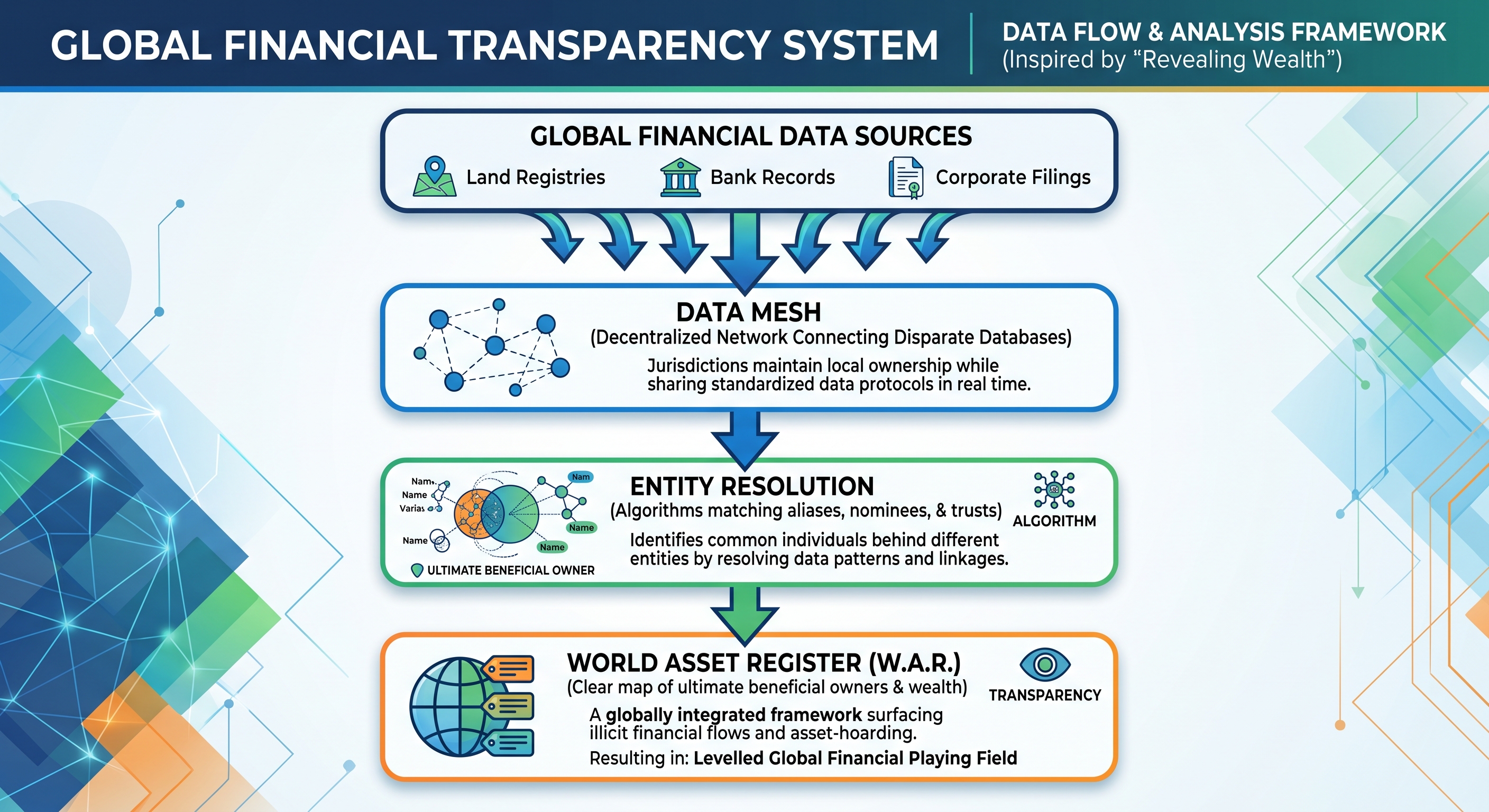
Infographic illustrating the Global Financial Transparency System, encompassing global data sources, a data mesh for connecting databases, entity resolution algorithms, and the World Asset Register framework.

Subject Oriented: Operational databases, such as order processing and payroll databases and ERP databases, are organized around business processes or functional areas. These databases grew out of the applications they served. Thus, the data was relative to the order processing application or the payroll application. Data on a particular subject, such as products or employees, was maintained separately (and usually inconsistently) in a number of different databases. In contrast, a data warehouse is organized around subjects. This subject orientation presents the data in a much easier-to-understand format for end users and non-IT business analysts.

Abstract geometric landscape with winding path, city, compass, and growth chart
A winding path leads through an abstract landscape toward a stylized geometric city.

Integrated: Integration of data within a warehouse is accomplished by making the data consistent in format, naming and other aspects. Operational databases, for historic reasons, often have major inconsistencies in data representation. For example, a set of operational databases may represent “male” and “female” by using codes such as “m” and “f”, by “1” and “2”, or by “b” and “g”. Often, the inconsistencies are more complex and subtle. In a Data Warehouse, on the other hand, data is always maintained in a consistent fashion.

Historic mining town with factories, railways, and smoke-filled mountain valley
A historic mining settlement winds through a mountain valley beneath smoke-filled skies.

Time Variant: Data warehouses are time variant in the sense that they maintain both historical and (nearly) current data. Operational databases, in contrast, contain only the most current, up-to-date data values. Furthermore, they generally maintain this information for no more than a year (and often much less). In contrast, data warehouses contain data that is generally loaded from the operational databases daily, weekly, or monthly, which is then typically maintained for a period of 3 to 10 years. This is a major difference between the two types of environments.

Historical information is of high importance to decision makers, who often want to understand trends and relationships between data. For example, the product manager for a Liquefied Natural Gas soda drink may want to see the relationship between coupon promotions and sales. This is information that is almost impossible – and certainly in most cases not cost effective – to determine with an operational database.

Antique compass on a weathered world map with red and gold cords
An antique compass rests on a weathered world map crossed by colorful travel cords.

Non-Volatile: Non-volatility means that after the data warehouse is loaded there are no changes, inserts, or deletes performed against the informational database. The Data Warehouse is, of course, first loaded with cleaned, integrated and transformed data that originated in the operational databases.

We build Data Warehouses iteratively, a piece or two at a time, and each iteration is primarily a result of business requirements, and not technological considerations.

Each iteration of a Data Warehouse is well bound and understood – small enough to be deliverable in a short iteration, and large enough to be significant.

Conversely, Big Data is characterised as being about:

Massive volumes: so great are they that mainstream relational products and technologies such as Oracle, DB2 and Teradata just can’t hack it, and

High variety: not only structured data, but also the whole range of digital data, and

High velocity: the speed at which data is generated, transmitted and received.

These are known as the three Vs of Big Data, and they are subject to significant and debilitating contradictions, even amongst the gurus of Big Data (as I have commented elsewhere: Contradictions of Big Data).

From time to time, Big Data pundits slam Data Warehousing for not being able to cope with the Big Data type hacking that they are apparently used to carrying out, but this is a mistake of those who fail to recognise a false Data Warehouse when they see one.

So let’s call these false flag Data Warehouse projects something else, such as Data Doghouses.

Glowing central network connecting six distributed data platforms
A glowing central network connects distributed data platforms through colorful digital pathways.

“Data Doghouse, meet Pig Data.”

Failed or failing Data Doghouses fail for the same reasons that Big Data projects will frequently fail. Both will almost invariably fail to deliver artefacts on time and to expectations; there will be failures to deliver value or even simply to return a break even in costs versus benefits; and of course, there will be failures to deliver any recognisable insight.

Failure happens in Data Doghousing (and quite possibly in Big Data as well) because there is a lack of coherent and cohesive arguments for embarking on such endeavours in the first place; a lack of real business drivers; and, a lack of sense and sensibility.

There is also a willing tendency to ignore the advice of people who warn against joining in the Big Data hubris. Why do some many ignore the ulterior motives of interested parties who are solely engaged in riding on the faddish Big Data bandwagon to maximise the revenue they can milk off punters? Why do we entertain pundits and charlatans who ‘big up’ Big Data whilst simultaneously cultivating an ignorance of data architecture, data management and business realities?

Some people say that the main difference between Big Data and Data Warehousing is that Big Data is technology, and Data Warehousing is architecture.

Now, whilst I totally respect the views of the father of Data Warehousing himself, I also think that he was being far too kind to the Big Data technology camp. However, of course, that is Bill’s choice.

Let me put it this way, if Oracle gave me the code for Oracle 3, I could add 256 bit support, parallel processing and give it an interface makeover, and it would be 1000 times better than any Big Data technology currently in the market (and that version of Oracle is from about 1983).

Therefore, Data Warehousing has no serious competing paragon. Data Warehousing is a real architecture, it has real process methodologies, it is tried and proven, it has success stories that are no secrets, and these stories include details of data, applications and the names of the companies and people involved, and we can point at tangible benefits realised. It’s clear, it’s simple and it’s transparent.

Just like Big Data, right?

Well, no.

See what I mean?

Therefore, the next time someone says to you that Big Data will replace Data Warehousing or that Data Warehousing is Big Data, or any variations on that sort of ‘stupidity’ theme, you can now tell them to take a hike, in the confidence that you are on the side of reason.

Many thanks for reading.

More perspectives on Big Data

Aligning Big Data: http://www.linkedin.com/pulse/aligning-big-data-martyn-jones

Big Data and the Analytics Data Store: http://www.linkedin.com/pulse/big-data-analytics-store-martyn-jones

A Modern Manager’s Guide to Big Data:http://www.linkedin.com/pulse/managers-guide-big-data-context-martyn-jones

Core Statistics coexisting with Data Warehousing

Accomodating Big Data

A bronze statue of a girl in a dress standing on a pedestal, holding her hand up, with a wolf and a sheep beside her, surrounded by leafy trees.
Girl and wolf in Munich

And a big thank you to Bill Inmon (the father of Data Warehousing and of DW 2.0)

Aligning Big Data – Chinese

03 Tuesday Mar 2015

Posted by Martyn Rhisiart Jones in Big Data, Consider this

≈ Leave a comment

Tags

Big Data, Good Strat, Martyn Jones

Aligning Big Data – Chinese version is thanks to Optimus Prime – published on http://www.36dsj.com/archives/23692

译文:数据仓库DW 3.0,一个大数据通用的结构框架和模型

大数据36大数据专稿,原文作者:Martyn Jones  本文由1号店-欧显东编译向36大数据投稿,并授权36大数据独家发布。转载必须获得本站及作者的同意,拒绝任何不标明作者及来源的转载!

引言:

为了带来一些类似的简单性,连贯性和完整性的大数据的辩论,我分享一个普遍信息架构和管理的进化模型。

这是对大数据到一个更通用的体系结构框架的调整和布局,架构集成了数据仓库(DW 2.0),商业智能和统计分析。

这个模型目前称为DW 3.0信息提供框架,简称DW 3.0。

回顾

在以前的一篇比较适用的博客名为“Data Made Simple – Even ‘Big Data‘ ”,里面主要有三个粗略类型的数据:企业运营数据;企业过程数据;以及企业信息数据。如下图:

大数据

图1-简要数据模型

简而言之数据的类型可以定义在以下几个:

企业运营数据:这是用于应用程序的数据,支持一个企业的日常运营。

企业过程数据:这是从企业系统是运行的测量和管理收集的数据。

企业信息数据:这主要是数据收集的来自内部和外部的数据源,通常最重要来源是企业运营数据。

这三个底层类型数据是DW 3.0基础。

主体

下面的图展示了DW 3.0总体框架::

大数据

图2 -DW3.0信息框架

在这个图中有三个主要元素:数据来源,核心数据仓库和核心数据。

数据来源:这个元素涵盖所有当前的来源,可用的数据的品种和数量用来支持“挑战识别”,“选择定义”的过程和决策,包括统计分析方法和场景法

数据仓库:这是一个DW 2.0模型的演化路径。它扩展了数据仓库的范式不仅包括非结构化和复杂的数据,而且执行的信息和结果来源于统计分析之外的核心数据仓库的场景。

核心统计:这个元素涵盖了核心的统计能力,特别是但不限于对于进化的数据量,数据速度,数据质量和数据的多样性。

这模块的重点是核心统计。也将提及到三者的关系和合并的效果。

核心统计:

下图关注的核心元素模型:

大数据

图3 – DW3.0核心统计

上图说明了数据流和信息通过数据采集的过程然后到统计分析和结果的集成。

这个模型还引入了分析数据存储的概念。这可以说是最重要的建筑元素。

数据来源

为了简单起见图中有三个显式指定的数据源(当然依赖的企业数据仓库或数据集市也可以作为一个数据源),但是,我在这篇文章中主要有以下三个数据源:复杂的数据;事件数据;基础数据。

复杂数据:这是结构化或高度复杂的结构化数据文件和其他复杂的数据中包含的文物,如多媒体文件。

事件数据:这是企业过程数据的一个方面,通常在一个细粒度的抽象层次。下面是业务流程日志,互联网web活动日志和其他类似事件数据的来源。这些来源所产生的量往往会高于其他数据源,和那些目前与大数据相关的大量的信息通过追踪即使是最轻微的行为数据覆盖生成一样。例如,有人随意浏览网站。

基础数据:这方面的数据包含可能描述为信号类型数据。通过复杂的事件关联和组件分析产生的连续高速流或者高度动荡的的数据。

革命从这里开始

在这里我将稍微突出建筑元素背后的一些指导原则。

没有业务就没有理由这样做:这是什么意思呢?这意味着每一个重大行动,甚至是高度投机活动,必须有一个有形的和可信的业务支持。就和“奥马哈圣人”,和“圣诞老人”的区别一样清楚。

架构决策都是基于一个完整的和深刻的理解需要实现什么和所有可用的选择:例如,拒绝使用高性能的数据库管理产品必须是有原因的,即使这原因是成本。不应该基于技术意见,如“我不喜欢供应商”如果对Hadoop有感觉,然后使用它,如果对Exasol或Oracle或Teradata有感觉,然后使用它们。那么你一定是一个技术不可知论者,但不是一个有教条的技术论者。

统计和非传统的数据源是完全集成到数据仓库未来架构前景::建设更多的公司仓库,无论是通过行动或遗漏,将导致更大的效率低下,更大的误解和更大的风险。

架构必须连贯,连贯,可用和成本效益:如果没有,有什么意义,对吧?

没有技术,技艺或方法是短板:我们需要能够低成本纳入任何相关现有的新兴技术。

减少早期性和减少频繁性:大量的数据,特别是在高速运转的是存在问题的。减少它们的存储容量,即使我们不能在理论上减少的速度是绝对必要的。我将详细说明这一点区别。

减少早期性,减少频繁性

这里我扩大早期的主题数据减少过滤和聚合,我们可能会产生越来越多的大量的数据,但这并不意味着我们需要囤积所有它为了得到一些价值。

简单的来说这就是将初始数据进行ETL(提取和转换)尽可能靠近数据生成器。这是数据库适配器的概念,但它可以逆转的。

让我们看一个场景。

一个公司想要实施一些投机性分析每天的每一分钟收集的许多互联网网站活动日志数据成,他们运行大量的日志文件分布式平台减少数据映射。

然后他们可以分析结果数据。

面临的问题,与许多网站被黑客,设计师,而不是工程师、建筑师和数据库专家开发,是乱堆着极大的和笨拙的文物,如大量的日志文件的详细钝角和新鲜感添加数据。

我们需要确保这个挑战可以移除吗?

我们需要重新考虑网络日志,然后我们需要重新设计它。

我们需要能够进行语法分析日志数据,以减少产生的大量数据占用严重设计和详细数据。

我们需要的双重选择,能够不断地将数据发送给一个事件设备,可以用来降低数据量在一个事件会话的基础上。

如果我们必须使用日志文件,用许多小日志文件减少大量的日志文件和更多的日志周期减少几个日志周期。我们还必须最大化并行日志的好处。

所以现在,我们得到了日志数据的使用可以通过日志文件、日志文件由一个事件设备(如工具包的一部分分析数据收集适配器)或发送的设备通过消息传递信号点而来。

一旦数据已经传输(传统文件传输/共享或消息)我们可以进入下一个步骤:ET(A)L -提取、转换、分析和负载。

日志文件,我们通常采用ETL(A)但是当然我们不需要ETL中的E即提取,因为这是直接连接。

再次减少ET(AL)是另一种形式的机制,这就是为什么分析方面包括确保得到的数据通过需要的数据,而没有认可价值的垃圾和噪音,会尽早并且经常清理。

分析数据存储

分析数据存储(可以是一个分布式数据存储在某个云)支持统计分析的数据需求。这里的数据组织、结构、集成和丰富的持续波动,偶尔需要统计学家和科学家关注数据挖掘。分析数据存储中的数据可以累计或完全刷新。它可以有一个短寿命或有显著高寿命。

分析数据存储的核心是分析数据。不仅可以用于提供数据统计分析过程,但它也可以用来提供长期持久存储分析结果和场景,和未来的一些分析,因此具有“回馈”的能力。

分析数据存储中的数据和信息也可以使用、来源于数据仓库中存储的数据,它也可能受益于拥有自己的专用数据集市专门为这个目的而设计的。

在分析数据存储的统计分析的结果也可能导致反馈用于调优数据,过滤和浓缩的规则,无论是智能数据分析、复杂事件和歧视适配器或ET(AL)工作。

总结

这一定是非常短暂的对于目前的DW 3.0的标签

模型不寻求定义统计或统计分析是如何应用的,已经做了足够多,但如何适应统计在一个扩展的DW 2.0架构,和几乎不需要想出反动和不合身的问题解决方案,可以解决的更好、更有效的方法通过明智、健全的工程原则和适当的明智的应用方法,技术和技巧。

原文:Aligning Big Data

Contradictions of Big Data

01 Sunday Mar 2015

Posted by Martyn Rhisiart Jones in Big Data, Consider this

≈ 1 Comment

Tags

Ask Martyn, Big Data, data management, Good Strat, Good Strategy, Martyn Jones, Martyn Richard Jones

What we’ve been told

We’ve been told that Big Data is the greatest thing since sliced bread, and that its major characteristics are massive volumes (so great are they that mainstream relational products and technologies such as Oracle, DB2 and Teradata just can’t hack it), high variety (not only structured data, but also the whole range of digital data), and high velocity (the speed at which data is generated and transmitted). Also, from time to time, much to the chagrin of some Big Data disciples, a whole slew of new identifying Vs are produced, touted and then dismissed (check out my LinkedIn Pulse article on Big Data and the Vs).

So, beware. Things in Big Data may not be as they may seem.

It’s not about big

I have been waging an uphill battle against the nonsensical and unsubstantiated idea that more data is better data, but now this view is getting some additional support, and from some surprising corners.

In a recent blog piece on IBM’s Big Data and Analytics Hub (Big data: Think Smarter, not bigger), Bernard Marr wrote that “the truth is, it isn’t how big your data is, it’s what you do with it that matters!”

Elsewhere, SAS echoed similar sentiments on their web site: “The real issue is not that you are acquiring large amounts of data. It’s what you do with the data that counts.”

Can we call that ‘strike one’ for Big Data Vs?

It’s not about variety

It is claimed that 20% of digital data is structured, it is based on the problematic suggestion that structured data is uniquely relational. It is also claimed that unstructured data includes CSV files and XML data, and this makes up far more than the 20% of the data generated. But this definition is simply wrong.

If anything, CSV data is structured, and XML data is highly structured, and it’s typically regular ASCII data. So it does not add variety, even though it is not structured in the ways that some people might expect, especially if that someone lacks the required knowledge and experience. Simply stated, CSV data is structured, it’s just that it lacks rich metadata, but that doesn’t make it unstructured.

“But”, I hear you say “what about all the non-textual data such as multi-media, and what about the masses of unstructured textual data?”

Take it from me, most businesses will not be basing their business strategies on the analysis of a glut of selfies, home videos of cute kittens, or the complete works of William Shakespeare or Dan Brown. Almost all business analysis will continue to be carried out on structured data obtained primarily from internal operational systems and external structured data providers.

Strike two! Third time lucky?

It’s not even about velocity

So, if we accept that Big Data isn’t really about the data volumes or data variety that leaves us with velocity, right? Well no, because if it isn’t about record breaking VLDBor significant data variety, then for most commercial businesses the management of data velocity becomes either less of an issue or just is no issue. The fact that some software vendors and IT service suppliers set up this ‘straw man’ argument and then knock it down with the ‘amazing powers’ of their products and services, is quite another matter.

Strike three, and counting.

It’s not about the manageability of Big Data

We have been told and time again that the major difference between a data scientist and professional statistician is that the ‘scientists’ know how to cope very well with massive volumes, varieties and velocities of data. Now it turns out that this is also questionable.

According to Bob Violino writing in Information Management (Messy Big Data Overwhelms Data Scientists – 20 February 2015) “Data scientists see messy, disorganized data as a major hurdle preventing them from doing what they find most interesting in their jobs”. So, when it comes to data quality and structure the ‘scientists’ don’t really have an advantage over professional statisticians.

Last year Thomas C. Redman writing in the Harvard Business Review (Data’s Credibility Problem) noted that when Big Data is unreliable “managers quickly lose faith” and “and fall back on their intuition to make decisions, steer their companies, and implement strategy” and when this happens there is a propensity to reject potentially “important, counterintuitive implications that emerge from big data analyses.”

Strike four?

The new analytics aren’t new

Data science and Big Data analytics are the new kids on the block, aren’t they?

Well, here are some real life scenarios.

A major banking equipment supplier: A lot of banking equipment is hybrid analogic-digital, a simple example of this would be a photo copier or a physical document processing device. One major supplier decided to incorporate the capture of sensor data produced by their devices to predict failure and problems. Predictive preventive maintenance rules are created and corroborated using the data generated by sensors on each customer device, and these rules then get incorporated into the devices logic.

A major IT vendor: What happens when you create an intersection and convergence between technologies, techniques and method from areas of mainstream IT, data architecture and management, statistics (quantitative and qualitative analytics) and data visualisation, artificial intelligence/machine learning and knowledge management? This is precisely what one of the main European IT vendors did, and the idea proved to be quite attractive to customers, prospects and investors.

A major integrated circuit supplier: The testing of ICs at the ‘fabs’ (manufacturing plants) generates serious amount of data. This data is used to detect errors in the IC manufacturing process, it is captured and analysed in as near real-time as possible, which is necessary due to the costly nature of over-running the production of faulty ICs. To get around this problem the company uses a combination of fast data capture, transformation and loading of data into a data analytics area to ensure early and precise problem detection.

All Big Data Analytics success stories?

The first happened in 1989, the second in 1993 and the third in 2001. Yes, Big Data and Big Data analytics are sort of newish.

Strike five.

The science is frequently not very scientific

What is science?

According to Vasant Dhar of the Stern School of Business (Data Science and Prediction), Jeff Leek (The key word in “Data Science” is not Data, it is Science), and repeated on Wikipedia, “In general terms, data science is the extraction of knowledge from data”. Well, excuse me if I beg to differ. I have seen data scientists at work, and the word science doesn’t actually jump out and grab you. It’s difficult to make the connection, just as it is to accurately connect some popular science magazines with fundamental scientific research.

If a professional and qualified statistician wants to label themselves a data scientist then I have no issue with that, it’s their problem, but I am not willing to lend credibility to the term ‘data scientist’ when it is merely an interesting job title, with at most a tenuous connection to the actual role, and one that is liberally applied, with the almost customary largesse of IT, to creative code hackers and business-averse dabblers in data.

As Hazelcast VP Miko Matsumura suggested in Data Science is Dead “… put “Data Scientist” on your resume. It may get you additional calls from recruiters, and maybe even a spiffy new job, where you’ll be the King or Queen of a rotting whale-carcass of data” and ” Don’t be the data scientist tasked with the crime-scene cleanup of most companies’ “Big Data”—be the developer, programmer, or entrepreneur who can think, code, and create the future.”

Strike six.

And the value is questionable

DATA: “Data is a super-class of a modern representation of an arcane symbology.” – Anon

If I had a dollar for every time I heard someone claim that data has intrinsic positive value then I would be as wealthy as Warren Buffet.

If I have said it once, I have said it a hundred time. In order for data to be more than an operational necessity it requires context.

Providing valid data with valid context turns that data into information.

Data can be relevant and data can be irrelevant. That relevance or irrelevance of data may be permanent or temporary, continuous or episodic, qualitative or quantitative.

Some data is meaningless, and there are cases whereby nobody can remember why it was collected or what purpose it serves.

Taking all this into account we can ask the deadly pragmatic question: what value does this data have? Which is sometimes answered with a pertinent ‘no value whatsoever’.

Strike seven.

So what is it really about?

It is said that Big Data is changing the world, but for all intents and purposes, and shamed by previous Big Data excesses, some people are rapidly changing the definitions and parameters of Big Data, and to position it as being more tangible and down-to-earth, whilst moving it away from its position as an overhyped and dead-ended liability.

Big Data is a dopey term, applied necessarily ambiguously to a surfeit of tenuously connected vagaries, and its time has come and gone. So, let’s drop the Big Data moniker, and embrace the fact that data is data, and long live ‘All Data’, yes, all digital data. Let’s consider all data and for what it’s worth to the business, and not for what some chatterers reckon its value is – having as they do, little or no insight into the businesses to which they refer, or of the data in that these businesses possess.

So, when push comes to shove, is Big Data really about high volumes, high velocity and high variety, or is it in fact about much noise, too much pomposity and abundant similarity leading to unnecessary high anxiety?

Thanks very much for reading.

Big Data in Question – Again

01 Sunday Mar 2015

Posted by Martyn Rhisiart Jones in All Data, Big Data, Consider this

≈ Leave a comment

Tags

All Data, Big Data, data management, Good Strat, good strat blog, Good Strategy, Martyn Jones, Martyn Richard Jones

Big Data is now an inhospitable and unhealthy land inhabited by those who, through accident or design, deceive naïve and sentimental bystanders and those who are willingly mislead.

When all of this Big Data malarkey started it was sort of funny, humorous and occasional witty, especially in the affected, bizarre and the frequently uninhibited ways that freshly-minted self-appointed gurus and experts would “big it up”

Doctor Freud would have had a field day with all of that, being as it was, and for that matter still is, a postmodern mishmash of Riefenstahl, Freddy Mercury and Monty Python on steroids. However, after that extended, operatic and high-camp hiatus it all went downhill.

The Big Data scene is fast becoming an outrageous and brash festival of deception, disinformation and obliviousness. Which is a pity, because it does the industry no good whatsoever.

It is telling that Big Data evangelists, gurus and assorted sycophants cannot even define Big Data adequately, never mind discuss (or for that matter, point at) tangible success stories, without falling into contradictions on all of the key defining characteristics of volume, variety and velocity, and resorting to crude debating devices to avoid or finesse the concerns and the questions.

Almost every morning I check out the industry news, and almost invariably, it comes with new mind-boggling examples of Big Data nonsense.

However, it isn’t always nonsense for nonsense’s sake, there are agendas, there are rational explanations why Big Data has become at the same time, one of the most hyped up fads in the history of IT, and one that its supporters find so difficult to actually explain and justify, in any reasonable sort of way.

Therefore, when it comes to Big Data, beyond the surfeit of platitudes, clichés, bluff and bluster, the only thing in play are the interests of industry, the patrons, the courtesans and their entourage of the innocent and the beguiled.

One of the biggest deceptions in Big Data is in the misleadingly named ‘success stories’. The thing is that most of these success stories that I have ever read have been:

  • So vague that it’s difficult to know how success is being defined never mind reached.
  • So secretive and obtuse is the avoidance of naming names, locations and other relevant Big Data references that it’s impossible to corroborate if these claims are actually true or not. Disclaimer: I have worked for some of the biggest IT vendors, and in senior roles, and I know what is behind comments such as “the Big Data project is a success, although the client name and project are confidential” and “it’s delivering such major competitive advantages that we are obliged to keep it under wraps”.
  • Stories stolen from elsewhere, such as from Data Warehousing, Business Intelligence, VLDB or Business Application projects.
  • Borderline fantasies and badly contrived technology fan fiction.

However, it doesn’t stop there.

One of the clearest examples of the questionable nature of Big Data evangelism is when it is used to piggyback Big Data hype on simple, tangible and immediately recognisable artefacts or applications that have little in common with Big Data.

This is an extreme illustration, but it works like this: “iPhones are commercially successful, iPhones are part of Big Data, and therefore Big Data is commercially successful.”

As if the mere conjuring up of association, affinity and proximity will convince people of the great and growing value of Big Data.

What I am also referring to are publicity pieces that may as well have been titled:

  • Smith, Galbraith, Mies, Keynes, Homer SImpson and the economic justification of Big Data
  • Lovelace, Babbage, von Neumann, Eckert, Davies, Codd, Knuth, Naur and the technological underpinnings of Big Data
  • Einstein, Freud, Edison, Faraday, Recorde and the intellectual structure of Big Data
  • Socrates, Kant, Hegel, Marx , Adorno and the philosophical correctness of Big Data
  • Great quotes about Big Data, from the Cambrian era to the postmodern époque
  • Great jokes about Big Data, from Mel Brooks to Steve Martin
  • Sportspeople and Big Data, from Lottie Dodd and Babe Ruth to Rafa Nadal and CR7
  • Industry support of Big Data, from Henry Ford to Neutron Jack

Do you recognise similarities?

It’s no big deal, just the use of unreliable, misleading and inappropriate fallacies, dressed up as cute, plausible and accessible collateral. People may think that such things are clever and witty, but they aren’t, it’s just misleading.

Let’s continue with something simple.

Evasion is, in ethics, an act that deceives by stating a true statement that is immaterial or leads to a false deduction. For example, citing events, persons or anecdotes from the history of IT to justify the supposed or imaginary value of Big Data. This is close to the notion of a non sequitur, which of course is an argument, the conclusions from which do not follow from its premise. It falls short of being full-on sophistry, purely because the simplistic, puerile and superficial arguments put forward in favour of Big Data do not match those of the true sophist who seeks to reason with clever but fallacious and deceptive arguments. Too many of the Big Data arguments are fallacious and deceptive, but no one, equipped with a reasonable capacity for critical thinking, should take such ‘arguments’ as valid.

Hold this thought: Big Data hype is a viper’s nest of logical fallacies, white lies and disinformation.

Just when I think things could not get any weirder, they do, and Big Data ceiling of hyperbole rises even higher, up to the rarer atmosphere of extreme tendentiousness.

There is a growing mass of Big Data hoop-la, hyperbole and flim flam that exceeds all previously bounds of overstatement, solecism and confabulation. This is where the real volumes, varieties and velocities are in Big Data; in hokie.

We live, as Oscar Wilde said in his day, in and age of surfaces. Yes, superficiality, puerility and short-termism are the competing orders of the day. However, I am still amazed – and maybe wrongly so – by what ostensibly professional, experienced and knowledgeable people are willing, able and prepared to accept, especially when it comes to Big Data flim flam sauce.

Here are some examples of the nonsense about Big Data that is taken as gospel by ‘adults’:

Data Warehousing is part of Big Data: No comment.

Big Data will replace Enterprise Data Warehousing: People can’t even explain the features and benefits of Big Data. I try it make it as easy as possible, ‘if you can’t say it, point to it’. But, seriously, people can’t even relate tangible and credible Big Data success stories, never mind show how it will replace Enterprise Data Warehousing, whether that’s the Inmon or Kimball flavour, take your pick.

Everyone and every organisation can benefit from Big Data: If people can’t explain this, and they don’t in terms of tangible benefits, then the claim should remain questionable.

Data Scientists will replace Statisticians: Why is that so? It is claimed that Data Scientists are uniquely equipped to handle massive volumes, varieties and velocities of data – well, as it turns out, this isn’t certain either.

Big Data is in its infancy: I think we may be confusing infancy with lack of real traction, and of time and place utility.

You cannot be serious: Just what are people talking about here? I have read vague, naïve and ill-informed pieces about data management, data architecture, data warehousing, reporting, business intelligence and a plethora of etcetera that have been passed off as observations and commentary on Big Data. So, what makes people recycle hackneyed, misleading and badly conceptualised ‘content’?

In the commentary on one of Bernard Marr’s pieces on LinkedIn (a professional networking site) I observed that no one can adequately explain what Big Data is without falling into contradictions and fancies, and no one seems to be capable or willing to provide tangible success stories.

Bernard responded to this comment by pointing out “the reason for that is that Big Data means different things to different people.”

Fair enough. It’s an explanation.

That said, I have always had more than a tenuous dislike of postmodern thinking, in fact most things ‘postmodern’. Call me old fashioned, jaded or cynical, but to me, the idea that everything can mean anything is an aberration that I prefer to leave to others.

I am at a loss to explain why so many reasonable people are willing to embrace the hype surrounding Big Data and Big Data Analytics, including the attendant surfeit of nonsense, incongruences and contradictions, and from my perspective, it defies reason and good sense.

Therefore, I will just end again with a fabulous quote from Ben Goldacre:

“You cannot reason people out of a position that they did not reason themselves into”.

Many thanks for reading.

Contradictions of Big Data – Short

01 Sunday Mar 2015

Posted by Martyn Rhisiart Jones in Big Data, Consider this, Good Strat, Good Strategy, Martyn Jones, Martyn Richard Jones

≈ Leave a comment

Tags

Big Data, data management, Good Strat, Good Strategy, Martyn Jones, Martyn Richard Jones

Please note: This is an edited version of a previous piece with a similar name, but focusing solely on the three main Vs of Big Data.

What we’ve been told

We’ve been told that business Big Data is the greatest thing since sliced bread, and that its major characteristics are:

  • massive volumes – so great are they that mainstream relational products and technologies such as Oracle, DB2 and Teradata just can’t hack it, and
  • high variety – not only structured data, but also the whole range of digital data, and
  • high velocity – the speed at which data is generated, transmitted and received

Which is a simple and straightforward means of classification. Big Data is about massive volumes, high variety and high velocity. Right?

It’s not about big

I have never bought into the idea that more data is necessarily better data, or that it provides better focus or leads to increased insight, in fact I have been quite vocal with my contrarian opinion, but now this view is getting some additional support, and from some surprising corners.

In a recent blog piece on IBM’s Big Data and Analytics Hub (Big data: Think Smarter, not bigger), Bernard Marr wrote that “the truth is, it isn’t how big your data is, it’s what you do with it that matters!”

Over at Fierce Big Data it was Pam Baker who stated that “the term big data is unfortunate because it’s really not about the size of the data”. (Big data is not about petabytes, but complex computing).

Elsewhere, SAS echoed similar sentiments on their web site: “The real issue is not that you are acquiring large amounts of data. It’s what you do with the data that counts.”

Well, apparently Big Data isn’t about “massive volumes” of data.

Strike 1!

It’s not about variety

It is claimed that 20% of digital data is structured, it is based on the problematic suggestion that structured data is uniquely relational.

It is also said that unstructured data includes CSV files and XML data, and this makes up far more than the 20% of the data generated. But this definition is wrong.

If anything, CSV data is structured, and XML data is highly structured, and it’s typically regular ASCII data. So there it does not add variety, even though it is not structured in the ways that some someone might expect, especially if that someone lacks the required knowledge and experience. Simply stated, CSV data is structured, it’s just that it lacks rich metadata, but that doesn’t make it unstructured.

“But”, I hear you say “what about all the non-textual data such as multi-media, and what about the masses of unstructured textual data?”

Take it from me, most businesses will not be basing their business strategies on the analysis of a glut of selfies, juvenile twittering, home videos of cute kittens, or the complete works of William Shakespeare. Almost all business analysis (whether done by a professional statistician or a data scientist) will continue to be carried out using structured data obtained primarily from internal operational systems and external structured data providers.

Variety, Sir? No problem.

Strike two!

It’s not even about velocity

So, if we accept that Big Data isn’t really about the massive data volumes or high data variety then that leaves us with velocity. Because if it isn’t about record breaking VLDB or significant data variety, then for most commercial businesses the management of data velocity becomes either less of an issue or just is no issue.

Even in some extreme circumstances, one can explore the suggestion that data sampling can remove issues with data volume as well as velocity.

However, the fact that some software vendors and IT service suppliers set up this‘straw man’ velocity argument and then knock it down with the ‘amazing powers’ of their products and services, is quite another matter.

So, is it really about velocity?

Strike three!

So what is it really about?

Big Data is a dopey term, applied necessarily ambiguously to a surfeit of tenuously connected vagaries, and its time has come and gone. Let’s dump the Big Data moniker, and the 3 Vs along with it, and embrace the fact that data is data, there will always be more of it.

So, let’s consider ‘all data’ and principally for its time and place utility.

If there is something that you are not sure about or have questions with then please leave a comment below or email me.

Thanks very much for reading.

Consider this: Big Data and the Pot of Tea

17 Tuesday Feb 2015

Posted by Martyn Rhisiart Jones in Big Data, Consider this, Good Strat, Good Strategy, Martyn Jones, Martyn Richard Jones, Strategy

≈ Leave a comment

Tags

Analytics, Big Data, data management, Good Strat, Good Strategy, Martyn Jones, Martyn Richard Jones

To begin at the beginning

Hold this thought: Big Data is King.

Is there just nothing that Big Data isn’t capable of fixing? From terrorism, world hunger, Ebola, HIV, fraud, money laundering and hiring the ‘right’ people through to winning the lottery, curing hangovers, arranging entrapment and finding the love of your life. Big Data is King. Continue reading →

The amazing world of Fred’s Big Data

15 Sunday Feb 2015

Posted by Martyn Rhisiart Jones in Big Data, Consider this

≈ Leave a comment

Tags

Big Data, data management, Good Strat, Good Strategy, information management, knowledge management, Martyn Jones, Martyn Richard Jones

Hold this thought: There are real golden nuggets of data that many organisations are oblivious to. But first let’s look at business process management. Continue reading →

A brief introduction to Knowledge Management

14 Saturday Feb 2015

Posted by Martyn Rhisiart Jones in Big Data, Consider this, Good Strat, Good Strategy, Martyn Jones, Martyn Richard Jones, Masterclass, statistics

≈ Leave a comment

Tags

Big Data, Consider this, data management, information manageemnt, knowledge management

A helpful slideset that is used to explain the purposes, positions and roles of Knowledge Management.

A brief introduction to Knowledge Management from Martyn Richard Jones

Enjoy! Please tell me what you think about this slide deck. Many thanks for viewing. 

Big Data, a promised land where the Big Bucks grow

12 Thursday Feb 2015

Posted by Martyn Rhisiart Jones in Big Data, Consider this, Good Strat, Information Management, Martyn Jones

≈ 2 Comments

Tags

Analytics, Big Data, Good Strat, Martyn Jones, statistics

Consider this. Many people come up to me in the street, and, apropos of nothing, they ask me how they can make money from Big Data.

Normally I would send such people to see a specialist – no, not a guru, but a sort of health specialist, but because this has happened to me so many times now, I eventually decided to put pen to paper, push the envelope, open up the kimono, and to record my advice for posterity and the great grandchildren.

So, here are my top seven tips for cashing in quick on the new big thing on the block.

1 – A business opportunity for faith

Like every new religion, trend or fad, Big Data has its own founding myths, theology and liturgy, and there is money to be made in it; loadsa lovely jubbly money. By predicating and evangelising Big Data you will be welcomed with open arms into the Big Data faith, and will receive all the attendant benefits that will miraculously and mysteriously fall upon you and your devout friends. Go on, I dare you. Be a Big Data guru, a shepherd to a flock of sheep, and enjoy the wealth, health and happiness that most surely will come your way. You too can look cool in red Prada slippers, a flattering and flowing gown and matching accessories.

2 – Acquire it, multiply it, weigh it, mark it up and sell it on

Simply stated, this is about acquiring other people’s data, by sacred means or profane, marking it up and then selling it on. The value you add is that you act as a trusted conduit, a conduit for good. You may care to enrich the data, swop the order of data, replicate and embellish data, make stuff up, etc. which all serves to ‘add value’ to the data. You may even consider adding nuggets of value to the data, just for kicks and giggles. My best friend’s favourite is injecting the good old ‘diaper and beer’ and ‘friends and family’ clichés into every Big Data collection, as it never fails to thrill, please and delight.

3 – Anything can be anything

The good thing about making money from Big Data is that it doesn’t need to be anything to do with Big Data. Make a 20GB Enterprise Data Warehouse? Call it a Big Data success. Sell 20 boxes of dodgy doughnuts down the alternative market? Proclaim a Big Data triumph. Sell your digital porn stash to your best mate? Point to the incredible invisible hand of the Big Data market at work. See what I’m doing there. Anything can be anything, and you too can cash in on that opportunity, big time.

4 – Big Data Patronage

Tense, nervous headaches? Do you like making up stories about Big Data, or for that matter anything else? Are you a natural born fibber but are strapped for cash? Then worry no longer. If you get a Big Data patron you will be sorted for ‘life’; get two and you’ll be sorted for the afterlife as well. With a Big Data patron you can get the most tenuous, crappiest and superficial of pieces published, promoted and vaunted – globally. Can’t make it up yourself, then outsource and offshore it, after all, just get the keywords right for SEO ranking and the gullible will flock to you in droves. The down side of this profession is that you will be targeted for writing half-truths, quarter-truths and downright lies, and you will be pilloried as a purveyor of rank hyperbole. But don’t worry, take heart and never lose the faith, you will be in good company. As one Big Data guru was want to say ” If you repeat a lie often enough, people will believe it, and you will even come to believe it yourself.” Amen! brother.

5 – Big Data Certification

By 2016 there will be global demand for 30 billion Big Data professionals. Are you prepared to cash in on that inevitability? No? Then consider this.

One of my best friends makes his living as a completely phony Big Data Scientist. For two hundred bucks he can make you a Data Scientist or a Big Data guru. Some guys give you an education but this guy gives you immediate access to high paying jobs, sex and a life in the city. Moreover, for an extra 250 bucks you can also become a certified Big Data Trainer, which will allow you to do unto others what has been done unto you.

6 – Creative Technology Reuse

Big Data has heralded in the biggest innovations known in the history of computing, and arguably in the entire history of humankind. One of those new inventions has been the now widely acclaimed and revolutionary ‘flat file data base’ (FFDB), and this has been accompanied with developments in low level operating system primitives that allow for the processing of these collections and hierarchies of FFDBs. So, if one has a mind to do so, one can get some real business leverage off of these new tendencies by borrowing 21st century technology found in old operating system hacks from the sixties and seventies and eighties and nineties and… Well, the point is that in order to get serious funding it is no longer good enough to have a half page business plan, it is also necessary to eke out ‘stuff’ that works within the new paradigms of Big Data and Big Data Analytics. For my next venture I will be looking for serious funding for my ‘Arbitrary Dawdle Down Data Street’ (AD3S) Big Data Analytics platform, a platform designed to support virtual 1k bit processing and the massively parallel provision of global regular expression search and match (S&M), concatenation and listing, and cooperative data-driven and streamed data extraction and reporting. I’m hoping to attract the attention of governments, the EU, the Manic Street Preachers, the UN, China, Vladimir Putin, the DOD, HP, Oracle, Gartner, Lana Del Rey, Deloitte and IBM. So, this is going to be absolutely massive. Word!

7 – Big Data Brokerage

According to leading management consultants and industry watchers Gartner, McKinsey and Deloitte, data needs to be managed and accounted like any other asset, such as money. To get into a similar view-point requires a massive leap of faith, but it is a conversion that might drive dividends. One avenue to be explored in eking out value from the apparently massively valuable Big Data lakes, silos and pools is through the operation of a Big Data Brokerage. A Big Data Brokerage is a business whose main responsibility is to be an intermediary that puts Big Data buyers and Big Data sellers together in order to facilitate a transaction. Big Data Brokerage companies are compensated via commission after the Big Data transaction has been successfully completed. They may also charge introductory fees. Just imagine the wealth of business opportunities in that. You could become the Goldman Sachs of data.

That’s it folks!

I hope you enjoyed this piece and would be pleased to hear your views on this and other subjects.

Whilst I understand the attraction and even the need of creating a new and significant growth industry, I would also advise a degree of restraint, and whilst I see that “Big Data” (the consideration of the potential value of All Data) has its allure, I also think that some good sense and informed caution should also prevail.

Thank you so much for reading.

Martyn Richard Jones

How to position Big Data

12 Thursday Feb 2015

Posted by Martyn Rhisiart Jones in Big Data, Consider this, Good Strat, Martyn Jones

≈ Leave a comment

Tags

Big Data, Good Strat, Martyn Jones

To begin at the beginning

Fueled by the new fashions on the block, principally Big Data, the Internet of Things, and to a lesser extent Cloud computing, there’s a debate quietly taking please over what statistics is and is not, and where it fits in the whole new brave world of data architecture and management. For this piece I would like to put aspects of this discussion into context, by asking what ‘Core Statistics’ means in the context of the DW 3.0 Information Supply Framework.

Core Statistics on the DW 3.0 Landscape

The following diagram illustrates the overall DW 3.0 framework:

There are three main concepts in this diagram: Data Sources; Core Data Warehousing; and, Core Statistics.

Data Sources: All current sources, varieties, velocities and volumes of data available.

Core Data Warehousing: All required content, including data, information and outcomes derived from statistical analysis.

Core Statistics: This is the body of statistical competence, and the data used by that competence. A key data component of Core Statistics is the Analytics Data Store, which is designed to support the requirements of statisticians.

The focus of this piece is on Core Statistics. It briefly looks at the aspect of demand driven data provisioning for statistical analysis and what ‘statistics’ means in the context of the DW 3.0 framework.

Demand Driven Data Provisioning

The DW 3.0 Information Supply Framework isn’t primarily about statistics it’s about data supply. However, the provision of adequate, appropriate and timely demand-driven data to statisticians for statistical analysis is very much an integral part of the DW 3.0 philosophy, framework and architecture.

Within DW 3.0 there are a number of key activities and artifacts that support the effective functioning of all associated processes. Here are some examples:

All Data Investigation: An activity centre that carries out research into potential new sources of data and analyses the effectiveness of existing sources of data and its usage. It is also responsible for identifying markets for data owned by the organization.

All Data Brokerage: An activity that focuses on all aspects of matching data demand to data supply, including negotiating supply, service levels and quality agreements with data suppliers and data users. It also deals with contractual and technical arrangements to supply data to corporate subsidiaries and external data customers.

All Data Quality: Much of the requirements for clean and useable data, regardless of data volumes, variety and velocity, have been addressed by methods, tools and techniques developed over the last four decades. Data migration, data conversion, data integration, and data warehousing have all brought about advances in the field of data quality. The All Data Quality function focuses on providing quality in all aspects of information supply, including data quality, data suitability, quality and appropriateness of data structures, and data use.

All Data Catalogue: The creation and maintenance of a catalogue of internal and external sources of data, its provenance, quality, format, etc. It is compiled based on explicit demand and implicit anticipation of demand, and is the result of an active scanning of the ‘data markets’, ‘potential new sources’ of data and existing and emerging data suppliers.

All Data Inventory: This is a subset of the All Data Catalogue. It identifies, describes and quantifies the data in terms of a full range of metadata elements, including provenance, quality, and transformation rules. It encompasses business, management and technical metadata; usage data; and, qualitative and quantitative contribution data.

Of course there are many more activities and artifacts involved in the overall DW 3.0 framework.

Yes, but is it all statistics?

Statistics, it is said, is the study of the collection, organization, analysis, interpretation and presentation of data. It deals with all aspects of data, including the planning of data collection in terms of the design of surveys and experiments; learning from data, and of measuring, controlling, and communicating uncertainty; and it provides the navigation essential for controlling the course of scientific and societal advances[i]. It is also about applying statistical thinking and methods to a wide variety of scientific, social, and business endeavors in such areas as astronomy, biology, education, economics, engineering, genetics, marketing, medicine, psychology, public health, sports, among many.

Core Statistics supports micro and macro oriented statistical data, and metadata for syntactical projection (representation-orientation); semantic projection (content-orientation); and, pragmatic projection (purpose-orientation).

The Core Statistics approach provides a full range of data artifacts, logistics and controls to meet an ever growing and varied demand for data to support the statistician, including the areas of data mining and predictive analytics. Moreover, and this is going to be tough for some people to accept, the focus of Core Statistics is on professional statistical analysis of all relevant data of all varieties, volumes and velocities, and not, for example, on the fanciful and unsubstantiated data requirements of amateur ‘analysts’ and ‘scientists’ dedicated to finding causation free correlations and interesting shapes in clouds.

That’s all folks

This has been a brief look at the role of DW 3.0 in supplying data to statisticians.

One key aspect of the Core Statistics element of the DW 3.0 framework is that it renders irrelevant the hyperbolic claims that statisticians are not equipped to deal with data variety, volumes and velocity.

Even with the advent of Big Data alchemy is still alchemy, and data analysis is still about statistics.

If you have any questions about this aspect of the framework then please feel free to contact me, or to leave a comment below.

Many thanks for reading.

Catalogue under: #bigdata #technology big data, predictive analytics

[i] Davidian, M. and Louis, T. A., 10.1126/science.1218685

Big Data Will Save the World

12 Thursday Feb 2015

Posted by Martyn Rhisiart Jones in Big Data, Good Strat, Good Strategy, Martyn Jones, Martyn Richard Jones

≈ Leave a comment

Tags

Big Data, Good Strat, Good Strategy, Martyn Jones, Martyn Richard Jones

Good morning fellow consumers; here’s a pop quiz question: What does Big Data have in common with Robitussin? Think about, take your time.

Okay, times up!

Robitussin is a legal pharmaceutical product commonly associated with coughs, colds and flu combinations. Continue reading →

The Big Data ‘Wow Wow’ Factor

08 Sunday Feb 2015

Posted by Martyn Rhisiart Jones in Big Data, Consider this, Good Strat, Good Strategy, Martyn Jones

≈ Leave a comment

Tags

Analytics, Big Data, data lake, Good Strat, Good Strategy, Martyn Jones, Martyn Richard Joens, Stories, trading

wFactor

The Wow Wow Factor! Trading, Big Data and 7 HabitsHi, I’m Ricky Jones, boss and co-founder of Becci Boo International Investments. Last week we said goodbye to our best ever Big Data energy commodity trader. He’d been with us for years.

Sadly, Coco Jones was determined to retire to the countryside, to his birthplace, to his real home, a snug little village in the hills of Montseny, and there was absolutely nothing we could do to convince him to stay. The thing about Coco is that he is not like you or me, he’s a highly intelligent Catalan sheepdog.

So, you might ask, how did Coco get to be a star trader at the Becci Boo Hedge Fund? Was it the tools he used? Was it the techniques he adopted? Was it the food he ate? What was so special about him and his amazing abilities? It’s a long story that I will relate as briefly as I can.

Back in time, there was one particularly disastrous week of trading at Becci Boo. Something had gone really wrong with our once reliable Big Data Trade Analytics platform, and wrong bets were being placed right, left and centre – and against trader’s better judgement. The CFO was livid. Out he comes onto the trading floor, swearing and blinding. “God! You guys are the damn pits! What the hell do you think you are doing? Can’t you get anything right? A Catalan sheepdog could trade more effectively than you feckless lot of feckless things.”

I try and diffuse the situation. “Come on, Jordi, don’t be like that, we’re only human and this is a tough business.” “You don’t believe me” he replies. “Sure, but you’re not going to convince me that a Catalan sheepdog could be a substitute for a highly experienced human trader are you?” “How much do you want to bet? These superior four legged beings would never place any faith in things that they don’t understand or can’t control, and they certainly wouldn’t need your Big Data gizmo to make a success of things.”

So, in the following weeks we arrange to run an experiment. We ring around all the owners of registered Catalan sheepdogs and ask them if they would like their dog to take part in our simple trading experiment. Food, lodging and generous expenses all included. We easily manage to get together 64 Catalan sheepdogs and their owners from all over Europe. The experiment we design is quite simple.

We give each dog a gadget (and actually for the more sophisticated dogs it was a smart phone and specially designed app) with two big buttons on it, a red button and a yellow button.

Every Monday morning we ask the assembled dogs to press one of two buttons depending on whether they think that the chosen energy commodities market will close higher or lower at the end of the week.

Red button for a higher closing price, yellow button for a lower closing price. As you might imagine dear reader it’s a walk in the park for these cunning canines. To make sure that all of the participating dogs have equal and fair chances in the experiment, we provide guardians with access to all our big data analytics, and we have multiple screens set up in each studio apartment so that each dog can follow all of the financial news that they need to take in and then view the results of machine learning, data mining and predictive analytics.

At the end of week one, 32 dogs remain in the experiment, and the other 32 are sadly sent home. Every week the exercise is repeated, and every week less dogs move on to the next round. By the end of week 5 only two dogs remain. By the end of week 6 we have a sole winner, Afi Bastò, who has accurately predicted the market movement of our energy commodities market for a record six weeks in succession. It’s an amazing success that proves Jordi right. Unfortunately, this is where things start to go wrong. Our marketing department tweets the news of the amazing Afi and it immediately goes viral.

Articles appear in the Wall Street Journal, Financial Times, Economist, Cinco Dias and Les Échos, hailing the amazing brilliance of the newly discovered Catalan commodity trader.

Hundreds of interviews are held and millions of photos make the rounds of the social and professional networks. Over the following year Afi is interviewed, researched, studied and investigated. Academic papers are written about him.

Amazing claims are made about his canine knowledge, wisdom and experience. This is shortly followed by the publication of a plethora of bestselling business books, with titles such as: The 7 Habits of the Highly Effective Canine – Personal Lessons in Trading; Be More Afi and Grow Rich; The Gos d’Atura That Conquered Chicago; Learn to Trade like Afi; Good Sheepdog, Great Afi; Who Moved My Dog Food; How Afi outperformed Big Data Analytics; etc.

Which unfortunately all goes to Afi’s head, and he begins to seriously lose his commodity trading mojo. So much so, that by the end of the year, we let Afi go, and we bring back “the incredible” Coco Jones, the dog that managed to get the market movements right for five weeks in a row, and who was only pipped at the post by “the amazing” Afi.

Since then, Coco has helped us to win far more than we lose, he has had an innate knack of being able to combine market knowledge with statistical analysis and a certain indescribable ‘insight’ that no one quite manages to understand never mind emulate, and all combined with an amazing caring character.

So, as you might imagine, we were really sad to see him go. After his epic leaving party, where he is acclaimed by all and sundry, but especially by Jordi, all the staff assembled outside the office entrance to see him off, and as he was slowly chauffeured away down the driveway he turned and looked back, and his face said it all. “I was lucky — I found what I loved to do early in life”.

Many thanks for reading.  

Here’s Coco paddling in his Big Data Lake

OLYMPUS DIGITAL CAMERA

File under: Good Strat, Good Strategy, Martyn Richard Jones, Cambriano Energy, Iniciativa Consulting, Iniciativa para Data Warehouse, Tiki Taka Pro

Big Data in Social Studies

03 Tuesday Feb 2015

Posted by Martyn Rhisiart Jones in Big Data, Consider this, Good Strat, Good Strategy, Martyn Jones, Martyn Richard Jones

≈ Leave a comment

Tags

Big Data, BS, Good Strat, Good Strategy, Martyn Jones, Martyn Richard Jones

You walk down the street, maybe in London, Paris and Rome – well, of course, not all at the same time.

You look out of your spacious and luxurious apartment in Manhattan, Unter den Linden or Mahim.

You are cycling slowly along the streets of Amsterdam, Bonn or Zurich.

Got the picture? Continue reading →

Consider this: Social Media Big Data killed Ad-land

21 Wednesday Jan 2015

Posted by Martyn Rhisiart Jones in Big Data, Consider this, Information Supply Frameowrk, Polemic

≈ Leave a comment

Tags

admen, advertising, Big Data, dave trott, DW 3.0, social media

Hold this thought: Big Data is the future of online business and interactive advertising is its profit.

Much is being made of Big Data and its role in social media and online interactive advertising. The advertising industry itself has a “big crush” on Big Data, and it fuels the elevated revenues, profits and share prices of a number of online companies.

Continue reading →

← Older posts
Newer posts →

Follow Good Strategy

Enter your email address to follow this strategy platform and receive free notifications of new content by email.

Top posts

  • Consider this: Care to Listen
  • Adaptive Reasoning
  • Censoring Mister Jones
  • Essential AI Terms Defined: A Comprehensive Guide
  • STRAIGHT TALK: Agile at Scale is Bullshit by Design - The Guardian
  • The Human Side of IT: Bridging Technology and People - REMASTER 2026
  • 12 Amazing Big Data Success Stories for 2016
  • Adaptive Control
  • CONSIDER THIS: Big Data Inertia
  • STRAIGHT TALK: Bullshit at the Data Lakehouse

Recent Comments

Unlocking Business V… on Building the Data Logistics Hu…
Unlocking Business V… on DATA WORLD: Understanding the…
Unlocking Business V… on Podcast Episode: DATA WORLD: T…
Unlocking Business V… on Building the Data Logistics Hu…
Unlocking Business V… on DATA WORLD: The Risks of Using…

Meta

  • Register
  • Log in
  • Entries feed
  • Comments feed
  • WordPress.org

Recent articles

  • Censoring Mister Jones
  • The Top 7 Vapourware Hallucinations For Next Year
  • Tokenmaxxing for Jesus
  • La revuelta por la vivienda en España: el audaz enfrentamiento de Sánchez con la derecha
  • Spain’s Housing Revolt: Sánchez’s Daring Showdown With the Right
  • How Green Was My Data?
  • Why Smart Leaders Trust Both Data Analytics and Gut Instinct
Privacy & Cookies: This site uses cookies. By continuing to use this website, you agree to their use.

To find out more, including how to control cookies, see here: Cookie Policy

Hours & Info

Spain
+34 692 376 698
martyn.jones@martyn.es
Lunch: 13:30pm - 14:30pm
Dinner: M-Th 20:00pm - 21:00pm, Fri-Sat:21:00pm - 22:00pm

The Stats

  • 130,649 hits

Meta

  • Register
  • Log in
  • Entries feed
  • Comments feed
  • WordPress.org
Log in
  • Censoring Mister Jones

Create a website or blog at WordPress.com

Loading Comments...