Beyond the Myth of “Purity of Arms”: Uncovering the Documented History of Pre-1948 Paramilitary Violence
The Good Strat Editorial Team
Spain, London and France, Wednesday 26th August 2026

For decades, a pervasive historical narrative has insisted that the conflict in pre-1948 Mandate Palestine was defined by a stark asymmetry of intent: an Arab population driven by ideological hostility on one side, and a Jewish community operating purely in self-defence on the other. Popularised in political discourse and corporate comment sections alike, this framing often relies on the assertion that pre-state Zionist military forces restricted their operations strictly to British colonial targets, maintaining an unblemished record of “purity of arms” (Tohar HaNeshek).
However, an examination of official British Mandatory police archives, contemporary diplomatic dispatches, and decades of research by mainstream Israeli and international historians reveals a far more complex, and violent, historical reality. Long before the formal declaration of the State of Israel in May 1948, armed underground paramilitaries systematically deployed urban bombings, village raids, and targeted assassinations against Palestinian Arab civilians and municipal infrastructure.
The Rise of Revisionist Paramilitarism
While the Haganah operated as the primary, official defence force of the Jewish Agency, internal political splits during the British Mandate led to the creation of armed underground factions that explicitly rejected defensive restraint.
The Irgun (Irgun Zvai Leumi), led by Menachem Begin (who would later serve as Israel’s sixth Prime Minister), adopted a doctrine of violent retaliation and urban terrorism. An even more radical splinter group, the Lehi (commonly known by the British as the Stern Gang), led by figures including future Prime Minister Yitzhak Shamir, actively targeted civilians, British officials, and international diplomats, even attempting to negotiate an alliance with Axis powers in 1941 to expel the British from Palestine.
Between 1937 and 1948, these groups, along with elite strike units of the Haganah (Palmach), engaged in a documented campaign of asymmetric urban warfare.
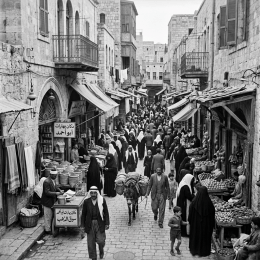
Urban Warfare: The Market Bombings (1937–1948)
One of the most devastating tactics pioneered during the late 1930s was the placement of remote or timed explosives in crowded civilian marketplaces, bus stops, and public plazas.
Historian Benny Morris (The Birth of the Palestinian Refugee Problem Revisited, Cambridge University Press) and Avi Shlaim (The Iron Wall, W.W. Norton & Company) detail numerous coordinated strikes that deliberately targeted civilian gathering places:
- Haifa Market Bombings (July 6, 1938): Two large landmines were detonated by the Irgun in a crowded Arab market in Haifa, killing 21 Palestinian civilians and injuring 52.
- Jerusalem Old City Market (July 15, 1938): An Irgun bomb concealed inside a vegetable crate exploded in the Old City’s central Arab market, resulting in 10 deaths and 30 injuries.
- Haifa Central Market (July 25, 1938): A second major bombing in Haifa’s Arab market claimed the lives of 39 civilians and wounded 70.
- Jaffa Gate, Jerusalem (January 7, 1948): In the escalating violence following the UN Partition Resolution, Irgun militants rolled a bomb concealed inside a steel barrel into a crowd of Arab civilians at a bus stop near Jaffa Gate, killing between 20 and 25 people.
These attacks were not accidental collateral damage occurring during engagements with armed irregulars; they were deliberate strikes on commercial hubs intended to inflict mass casualties, disrupt daily life, and induce panic among the urban Arab population.
Rural Raids and Village Massacres
As full-scale civil war erupted in late 1947, the violence expanded from urban centres to rural communities across Galilee and the Jerusalem corridor.
- Al Khisas (December 18, 1947): A Haganah retaliatory raid on the village of Al Khisas in northern Galilee destroyed several homes and resulted in the deaths of 10 Arab civilians, including five children.
- Balad al, Shaykh (December 31, 1947): Following a deadly riot at the Haifa Oil Refinery triggered by an Irgun grenade attack on day labourers, the Palmach launched a midnight raid on the nearby village of Balad al, Shaykh. Estimates of the civilian death toll range from 14 to over 60 villagers, including women and children.
- Deir Yassin (April 9, 1948): Perhaps the most infamous incident of the pre-state period occurred when joint forces of the Irgun and Lehi entered the village of Deir Yassin west of Jerusalem. Jacques de Reynier, head of the International Committee of the Red Cross delegation in Jerusalem, personally visited the site and documented the aftermath. More than 100 Palestinian civilians, including women, children, and the elderly, were killed. Paramilitary leaders leveraged the psychological impact of Deir Yassin to accelerate the flight of surrounding Palestinian populations.
Targets of State and International Infrastructure
Paramilitary operations were not limited to local Arab populations. To dismantle British control and suppress diplomatic intervention, paramilitary forces conducted high-profile attacks on international targets and municipal civilian centres:
- The King David Hotel (July 22, 1946): The Irgun planted explosives in the basement of the south wing of Jerusalem’s King David Hotel, which housed the British Mandatory Secretariat and Military Headquarters. The resulting collapse killed 91 people, including 28 British citizens, 41 Arab civilians, 17 Jewish staff members, and 5 others.
- The Semiramis Hotel (January 5, 1948): The Haganah bombed the Christian Arab, owned Semiramis Hotel in Jerusalem’s Katamon neighbourhood under the incorrect assumption that it served as an Arab military headquarters. The blast killed 24 civilians, including the Spanish Deputy Consul, Manuel Allende Salazar.
The Legacy of Historical Revisionism
To acknowledge these documented events is not to erase the real violence suffered by Jewish communities during the Arab revolts of the 1920s and 1930s, nor is it to ignore the actions of Arab irregular forces during the 1948 war.
However, the historical record, preserved in British administrative reports, Arab municipal records, and Israeli military archives, conclusively dismantles the myth that Zionist paramilitary operations were exclusively defensive or aimed solely at colonial authorities. The strategic deployment of urban bombings, village massacres, and targeted violence against civilians was an undeniable feature of the conflict’s origin story.
Failing to engage with this history does not preserve truth; it merely replaces rigorous scholarship with ideological mythology. Understanding the full, unvarnished history of pre-1948 violence remains essential for anyone seeking an honest appraisal of the Israeli-Palestinian conflict today.
Executive Summary
True peace and reconciliation begin with the courage to confront the unvarnished past. The myth of “purity of arms”, the belief that pre-1948 Zionist paramilitaries operated solely in self-defence or exclusively against British colonial targets, is directly contradicted by the historical record. Archives, diplomatic dispatches, and mainstream historians confirm that underground armed groups (such as the Irgun, Lehi, and Palmach) systematically deployed civilian-targeted violence across pre-state Mandate Palestine.
Behind the political narratives lie devastating human tragedies:
- Marketplace Bombings: Timed explosives placed in crowded Arab markets in Haifa and Jerusalem deliberately targeted everyday civilian life, leaving dozens of families grieving.
- Village Massacres: Raids on communities like Al-Khisas, Balad al-Shaykh, and Deir Yassin claimed the lives of hundreds of innocent villagers, including women, children, and older people, instilling a terror that accelerated mass civilian displacement.
- Targeted Bombings: High-profile attacks on public infrastructure, such as Jerusalem’s King David and Semiramis hotels, resulted in heavy civilian casualties among Arab, British, and Jewish staff alike.
Acknowledging these documented facts does not erase the pain and violence endured by Jewish communities during this era. Rather, it honours all victims of history by replacing comforting mythologies with honest scholarship. Recognising the shared, tragic reality of pre-1948 violence is an essential, compassionate step toward true empathy, mutual understanding, and a lasting peace today.
Afterwords
1. Tony Cliff (Ygael Gluckstein)
Tony Cliff (born Ygael Gluckstein in Mandatory Palestine to a prominent Zionist family) abandoned Zionism in his youth to become a Trotskyist, later founding the International Socialists (and the Socialist Workers Party in the UK).
- “Separateness” as the Root of Violence: Cliff argued that violence was not an accidental byproduct of Zionism, but its logical conclusion. He noted that Zionism’s fundamental premise, separating Jewish workers from the indigenous population (e.g., through “Hebrew Labour” policies and Arab eviction from Jewish National Fund lands), inevitably required state violence and imperial alignment to maintain.
- Witnessing Early Paramilitary & Street Violence: In his autobiography and writings (Roots of Israel’s Violence), Cliff recalled how early economic boycott policies escalated into physical violence. He cited incidents from the 1930s and 40s where young Zionist activists poured paraffin on Arab produce in markets to enforce exclusive reliance on Jewish labour, noting that Menachem Begin’s Irgun adopted brown-shirt aesthetics and fascist salute styles during that era.
- Structural Oppression: Cliff observed that even before full-scale military conflict, systemic discrimination, such as total segregation in schools, workplaces, and housing, laid the structural groundwork for mass displacement and violence during the 1948 Nakba.
2. Other Key Anti-Zionist & Non-Zionist Jewish Figures
Albert Einstein and Hannah Arendt (1948 Open Letter)
Following the Deir Yassin Massacre in April 1948, Albert Einstein, Hannah Arendt, Sidney Hook, and several other prominent Jewish intellectuals wrote a famous open letter to the New York Times (published December 4, 1948) condemning Menachem Begin and his political party (Freedom Party / Tnuat HaHerut, derived from the Irgun):
“Among the most shocking political phenomena of our times is the emergence in the newly created state of Israel of the ‘Freedom Party’… a political party closely akin in its organization, methods, political philosophy and social appeal to the Nazi and Fascist parties… They preached a mixture of ultra-nationalism, religious mysticism, and racial superiority… They initiated a reign of terror in the Jewish community of Palestine.”
Marek Edelman (Commander of the 1943 Warsaw Ghetto Uprising)
Edelman, one of the few surviving leaders of the Warsaw Ghetto Uprising who refused to emigrate to Israel, spent his life criticising Zionism and state violence:
- He rejected the nationalist framing of Jewish identity, arguing that Zionism compromised the universalist lessons of anti-fascist resistance.
- In 2002, Edelman published an open letter addressed to “Palestinian partisan commandos,” comparing their struggle against military occupation to the Warsaw Ghetto fighters, sparking intense outrage among Israeli authorities but underscoring his lifelong opposition to state suppression.
Martin Buber and Judah Magnes (Brit Shalom)
While not Anti-Zionist in the Marxist sense, prominent Jewish thinkers like Martin Buber and Judah Magnes (founder of the Hebrew University of Jerusalem) formed Brit Shalom (Covenant of Peace) in the 1920s to oppose nationalist paramilitarism:
- Buber explicitly warned that trying to establish a sovereign Jewish state by force over an indigenous majority would pollute the moral character of Jewish culture and lead to perpetual war.
- Magnes warned that a partition enforced by military victory would result in ongoing instability, advocating instead for a binational, equal state for Arabs and Jews.
Simha Flapan and the Israeli “New Historians”
Jewish Israeli scholars like Simha Flapan (The Birth of Israel: Myths and Realities), Avi Shlaim, and Ilan Pappé dismantled the “Purity of Arms” myth through archival research:
- Flapan documented that pre-state military planning deliberately incorporated tactics designed to terrorize civilian populations into fleeing their homes, creating a demographic Jewish majority through forced displacement.
Leave a Reply